Short answer
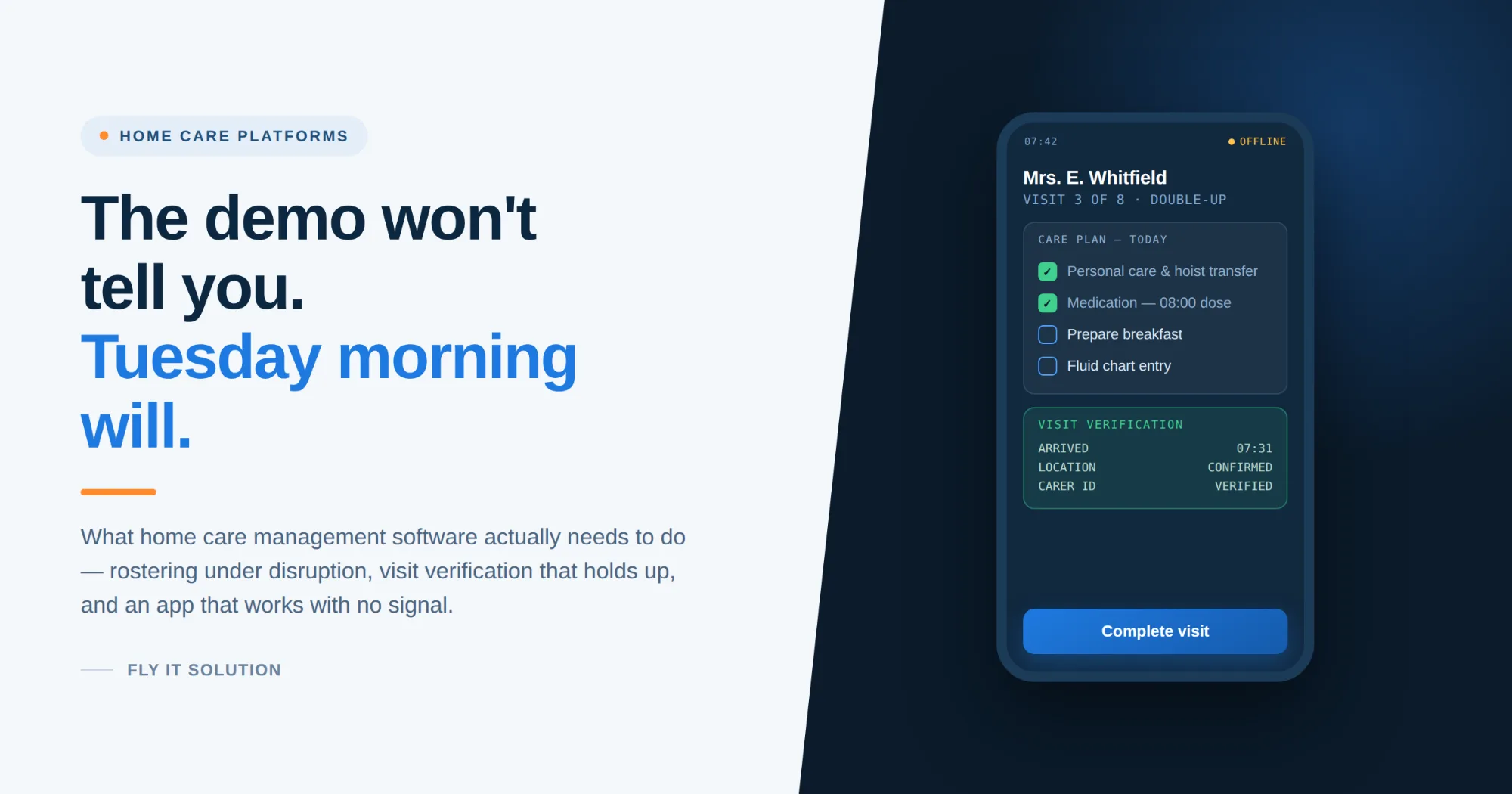
Home care management software has to survive the 6am call-out, not just look good in a demo. The four things that decide whether it works are rostering that handles disruption, visit verification that produces evidence regulators accept, care plans carers can read on a phone in a hallway, and billing that reconciles against verified visits automatically. Everything else is secondary and if the carer-facing mobile app is weak, nothing else in the system matters.
It's 6:04 on Tuesday morning. A carer calls in sick.
She had fourteen visits booked. Three of those clients need two carers. Two have specific continuity requirements on the same face, or the visit doesn't go well. One is a double-up with hoisting, so whoever covers it needs the training on file. Another is a medication visit at a fixed time.
Somebody now must rebuild that day before 7am, from memory and a phone.
That morning is the honest test of any home care management platform. Not the dashboard. Not the reporting suite. Whether a coordinator, under pressure, can see who's free, who's qualified, who the client will accept, and get the day covered before families start calling.
I've watched agencies run this on a whiteboard, a spreadsheet and eleven WhatsApp messages. It works in the sense that the visits get covered. What it costs is a coordinator's entire morning, every time and an audit trail that doesn't exist.
The four things that actually break
Home care software gets sold on feature lists. The feature lists are largely the same. What separates systems is how they handle these four, and you can't tell from a brochure.
Rostering under disruption. Any system can display a schedule that nobody changes. The question is what happens when it does change which is daily. Can you see availability, qualification, client preference, travel time and continuity in one view, and reassign in a few clicks? Or does covering a shift mean cross-referencing three screens and a phone call?
Visit verification. Did the visit happen, when, for how long, and by whom. In several markets this is no longer a management preference it's a legal requirement, and I'll come to that.
Care plan currency. The plan in the office and the plan in the care's hand must be the same plan. When a client's needs change on Monday, the care arriving Wednesday needs to know. Systems that require a sync, a re-download, or an office phone call to convey a change will eventually deliver care against out-of-date instructions.
Billing that matches reality. Invoiced hours should derive from verified visits, not from the roster. Rostered-versus-actual is where agencies lose money quietly, a visit that ran short, a cancelled call that got invoiced, a double-up billed as a single. If your billing runs off the plan rather than the evidence, you are guessing.
Fix these four and the rest is convenience. Get any of them wrong and staff build workarounds which is how you end up with the shadow spreadsheet again, except now you're also paying for a monthly licence.
Visit verification is a legal requirement, not a feature
This is the part agencies most often underestimate, and it's market-specific so know which regime applies to you.
In the United States, the 21st Century Cures Act requires states to implement Electronic Visit Verification for Medicaid personal care services and home health services. The deadlines have passed: 1 January 2020 for personal care services and 1 January 2023 for home health services, with states facing incremental federal funding reductions of up to 1% for non-compliance (Medicaid.gov).
The statute specifies six data points every verified visit must capture:
1. The type of service performed
2. The individual receiving the service
3. The date of the service
4. The location of service delivery
5. The individual providing the service
6. The time the service begins and ends
That list is worth reading as a software specification, because that's effectively what it is. Note point four in particular: location. A system that records a start and end time without location isn't producing EVV-compliant evidence.
In the United Kingdom, there's no direct EVV equivalent, but CQC inspection looks for evidence that care was delivered as planned and that records are accurate and contemporaneous. Electronic call monitoring is how most agencies produce that evidence, and commissioning local authorities frequently requires it contractually.
In Australia, NDIS and Aged Care providers face audit against practice standards, with service delivery records and worker screening among the things that must be evidenced. Again, not identical to EVV, but the same underlying demand: prove the visit happened as recorded.
The common thread across all three: an assertion is not evidence. Systems that let an office user type in that a visit occurred, with no independent verification, will not stand up when someone asks you to prove it.
The mobile app is the whole system
This is the point I'd most like agency owners to take away, because it's where the demo misleads most.
You will be shown the office view, the scheduling board, the dashboards, the reports. It'll look capable. Then the system goes live and it turns out that the carer app is slow, needs signal, and takes eleven taps to complete a visit.
What happens next is predictable. Carers stop completing visits in the app. They do it later, in a batch, from memory. Your verification data becomes fiction, your billing runs off fiction, and the audit trail you bought the system for doesn't exist.
So test the carer app the way it'll be used:
•On a cheap phone, not the demo iPhone. A meaningful share of care workers are on entry-level Android devices several years old.
•With no signal. Basements, rural areas, thick-walled buildings. Can the carer open the care plan, record the visit, and have it sync later? Offline capability is not optional in this sector.
•With one hand, in a hurry. Count the taps from opening the app to completing a visit. Anything above four or five and adherence will drop.
•In gloves, in poor light, standing in a hallway. Touch targets and contrast matter more here than in almost any other software category.
•By an actual carer, not by you. Ten minutes of a care worker using it will tell you more than the whole sales process.
If the carer app is bad, no amount of office-side capability compensates. The data all originates at the front door.
What good looks like the practical checklist
Beyond the four fundamentals, these are the things experienced operators check.
Rostering and staffing
•Availability, qualifications, training expiry and client preference visible in one scheduling view
•Travel time between visits accounted for, not assumed
•Continuity tracking, so you can see which clients are getting a rotating cast
•Fast reassignment with an audit trail of who changed what
Care delivery
•Care plans accessible offline, current at the point of care
•Task-level completion, not just visit-level
•Medication administration recording with a clear exception path refused, unavailable, held
•Incident and body-map recording with photo capture
•A way to flag concerns that reaches a human quickly
Compliance and evidence
•Visit verification appropriate to your regulatory regime
•Staff compliance tracking with expiry alerts background checks, training, insurance, right to work
•Document management with version history
•Audit exports that produce what an inspector or commissioner asks for
Finance
•Invoicing derived from verified visits
•Multiple funding sources handled per client public funding, private pay, insurance, split packages
•Payroll from actuals including travel and unsocial-hours rates
•Rostered-versus-actual variance reporting
Families and clients
•A family portal showing history and care notes, with clear consent controls
•This one is consistently underestimated. It reduces inbound calls significantly and is one of the few things families actively notice.
Where agencies waste money on software
Four patterns, seen repeatedly.
Buying for the head office and forgetting the field. Covered above, and it's the expensive one.
Paying per user when your workforce churns. Home care has high turnover. A per-seat licence with a minimum commitment can quietly become your third-biggest cost. Model it at your real headcount including leavers.
Choosing a system that can't handle your funding mix. Agencies with public funding, private clients and insurance-funded packages need all three billed correctly from one system. Plenty of platforms handle one well and the others badly.
Underestimating migration and training. Client records, care plans, staff compliance documents, historical visits. And training people who may not be confident with technology, across shifts, without stopping service. Budget properly for both; the software cost is often the smaller number.
Buy, white-label, or build
Three routes, and most agencies only consider the first.
| BUY OFF-THE-SHELF | WHITE-LABEL A PLATFORM | BUILD CUSTOM | |
|---|---|---|---|
| Best for | Standard agency operations, one funding regime | Agencies wanting their own branded platform, or organisations selling to other providers | Unusual service models that no product fits |
| Speed | Fastest | Fast configuration, not construction | Slowest |
| Branding | Vendor's | Yours your name, your domain | Yours |
| Cost shape | Per user, ongoing | Typically one-time or licensed deployment | Higher upfront, no licence fees |
| Watch for | Being asked to change how you work | Confirm what's genuinely rebrandable | Under-investing in the boring modules |
The white-label route is the one most agency owners don't know exists. It suits two situations in particular: a provider large enough that the software becomes part of its own identity rather than a vendor's, and a franchise or group that wants one branded platform across its network rather than each location choosing separately.
What to ask before you sign
Take these into any demo.
1. “Can I see the carer app on an old Android phone, offline?” The single most informative request you can make. Note how the vendor reacts to it.
2. “Show me covering a same-day sick call.” Make them do it live, with a double-up and a continuity requirement. This is your Tuesday morning.
3. “How does an invoice get created from a visit?” You want to hear that it derives from verified actuals. If it derives from the roster, ask what happens when the two disagree.
4. “What does an audit export look like?” Ask for a real one. “You can run reports” is not an answer.
5. “Who owns our data and how do we get it out?” Ask for the export format and whether it includes care notes and documents, not just client names.
6. “What does year two cost at our real headcount, including turnover?”
And one that isn't a question: ask to speak to an agency of your size, in your funding regime, that has been live for over a year. New customers are always happy. The interesting information is with the ones past the honeymoon.
Frequently asked questions
What is home care management software?
It's a system that runs the operational side of a home care agency rostering carers to client visits, giving carers care plans and task lists on a mobile app, verifying that visits happened, recording medication and incidents, tracking staff compliance, and generating invoices and payroll from what actually occurred rather than what was scheduled.
What is EVV and does our agency need it?
Electronic Visit Verification is the electronic capture of six data points about each visit: the service type, the client, the date, the location, the carer, and the start and end times. Under the 21st Century Cures Act, US states must require it for Medicaid personal care services and home health services. Agencies outside that funding stream may not be legally required to use it, but similar evidence expectations exist in the UK through CQC inspection and in Australia through NDIS and Aged Care standards.
How do we choose between home care platforms?
Judge them on the four fundamentals rostering under disruption, visit verification, care plan currency at the point of care, and billing derived from verified visits and test the carer mobile app on an old phone with no signal. Feature lists are largely identical across vendors; execution is not.
Can home care software work offline?
The good ones do, and it matters. Carers work in basements, rural areas and thick-walled buildings where signal is unreliable. The app should let them open the care plan, record tasks and complete the visit offline, then sync when connectivity returns. Ask to see this demonstrated rather than described.
How long does it take to move a home care agency onto a new system?
The software configuration is rarely the constraint. Migrating client records, care plans and staff compliance documents, then training a distributed workforce across shifts without interrupting service, is what sets the timeline. Plan a phased rollout by team or region rather than switching everyone at once.
Can we run a home care platform under our own brand?
Yes that's what a white-label deployment is. The platform runs under your name and domain, so clients, families and carers see your brand rather than a software vendor's. It suits larger providers and franchise groups wanting one consistent branded system across locations.
The bottom line
Home care is a business where the product is delivered by one person, alone, in someone else's home, often without reliable signal. Software that doesn't respect reality gets worked around, and a worked-around system is worse than none because you're now paying for a record you can't trust.
Judge platforms on Tuesday morning, not the demo. And put the app in a carer's hands before you sign anything.
| See the platform → |
|---|
Fly IT Solution builds white-label business platforms and custom healthcare software from Mohali, India and Minneapolis, USA, with more than a decade of delivery across healthcare, logistics, e-commerce and field services. Our home care management platform is available as a branded deployment under your own name and domain. The observations above come from building operational software for distributed workforces including the projects that taught us how much depends on the app in the field worker's hand.
Sources: Centers for Medicare & Medicaid Services, Electronic Visit Verification guidance under the 21st Century Cures Act.
This article describes regulatory requirements in general terms and is not legal or compliance advice. Confirm current obligations with your regulator, state Medicaid agency, or commissioning body.