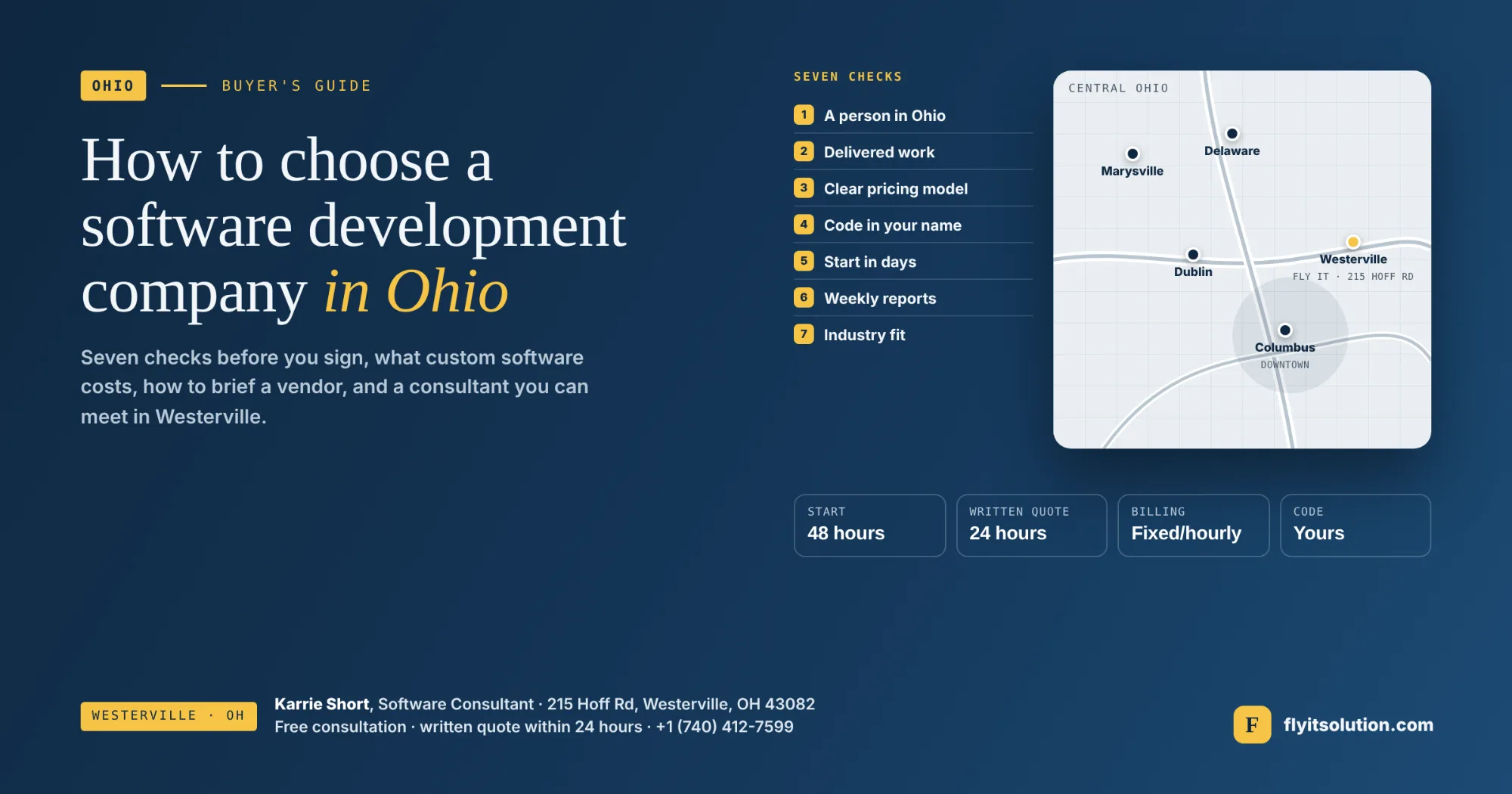
To choose a software development company in Ohio, check seven things before you look at price: a person you can meet in Ohio, delivered work you can inspect, a clear pricing model, code that ends up in your name, a start date measured in days, weekly reporting, and experience in your industry. A vendor that passes all seven will rarely be the wrong choice.
This guide explains each check, what custom software costs, how to brief a vendor so the quote is accurate, and how to start with us in Westerville.
The seven checks
1. A person in Ohio. Someone who can meet you at your premises or by video in your time zone, and who stays your contact after launch. Ask who you will call in month six.
2. Delivered work. Case studies with named features, not logos. Ask to see one system running and ask what it does on a normal day.
3. A clear pricing model. Fixed price or hourly, chosen by you, with a written quote before any work starts and a change process you understand.
4. Code in your name. The repository, the deployment and the accounts belong to your company from day one, so you are never locked in.
5. A start in days. A kick-off date within days of sign-off. A queue of weeks means your project is not the priority.
6. Weekly reports. A written progress report every week and something you can click on by week two.
7. Industry fit. Experience with businesses like yours: manufacturing, repair, distribution, real estate, health care or logistics.
Price comes after the seven, not before. The cheapest quote with the wrong terms usually costs a second project.
What custom software costs in Ohio
Custom software is quoted per project, because integrations and the number of users drive cost more than screens do. As a guide from our custom CRM software development page, a focused CRM runs from about $5,000 to $10,000, a mid-size one $10,000 to $15,000, and larger systems from $15,000.
A new product or portal usually starts as MVP software development, typically four to six weeks to a first working release. A custom ERP software development project takes a few months for its first release and usually covers inventory, orders and invoicing first.
How to brief a vendor: five steps
A clear brief gets a better quote and a faster start from any vendor.
1. Write down the one process that hurts most. Not a feature list: the job that goes wrong every week, who does it, and what it costs when it fails. Quoting, scheduling, inventory and invoicing are the usual four for Ohio businesses.
2. List the systems the new software must talk to. Accounting, email, a customer's portal, a carrier, a machine. Integrations drive cost more than screens do, so name them up front.
3. Decide who will use it and where. Office staff at a desk, technicians on a shop floor, reps in a truck. Phone use changes the design and the price.
4. Ask for a first release, not the whole system. The vendor should propose what goes live first, usually in four to six weeks, and what follows. A proposal with no phases is a warning sign.
5. Check the terms before the price. Who owns the code, how progress is reported, how changes are priced, and who you call in Ohio. The cheapest quote with the wrong terms costs the most.
How Fly IT Solution works in Ohio
Fly IT Solution is a software development company in Ohio with a consultant in Westerville, in the Columbus metro area. Karrie Short meets business owners in person across central Ohio and by video from Cleveland, Cincinnati, Dayton, Toledo and Akron.
Projects start within 48 hours of agreement, with weekly progress reports, fixed-price or hourly billing, a written quote within 24 hours of a free consultation, and full ownership of the code. Engineering teams in Minneapolis and Mohali build and support the software.
We build custom CRM and ERP systems, web and mobile applications, customer and vendor portals, MVPs for new products, and white-label platforms for repair shops, home care agencies, event organizers and e-learning providers. The full list and Karrie's details are on the Ohio page.
Start with a free consultation
Bring the one process that hurts most and whatever it runs on today. Book a free consultation with Karrie at 215 Hoff Rd, Westerville, or call +1 (740) 412-7599, and you will have a written scope and quote within 24 hours.
Frequently asked questions
How do I choose a software development company in Ohio?
Judge seven things: a person you can meet in Ohio, delivered work you can inspect, a clear pricing model, code ownership in your name, how fast the project starts, how progress is reported, and whether the company has built for your industry. Ask for a written scope and quote after a free consultation and compare vendors on those terms rather than on the headline price.
How much does custom software development cost in Ohio?
It depends on scope and integrations, so we quote in writing within 24 hours of a free consultation. As a guide from our custom CRM page, a focused CRM runs from about $5,000 to $10,000, a mid-size one $10,000 to $15,000, and larger systems from $15,000; an MVP of a new product is typically four to six weeks of work. Fixed-price and hourly billing are both available.
Does Fly IT Solution have an office in Ohio?
Yes. Karrie Short, Software Consultant, is based at 215 Hoff Rd, Westerville, OH 43082, in the Columbus metro area, and meets businesses in person across central Ohio or by video from Cleveland, Cincinnati, Dayton, Toledo and Akron. Engineering teams in Minneapolis and Mohali build and support the software, which is how projects start within 48 hours of agreement.
What kinds of software does Fly IT Solution build for Ohio businesses?
Custom CRM and ERP systems, web and mobile applications, customer and vendor portals, MVPs for new products, and white-label platforms for repair shops, home care agencies, event organizers and e-learning providers. Recent Ohio-focused guides cover ERP and automation for manufacturers, repair shop software, and real estate portals.
How quickly can a project start?
Within 48 hours of agreement. The sequence is a free consultation, a written scope and quote within 24 hours, kick-off within 48 hours of sign-off, weekly progress reports from the first week, and a first release typically in four to six weeks for an MVP-sized project. You own the code and the deployment throughout.