This is one of the most common questions we get now, and it is usually asked as if the two were rivals. They are not.
WordPress is a system for publishing pages. Lovable is a machine that writes an application when you describe one. Asking which is better is like asking whether a printing press is better than a workshop.
So this article will not score them on twelve features and declare a winner. It will help you work out which one you are building because once you know that the choice makes itself.
| If you are building website pages, posts, a blog, something that needs to rank and be edited by non-technical people every week use WordPress. It runs 40.2 percent of all websites for a reason. If you are building an app that happens to live at a web address a dashboard, a portal, a tool with logins and data Lovable can get you a working version faster than anything else, provided someone can maintain the code it writes. Decide which of those you are making first. |
|---|
What is WordPress, in 2026?
WordPress is an open-source content management system. You install it, pick a theme, add plugins, and edit pages and posts in a visual editor that a non-technical person can learn in an afternoon.
As of 24 September 2026, W3Techs reports it on 40.2 percent of all websites, and 58.8 percent of sites whose CMS is known. That share is not a vanity number. It is why every host supports it, every SEO tool integrates with it, and any agency or freelancer anywhere can maintain it.
Its weaknesses are as well-known as its strengths: plugin sprawl, security if updates are neglected, and real awkwardness the moment you need application logic rather than pages.
What is Lovable?
Lovable is an AI-powered builder. You describe what you want in a chat “a portal where clients upload documents and see their status” and it writes the application.
In its own words, a project includes a front end, backend, database, authentication and integrations, all backed by editable code. A project can be synced to GitHub, GitLab or Bitbucket, so a developer can take it over. It starts free, and paid plans are credit-based: a small change costs a fraction of a credit, a whole feature costs more.
What it is good at is interactive things dashboards, internal tools, prototypes, the first version of a product. What it is not is a publishing system. There is no editor your assistant can use on Tuesday to fix a typo; there is a prompt, or there is code.
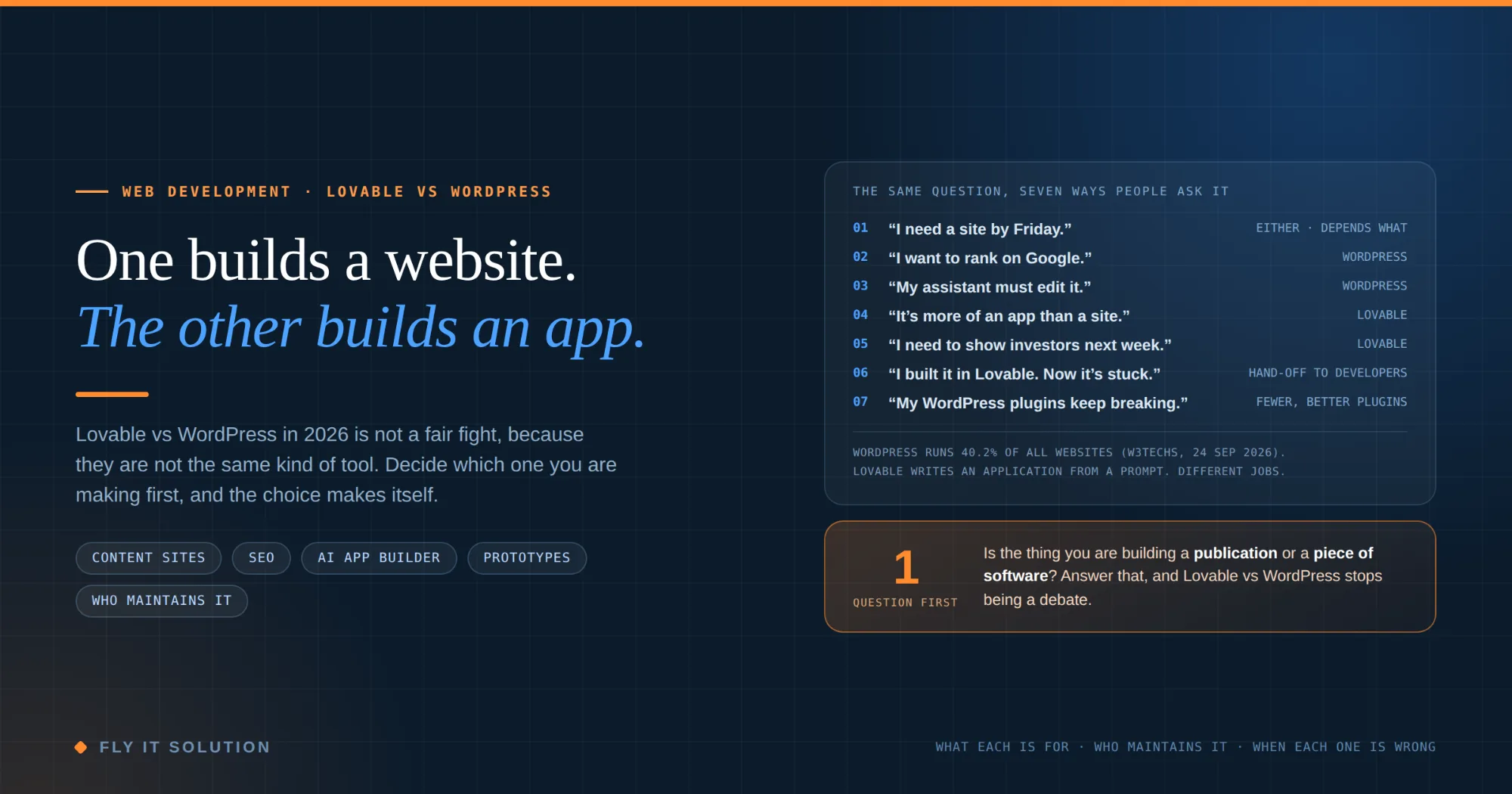
The same question, seven ways people ask it
Here is what people say when they ask us this, and the one-line answer to each.
“I need a site by Friday.”
But Friday is not the deciding factor. What is on the site is. A five-page company site by Friday is a WordPress theme and an afternoon. A working client portal by Friday is Lovable, and a rough one.
“I want to rank on Google.”
WordPress. Content that ranks needs a system built for content: clean URLs, an editor, categories, an SEO plugin, a sitemap, and years of people solving exactly this problem. An AI-generated app can be made to rank, but you will be doing the plumbing yourself.
“My assistant has to be able to update it.”
WordPress. This one question ends more Lovable conversations than any other. A non-technical person can edit a WordPress page. A non-technical person cannot safely edit a codebase, and prompting an AI to change a heading is not a workflow anyone should run a business on.
“It's more of an app than a site.”
Lovable, or at least start there. If the thing has logins, data, roles, uploads and states, it is software. WordPress can be bent into software with enough plugins, and it is rarely worth it.
“I need to show investors next week.”
Lovable. A clickable, working prototype from a description in a day is something nothing else does as well. Just be clear with yourself that it is a prototype.
“I built it in Lovable and now it's stuck.”
This is the most common call we get about Lovable, and it is not a failure of the tool. It is what happens when a prototype becomes a product. The code syncs to Git, so a developer can take it over — but generated code often needs restructuring, tests and a hardened backend before it is something you would run a business on.
“My WordPress plugins keep breaking.”
Fewer, better plugins. Most broken WordPress sites are running thirty plugins from thirty authors. The fix is usually one custom plugin that does what you actually need, replacing six that half do.
How to tell which one you are building
Ignore the tools for a moment and ask one question: is this thing a publication or a piece of software?
A publication has pages that people read. It changes when someone writes something new. Its hard problems are being found, being read and being edited easily. That is a website, and WordPress was built for it.
A piece of software has users who do things. It changes when a user acts. Its hard problems are logic, data, permissions and what happens when something goes wrong. That is an app, and Lovable writes apps.
Most businesses need one of each a website that explains what they do, and software that does it. The mistake is trying to make one tool do both. Put the brochure on WordPress and the product somewhere built for products.
Side by side, for the part that is comparable
| WordPress | Lovable | |
|---|---|---|
| What it makes | A website: pages, posts, media, forms | An application: screens, logins, data, logic |
| Who edits it day to day | Anyone, in a visual editor | Someone comfortable with prompts or code |
| SEO and content | Built for it; mature tooling | Possible, but you build the plumbing |
| Time to first working version | Hours for a site on a theme | Hours for a prototype app |
| Cost shape | Free software; hosting, theme and plugins | Free to start; credits per change on paid plans |
| Who maintains it in year three | Any WordPress developer, anywhere | A developer who has taken over the codebase |
| Ownership | Your code, your host, your data | Your code once synced to Git; your data on the connected backend |
| Where it breaks | Plugin conflicts, neglected updates | Prototype-to-product gap; edge cases the prompt never mentioned |
What we do with both
We work on both sides of this line, which is why we do not have a horse in the race. When the answer is WordPress, we build custom WordPress plugins and themes usually one plugin that does exactly what the business needs, replacing the six that half did.
When the answer is software, we build no-code and low-code solutions, and increasingly we take Lovable prototypes to production: restructuring the generated code, adding tests, hardening the backend, and handling the cases the prompt never mentioned. The prototype was not wasted. It told everyone what to build.
Most of the value is in the first conversation, where we tell you which of the two you are actually building. Sometimes the answer is both, on two different systems, and that is fine.
When each one is the wrong choice
WordPress is wrong when the product is the software. A marketplace, a client portal, a booking engine with real rules you will spend more fighting plugins than you would build it properly.
Lovable is wrong when the thing is a website someone non-technical must run. It is also wrong as a destination for anything that handles money or sensitive data without a developer having been through the code.
And both are wrong if nobody has decided what is being built. That decision costs nothing and saves the most.
FAQ
Is Lovable better than WordPress?
They are not the same kind of tool, so neither is better in general. WordPress is a content management system: it is the right choice for a website whose job is pages, posts, SEO and being edited by non-technical people, and it runs 40.2 percent of all websites according to W3Techs as of September 2026. Lovable is an AI app builder: you describe an application in plain language, and it generates working code with a front end, backend, database and authentication. If you are building a website, WordPress. If you are building an app that happens to live at a web address, Lovable is worth a look.
What is Lovable and what does it build?
Lovable is an AI-powered builder where you describe what you want in a chat and it writes the application for you. In its own words, projects include a front end, backend, database, authentication and integrations, all backed by editable code, and a project can be synced to GitHub, GitLab or Bitbucket so a developer can take it over. It starts free and paid plans are credit-based, with each change consuming a fraction of a credit or more depending on how much it does. It is strongest at interactive things - dashboards, portals, internal tools, prototypes - not at publishing content.
Is WordPress still worth using in 2026?
Yes, for the job it is built for. W3Techs reports WordPress on 40.2 percent of all websites and 58.8 percent of sites whose CMS is known, as of 24 September 2026. That share is why it still wins for content sites: every host supports it, every SEO tool integrates with it, plugins exist for almost anything, and any agency or freelancer can maintain it. Its weaknesses are also well known - plugin sprawl, security if it is not kept updated, and awkwardness the moment you need real application logic rather than pages.
Can Lovable replace WordPress for a business website?
For a brochure site or a blog, it is the wrong tool even though it can produce something that looks right. A business website needs an editor a non-technical person can use every week, SEO plumbing, a media library, and years of predictable maintenance. WordPress has all of that built in and a market of people who know it. A Lovable site is an application: changing a paragraph means prompting or editing code, and the person who maintains it needs to be comfortable with a codebase. Use Lovable when the thing you are building behaves like software, not like a publication.
What happens to a Lovable project when you need more than it can do?
This is the question to ask before you start, and the honest answer is: it depends on whether anyone can take the code over. Because Lovable syncs to a Git repository, a developer can pick up the generated code and continue it as a normal project - but generated code is not always structured the way a team would structure it, and features that were easy to prompt can be hard to extend. We regularly take Lovable prototypes to production; the work is usually restructuring, adding tests, hardening the backend and handling the edge cases the prompt never mentioned.
Does Fly IT Solution work with both Lovable and WordPress?
Yes. We build custom WordPress plugins and themes when WordPress is the right foundation, and we build no-code and low-code solutions - including taking Lovable and similar AI-generated prototypes to production - when the project is really an application. Most of the value is in the first conversation, where we tell you which of the two you are actually building. We work from Mohali, India and Minneapolis, Minnesota.
Sources: W3Techs, 24 September 2026; Lovable documentation and pricing page, checked the same day. Both change; re-check before relying on them.