Short answer: Building stopped being the hard part. An AI coding tool will hand you a working prototype on Saturday afternoon, which means speed is no longer what separates the startups that survive from the ones that don't. Of the 385 VC-backed shutdowns since 2023 where CB Insights could identify a cause, 43% cited poor product-market fit they built the wrong thing efficiently. The job of an MVP is not to be built fast. It is to answer one question you cannot answer any other way, before your money runs out. Everything in this article is about choosing that question and cutting everything that doesn't serve it.
I want to start with the number that should change how you scope your build.
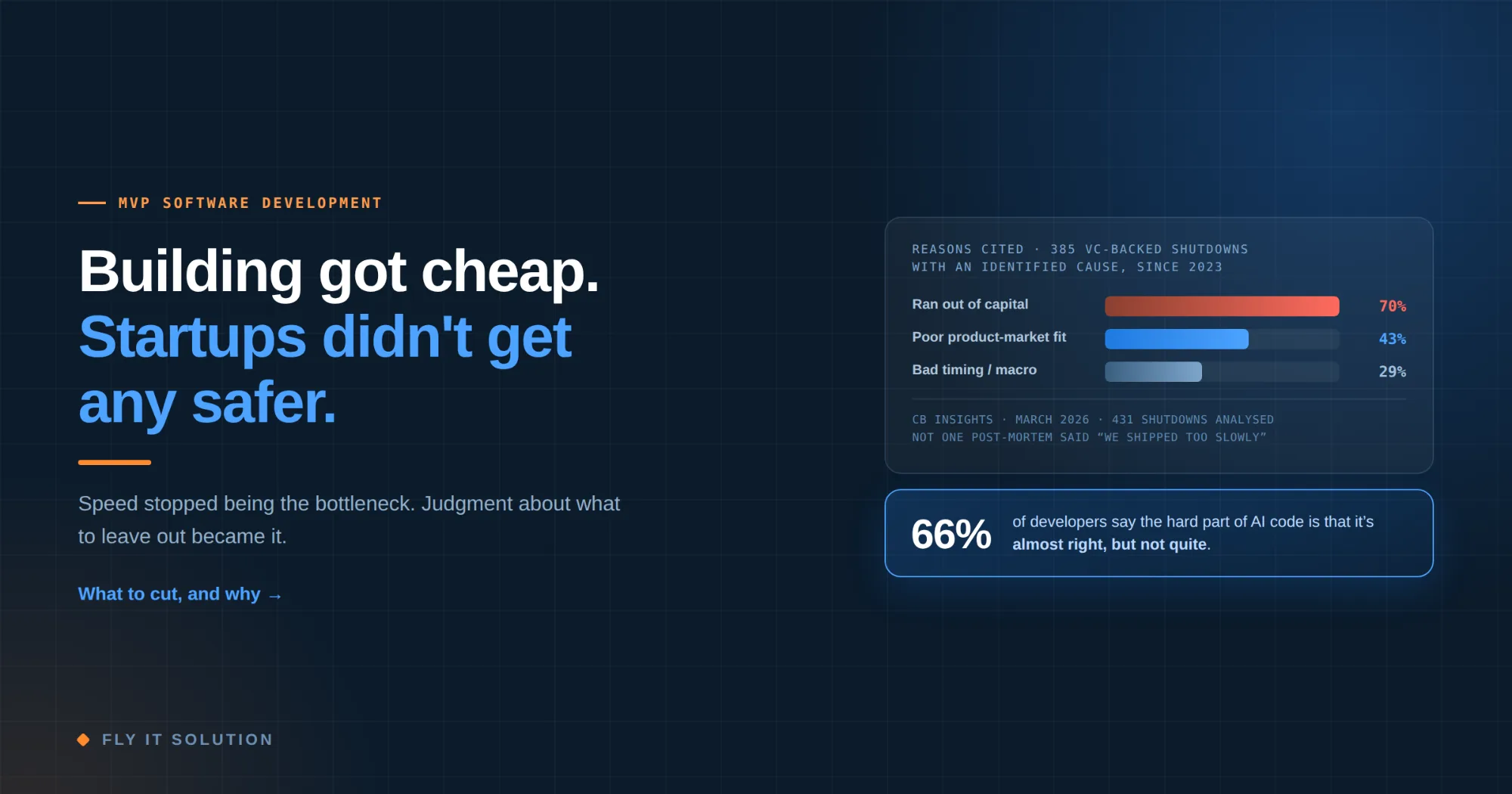
In March 2026, CB Insights published an analysis of 431 VC-backed companies that shut down since 2023, in what it calls the post-zero-interest-rate shakeout. Of the 385 where a reason could be identified, the top four were:
| Reason cited | Share of failures |
|---|---|
| Ran out of capital | 70% |
| Poor product-market fit | 43% |
| Bad timing or macro conditions | 29% |
| Unsustainable unit economics | 19% |
(Companies cited more than one reason, so the column exceeds 100%.)
Read those two top lines together, because separately they mislead. "Ran out of capital" is how a startup dies. It is almost never why. Money is the clock, not the cause. What the second line tells you is that in more than four out of ten of these companies, the clock ran out while the team was building something the market did not want.
Notice what is absent from that table. Nobody's post-mortem says "we shipped too slowly." Nobody says "our stack was wrong." Those are the things founders spend the most anxious energy on, and they are not what shows up in the autopsy.
What actually changed in the last two years
Here is the part everyone has felt but few have priced correctly.
The 2025 Stack Overflow Developer Survey 49,000-plus developers across 177 countries found that 84% are using or planning to use AI tools in their development process. That is not fringe practice any more. It is the default.
For a founder, this is genuinely good news, and I don't want to be sour about it. A non-technical person with a clear idea and a paid Lovable or Cursor subscription can now produce something that runs, has screens, accepts login and demos convincingly. Five years ago, that was six weeks and $30,000. That change is real and it is permanent.
But it moved the bottleneck. It did not remove it.
The bill nobody shows you upfront
The same survey asked developers what problems they hit with AI tools. The most-selected answer, from 66% of all respondents, was dealing with "AI solutions that are almost right, but not quite." The second, from 45.2%, was that debugging AI-generated code takes more time than writing it would have.
And the trust numbers are the quiet story: 46% of developers actively distrust the accuracy of AI output, against 33% who trust it. These are the people who use it every day. Their skepticism is earned, not reflexive.
"Almost right, but not quite" is a very precise description of what a founder ends up holding after a weekend of AI-assisted building. It logs in. It saves a record. It looks like the thing. And then someone asks what happens when two users edit the same record, or where the payment webhook retries, or whether the password reset token expires and the answer is that nobody decided, because nobody was asked.
That is not an argument against building your prototype this way. Build it. It is an argument against mistaking it for a product, and against the specific expensive mistake of showing it to an investor, getting a term sheet, and only then discovering what it costs to make it real.
So what is MVP for?
The phrase has been abused into meaninglessness. Most of what gets called an MVP is just a small version of the product someone has already decided to build. That is not a minimum viable product. That is the first release with a smaller budget.
A useful definition, and the one I'd hold you to:
| An MVP is the smallest thing you can build that would change your mind. |
|---|
If no result from launching it would cause you to alter course, you have not built an experiment. You have built a down payment on an assumption.
This is where most scoping conversations go wrong, and it is the single highest-leverage half hour in the whole engagement. Before anyone opens a design file, you should be able to finish this sentence:
If you cannot finish it, more features will not help you. They will only make the eventual pivot more expensive, because you will have more code to throw away and more sunk cost telling you not to.
The question test
Run every proposed feature through one filter: does this change the answer to our question?
Here is what that looks like in practice for a marketplace MVP whose question is "will suppliers list inventory without being paid to?":
| Feature | Verdict | Why |
|---|---|---|
| Supplier listing flow | Build properly | This is the question. |
| Buyer search and browse | Build roughly | Suppliers need to believe someone will see it. |
| Payments and payouts | Fake it | Invoice manually. You have no transactions yet. |
| Supplier onboarding automation | Do it by hand | Ten suppliers is a phone call, not a feature. |
| Admin dashboard | Cut | You are the admin. Use the database. |
| Ratings and reviews | Cut | Meaningless below critical mass. |
| Mobile app | Cut | A responsive web app answers the same question. |
| SSO, roles, audit logs | Cut | Nobody has ever churned from a ten-supplier pilot over SSO. |
The awkward truth of that table is that the highest-value work in an MVP engagement is deletion, and deletion is the thing founders resist hardest because every cut feature is one you were emotionally attached to, and because a shorter scope feels like less value for the money.
It is the opposite. A vendor who agrees to build everything on your list is not being accommodated. They are being paid by the feature.
Where AI-built prototypes genuinely belong
I want to be even-handed here, because the reflexive agency position "vibe coding is dangerous, hire us instead" is self-serving and mostly wrong.
Use an AI-built prototype when:
•You are testing whether people want it at all. Throwaway code is correct for a throwaway question.
•You need something clickable for a customer interview next week.
•You are the only user, or your user’s number in the single digits and you know all their names.
•You want to explore three product directions cheaply before committing to one.
Bring in an engineering team when:
•Real customer money moves through it.
•You are handling health, financial or identity data, and a breach is an existential event rather than an embarrassment.
•You have signed a customer who will ask about uptime, backups or SOC 2.
•The prototype is working and the problem is now that you cannot safely change it every fix breaks something else.
•You are raising, and technical diligence is coming.
That fifth one is the most common way founders arrive at our door, and it is not a failure. It is what success looks like at that stage. The prototype did its job. It proved the question. Now it is load bearing and it was never built to be.
What an honest MVP engagement looks like
There is no universal timeline, and any agency quoting you one before understanding your domain is guessing. But the shape is consistent:
| Stage | What actually happens | Typical span |
|---|---|---|
| Discovery and scoping | Write the falsifiable question. Agree with what is out of scope, in writing. | 3-5 days |
| Feature prioritisation | Cut the list. Decide what gets faked, done manually, or deferred. | 2-3 days |
| Design and prototype | Clickable flows for the core path only. Show real users before coding. | 1-2 weeks |
| Agile build | Working software every sprint, in your hands, not in a demo video. | 4-10 weeks |
| Testing and launch | Real users, real data, instrumentation that answers the question. | 1-2 weeks |
| Measure and iterate | Look at the answer. Be willing to hear "no." | Ongoing |
Two things to insist on regardless of who you hire.
You own everything from day one. Repository, cloud account, domain, design files. Not "on final payment." If a vendor holds your infrastructure hostage as leverage, you have found out something useful about them cheaply.
No black-box sprints. You should be able to open a working build at the end of every sprint. A team that only shows you screenshots is a team you cannot audit.
The scoping conversation to have before you sign anything
Ask any prospective development partner these five, and pay attention to whether they answer or deflect:
1. "Which of my features would you cut?" If the answer is none, they are quoting, not consulting.
2. "What question does this MVP answer, and how will we know?" If they cannot restate it in one sentence, they were not listening.
3. "What are you going to fake or do manually?" A good answer here is a sign of experience. It is also where your budget is saved.
4. "What breaks first if this works?" They should have a specific answer about the part of the architecture that will need rewriting at scale, and they should be relaxed about it.
5. "What would make you tell me not to build this?" Anyone who says nothing would is selling.
Frequently asked questions
What is MVP software development?
MVP software development is building the smallest working version of a product that can test whether a specific assumption about your market is true. It is not a cheap version of the full product. The defining activity is deciding what to leave out, so that a real answer arrives before the budget does.
How long does it take to build an MVP in 2026?
For a focused scope, most MVPs run from a few weeks to a few months from discovery to launch. The variable is rarely engineering speed AI-assisted development has compressed that considerably. It is how long it takes to agree what the product will not do, and how much regulated or integration-heavy work sits in the core path.
Can I just build my MVP with AI tools like Lovable or Cursor?
For validation, often yes, and you should. AI tools are excellent for throwaway prototypes, customer interviews and exploring directions cheaply. They become a liability once real customer money or sensitive data moves through the product, or once the codebase is too fragile to change safely. The 2025 Stack Overflow survey found 66% of developers frustrated by AI output that is "almost right, but not quite" that gap is what you inherit.
Why do most MVPs fail?
Usually not for technical reasons. CB Insights analysed 431 VC-backed companies that shut down since 2023; of the 385 with an identifiable cause, 43% cited poor product-market fit and 70% ran out of capital. Running out of money is the mechanism; building something the market did not want is the cause. Scope discipline is what buys you more attempts before the money is gone.
How much should an MVP cost?
Enough that the team can afford to say no to features, and little enough that being wrong is survivable. A useful test is whether you could find three swings at the problem. If the first MVP consumes the whole runway, it is not a minimum viable product it is the company.
What should I own at the end of an MVP build?
The source code and its full history, the cloud accounts and domains registered in your name, design files, documentation and any credentials. All of it, from day one rather than on final payment. Anything less makes changing vendors an act of demolition.
The bottom line
The cost of building software fell off a cliff, and that is a genuinely good thing for founders. But it did not make startups more likely to succeed, because building was never the constraint. Judgment was.
What is scarce in 2026 is not someone who can produce working code. It is someone who will sit with you for half a day, listen properly, and then argue you out of two-thirds of your feature list and be right about which two-thirds.
That is an uncomfortable service to sell, because it looks like less. It is the part that decides whether you get a second attempt.
Book a free MVP scoping call →Bring your feature list. We will spend the time on what to remove from it, and you will get a written scope with the exclusions named, whether you go on to work with us.
Fly IT Solution builds MVPs and custom software from Mohali, India and Minneapolis, Minnesota, with more than a decade of delivery across healthcare, EdTech, e-commerce, logistics, fintech and field services. We work in React, Next.js, Laravel and Node.js, with AI integrations where they earn their place. Our US presence means working-hours overlap with founders across North America rather than a next-morning reply. Projects start within 48 hours of agreement, and clients own their code, infrastructure and accounts from day one.
The scoping observations in this article come from our own delivery experience and are offered as opinion, not as research findings. The statistics are attributed to their sources below and can be checked independently. This article is general guidance, not investment or legal advice.
Sources: CB Insights, Why Startups Fail: Top Reasons (analysis of 431 VC-backed shutdowns since 2023, published 5 March 2026), cbinsights.com/research/report/startup-failure-reasons-top; Stack Overflow, 2025 Developer Survey (49,000+ respondents across 177 countries), survey.stackoverflow.co/2025.