Short answer
Repair shop management software earns its money in four places a job card that can't get lost, a technician interface that works at the bench, photo-based quality control that ends disputes, and a quote-to-invoice chain nobody must retype. If a system doesn't do those four well, the extra features won't save it. And if you're repairing goods in the EU, the rules that took effect on 31 July 2026 have made it traceable quoting a legal matter, not just good practice.
Count how many times someone in your workshop answers “is it ready yet?” this week.
That's the number I'd start with, because most shop owners have never counted it. It's usually somewhere between fifteen and forty calls a week, each one taking two to five minutes including the walk to the bench to check. Call it two hours of skilled labour, every week, spent reading a job card aloud down a phone.
Then there's another version of the same problem. A customer arrives to collect. Nobody can find the job card. The item is here somewhere and now two people are searching a workshop while someone waits at the counter.
Neither of these is a software problem exactly. They're symptoms of the same thing: the state of a repair lives in a piece of paper, a whiteboard and someone's memory, and none of those are query able.
This is about what to do instead, and how to tell a system that fixes it from one that just digitises the paperwork.
What paper costs you
Four costs, roughly in order of size, and only one of them is obvious.
Labour spent answering status questions. Covered above. It's the visible one.
Work you did but never charged for. This is the expensive one. A technician replaces a fitting that wasn't on the quote because it obviously needed doing. It doesn't reach the invoice, because the invoice is written from the quote. Multiply by every job where something extra was needed. Most shops running on paper are undercharging by a margin they've never measured, and they'd be genuinely surprised by the number.
Disputes you can't win. “That scratch wasn't there when I dropped it off.” Without a photo taken at intake, you're arguing from memory against a customer arguing from memory, and you'll usually concede because arguing costs more than conceding.
Jobs that stall silently. A repair waiting on a part sits in a corner. Nobody's tracking it because there's no list of waiting-on jobs there's a pile. It surfaces when the customer chases, by which point you've lost the relationship rather than just the week.
Add those up before you look at any software pricing. The comparison isn't software cost versus zero. It's software cost versus what the current way is already costing you.
The rules changed for repairers this year
This is worth knowing whether you buy anything, and most repair shops haven't caught up with it yet.
The EU Directive on the repair of goods Directive (EU) 2024/1799 was adopted in June 2024 and member states have had to apply it since 31 July 2026 (European Commission).
Most coverage focuses on what manufacturers must do. The parts that matter to an independent repair business are different:
The European Repair Information Form. Repairers can issue a standardised form so consumers can compare offers like for like. The detail that matters operationally: once you've provided it, your quoted conditions stay valid for 30 days.
Read that as a software requirement. It means a quote is now a binding commitment with a clock on it, and you need to be able to reproduce exactly what you quoted, to whom, and when. If your quotes live in a notebook or a WhatsApp thread, that's a problem waiting for its first argument.
The European Repair Platform. Becoming operational in January 2028, built into the Your Europe portal, letting consumers find registered repairers. Member states manage registration. Repair discovery is being formalised, and shops that look organised will do better on it than shops that don't.
A longer guarantee when consumers choose repair over replacement an extra year of legal guarantee protection. That tilts demand toward repair, which is good for your business and means more jobs flowing through whatever system you're running.
If you're outside the EU, none of this binds you. But the direction is the same everywhere several US states have passed right-to-repair legislation, and the underlying expectation is identical: traceable quotes, documented work, evidence you can produce. Systems built for that now won't need retrofitting later.
The four things that decide whether a system works
Feature lists across repair shop software are largely identical. These four are where they differ, and you can only judge them by testing.
1. A job identity that can't get lost
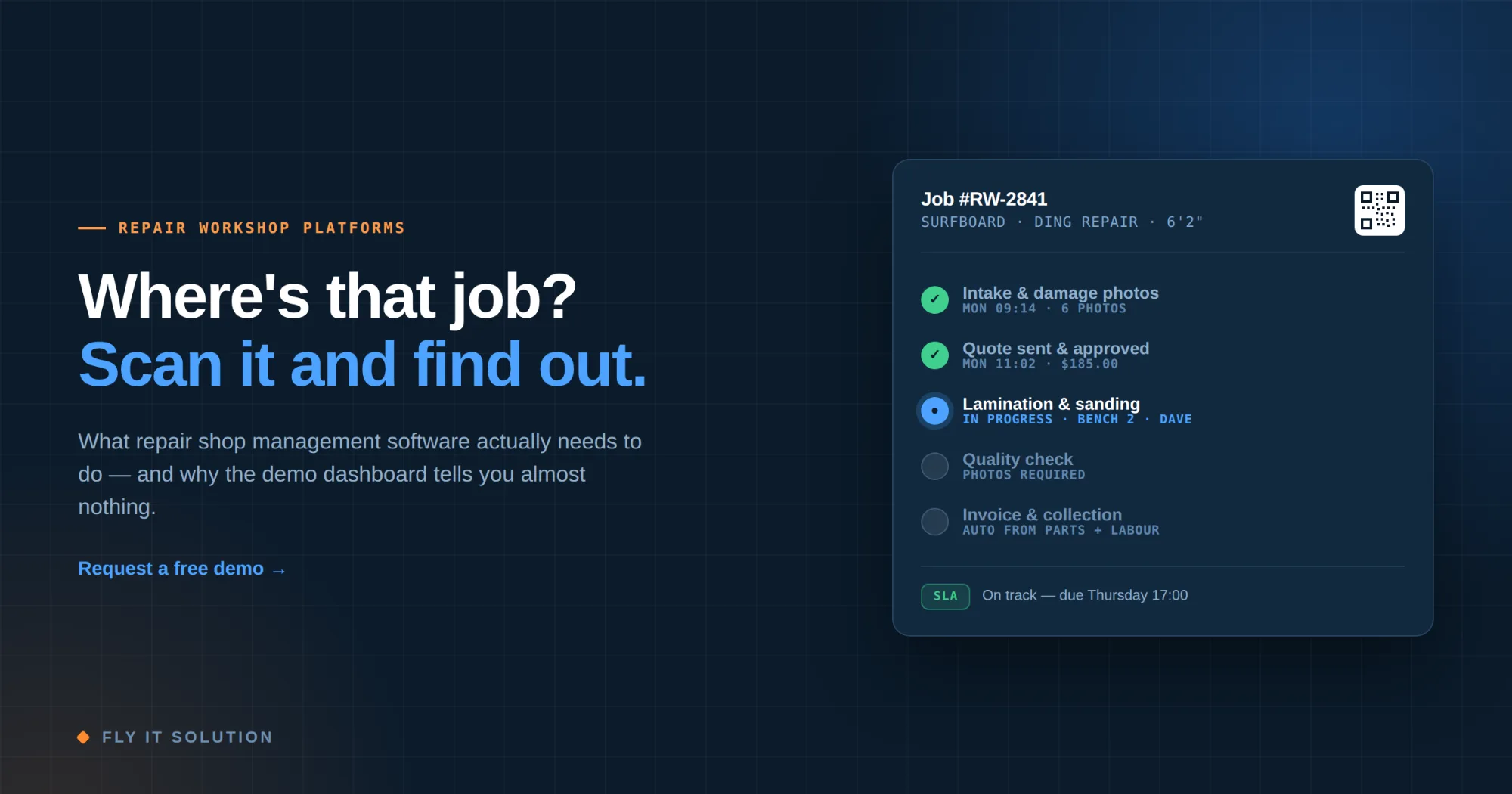
Every item entering the workshop needs an identity attached to the physical object a QR-coded job card is the standard approach, and it works because the alternative is a paper ticket that ends up under a bench.
The test is simple: scan the code, and the job opens. Status, history, photos, parts used, customer details, what is waiting on. If finding a job means searching by customer name in a list, you've digitised the filing cabinet, not fixed the problem.
2. A technician interface built for the workshop
This is where most systems fail, and where demos mislead most.
You'll be shown the owner's dashboard. It'll look impressive. Then it goes live and it turns out updating a job status on the shop floor takes eleven taps on a device with a cracked screen, so technicians stop doing it, and by Thursday the dashboard is fiction.
Test it the way it'll be used:
•On the actual device your techs will hold, not the demo tablet
•With dirty or gloved hands touch targets matter more here than in almost any other software
•Counting taps from opening the app to updating a status. More than two or three and adherence drops
•By an actual technician, not by you. Ten minutes of a tech using it tells you more than the whole sales process
If the bench-side experience is bad, nothing upstream compensates. All your data originates there.
3. Photos as a required step, not an optional one
Before-and-after photos attached to the job, mandatory before it can be marked completely.
This is the single feature repair businesses appreciate fastest, and it does three jobs at once: it ends damage disputes, it justifies the invoice when a customer questions what was done, and it gives you a quality record when the same fault comes back in three months.
“Optional photo upload” is not the same thing. If it's optional under time pressure, it won't happen, and it's precisely the jobs that go wrong where you'll wish it had.
4. Quote to approval to invoice as one chain
The customer approves a quote. That approval becomes the invoice. Parts consumed decrement stock and appeared on the bill. Nobody retypes anything.
Where this chain breaks, money leaks work done that was never quoted, quotes approved that were never invoiced, parts used that were never charged. And under the EU rules above, the quote end of that chain now needs to be reproducible on demand.
What else to look for
Beyond the four fundamentals, the things experienced shop owner’s check:
•Real-time work-in-progress view everything in the shop, what stage it's at, what's blocked and on what
•SLA or turnaround alerts before a promise is broken, not after
•Inventory tied to jobs parts consumed on a repair decrement stock automatically; standalone stock counting is a spreadsheet with extra steps
•A customer status link the direct fix for those fifteen-to-forty weekly calls
•Role-based access owner, technician, quality checker, front desk. A tech shouldn't see margins; a new counter hire shouldn't be able to delete jobs
•Branded job cards and invoice PDFs — these go to your customers and are the most visible artefact of the whole system
•Production routing for multi-stage work, where a job passes through several benches in sequence
Own it or rent it?
Two commercial models, and the difference compounds.
| MONTHLY SAAS SUBSCRIPTION | ONE-TIME OWNED DEPLOYMENT | |
|---|---|---|
| You pay | Per user or per shop, monthly, forever | Once |
| Upfront cost | Low | Higher |
| After 3 years | Still paying; total often exceeds a one-time cost | Nothing further beyond hosting and support |
| If prices rise | You absorb it | Nothing changes |
| Branding | Vendor's | Yours, if it's a white-label deployment |
| Best for | Trying it out, single small shop | Multi-site, franchise groups, or anyone planning to still be trading in five years |
Model both over three years at your real headcount before deciding. “Lower upfront” and “cheaper” are not the same sentence, and subscription math’s gets worse as you grow.
For context on the owned model: Fly IT Solution's repair workshop platform is a $4,999 one-time deployment including brand customisation, domain setup, server deployment, team training, documentation and three months of maintenance run under your own name rather than a software vendor's.
What to ask before you buy
1. “Can I see the technician view on a normal phone?”
The most informative request you can make. Watch how the vendor reacts.
2. “Show me a job from intake to invoice, live.” Scan in, quote, approve, do the work, log parts, photograph, and invoice. If any step needs re-keying, you've found a leak.
3. “Are quality photos mandatory or optional?” And can you make them mandatory?
4. “Can I produce a quote as it stood 30 days ago?” Relevant to EU obligations, and a good test of whether the system keeps proper history.
5. “What does year three cost?” All in, at your real headcount.
6. “Which real workshops are running this today?” Ask to speak to one past its first year.
What this looks like running
Fly IT Solution's repair workshop platform runs a working surfboard repair workshop today QR-tracked job cards from intake to delivery, technicians updating jobs from a mobile interface at the bench, mandatory repair photos before sign-off, inventory logged against jobs, and invoices generated from what was done.
The useful thing about a platform in production isn't the case study. It's that someone has already hit the awkward cases the job that comes back, the customer who disputes the finish, the part that arrives late, the repair that turns out bigger than quoted and the system has been adjusted to handle them. A demo environment has met none of that.
Frequently asked questions
What is repair shop management software?
Also called repair workshop management software, it's a single system covering the operational side of a repair business logging items in with a trackable job card, giving technicians a mobile interface to update work at the bench, recording quality-control photos, tracking parts and inventory against jobs, managing quotations and approvals, and generating invoices from work actually completed.
How does repair software stop damage disputes?
Through mandatory photo capture at intake and before sign-off, attached to the job record with a timestamp. When a customer says a mark wasn't there before, you have dated evidence rather than two conflicting memories.
Does the EU Right to Repair directive affect independent repair shops?
Directive (EU) 2024/1799 has applied since 31 July 2026. Much of it targets manufacturers, but two parts matter to repairers: the European Repair Information Form, which fixes your quoted conditions as valid for 30 days once issued, and the European Repair Platform for finding registered repairers, operational from January 2028. Confirm your specific obligations with your regulator or trade body.
Should we buy repair shop software on subscription or as a one-time purchase?
Model both over three years at your real headcount. Subscriptions are cheaper to start and often more expensive by year three, and the total rises as you add staff. A one-time owned deployment costs more upfront and nothing after, which suits multi-site operators and anyone planning to trade long term.
Can we run repair shop software under our own brand?
Yes, with a white-label deployment. The platform runs on your domain under your name, and job cards and invoices carry your branding rather than a software vendor's which matters because those documents go to your customers.
How long does it take to get a repair workshop onto a new system?
For a configured deployment, expect a discovery call, branding and configuration, a review and training round, then go-live with a support window. The main variable is how much customisation your repair type needs surfboards, phones and industrial equipment have genuinely different workflows.
The bottom line
The point of repair shop management software isn't the dashboard. It's that nobody has to walk to the bench to answer a phone call, no job sits in a corner unnoticed, no work goes out unbilled, and when a customer disputes something, you can open a photo instead of an argument.
Judge any system on the bench, not the boardroom. Put it in a technician's hands before you sign anything.
| Request a free demo → |
|---|
Fly IT Solution builds white-label business platforms and custom ERP and CRM systems from Mohali, India and Minneapolis, USA, with more than a decade of delivery across retail, logistics, healthcare and field services. Our repair workshop management platform runs a working surfboard repair business today and is available as a one-time deployment under your own brand and domain. The observations above come from building it and from the workshops we've watched run on paper.
Sources: European Commission, Directive on the repair of goods (Directive (EU) 2024/1799).
This article describes regulatory requirements in general terms and is not legal advice. Confirm your obligations with your national regulator or trade association.