Most care businesses are not short of software. They have a scheduling app, a messaging group, a spreadsheet of patients and a cupboard of paper log sheets.
What they are short of is one place where today's care exists where a manager can see it, a nurse can add to it from the bedside, and a family can be shown it.
That is what a homecare management platform is for. The white-label version is the one that carries your name instead of a vendor's.
| A white label homecare management platform is care-operations software patients, nurses, bedside logs, vitals, reminders and reports deployed under your own brand and domain. It replaces the paper log, the messaging group and the spreadsheet with one system nurses use on a phone and managers see in real time. Licensed once rather than rented monthly, it gets cheaper the longer you run it. |
|---|
What is a white label homecare management platform?
A homecare management platform runs a care service day to day. Who the patients are, which nurse is assigned to whom, what was done at each visit, what the vitals were, what is due tomorrow, and what the family report should say.
It is not a hospital system. It is the daily operation of care, made visible.
White label means the software is built and maintained by a software company but presented as yours. Your logo, your domain, your name on every report. Nurses log in to your system, and nobody sees the vendor.
What care businesses say before they switch
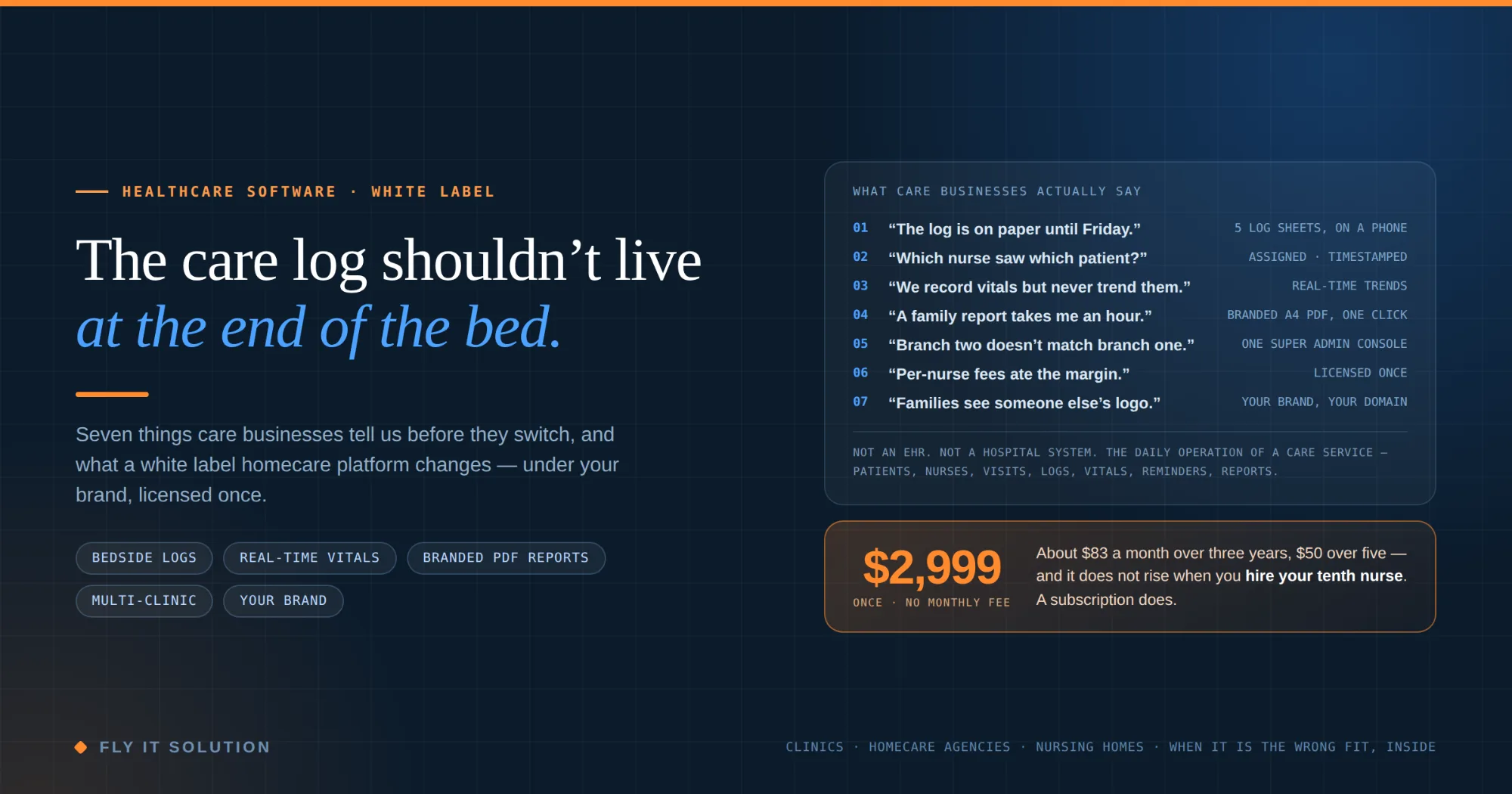
These are the seven things we hear most, in the words people use. If more than two sound like your service, keep reading.
“The log is on paper until Friday.”
Nurses fill in a sheet at the bedside. Somebody types it up at the end of the week. Until then, the care that happened exists only on a clipboard in a bag.
“I can't tell you which nurse saw which patient on Tuesday.”
Not without ringing them. Assignments live in a message thread, and the thread has moved on.
“We record vitals every visit. Nobody looks at the trend.”
Written down faithfully, never plotted. A slow decline over three weeks is invisible until it is an emergency.
“A family report takes me an hour.”
Pull the month's logs, the medication list and the test results into a document. Format it, check it, send it. For every patient whose family asks.
“Branch two doesn't match branch one.”
A different manager, a different spreadsheet. The owner cannot see the whole business without merging two things by hand.
“The per-nurse fees ate the margin.”
A subscription that was affordable for four nurses is a real cost at fourteen. It goes up with every hire — when things are going well.
“Families see someone else's logo.”
The report, the portal, and the app all carry a software company's brand. For a business whose product is trust, that is a strange thing to hand over.
How to tell when you need one
Here is a test with no software in it. Pick any patient and ask: what happened at their last three visits, who was there, and is anything trending the wrong way?
If the answer takes a phone call, a folder and twenty minutes, the information exists in exactly one place. And that place is not where the decision is being made.
A clipboard at the end of the bed is a good record for the person standing at the bed. It is useless to the manager across town, the nurse covering tomorrow, and the daughter who rings on Sunday.
A platform is the same log sheet, existing in all those places at once, the moment it is written. If care happens in more than one place, with more than one person, you need that from the first week.
What we built, and how it answers each of those
HealthSync is our white-label homecare management platform. Here is what it does about each statement above.
| What you said | What the platform does |
|---|---|
| The log is on paper until Friday | Five clinical log sheets feeding, vitals, respiratory, glucose, general care on the nurse's phone, saved as they are filled in. |
| Which nurse saw which patient | Every patient is assigned; every log is time-to-time and attributed. The admin sees it as it happens. |
| Nobody looks at the trend | Vitals are plotted over time as they are logged, so a slow change is visible before it is a crisis. |
| A family report takes an hour | A branded A4 PDF pulling vitals, test results and medication, generated in one click. |
| Branch two doesn't match branch one | One super admin console over every clinic, each clinic's data isolated at row level. |
| Per-nurse fees ate the margin | Licensed once for $2,999. No monthly fee, no per-nurse pricing. |
| Families see someone else's logo | Your branding across the interface and every report, on your own domain. |
Alongside those: a 30-condition history checklist on every patient, scheduling with automated reminders, in-app notifications, an analytics dashboard, and three role portals clinic admin, nurse and super admin.
A closer look: the bedside log
Everything on a care platform depends on one thing: the nurse records the visit, at the visit, on the platform. If that fails, nothing downstream works.
So, the log sheets are the ones nurses already use, laid out for a phone held in one hand. Nothing to learn beyond where the button is.
Each entry is attributed to the nurse who is logged in and timestamped on save. And because the same entry feeds the vitals trend, the family report and the admin dashboard, one blood-pressure reading updates four places at once.
That is the whole transformation. Smaller than the word suggests, and more useful: the care that happens exists everywhere it is needed, the moment it happens.
What does it cost?
HealthSync is licensed for $2,999, one time. That includes branding, deployment on your domain, configuration of clinics, roles, services and log sheets, training, documentation and a post-launch support period.
| If you run it for | $2,999 works out at | A per-nurse subscription would |
|---|---|---|
| 12 months | about $250 / month | Bill its rate, times your nurses |
| 36 months | about $83 / month | Bill the same, times more nurses |
| 60 months | about $50 / month | Still be billing |
Hosting, your domain and any customisation beyond configuration are your own costs the same on any platform, without a mark-up. Prices are in US dollars.
Who suits this, and where
Home health agencies in the United States managing nurses across a city. Domiciliary care providers in England, regulated by the Care Quality Commission, who need visit records that stand up to inspection.
Home nursing services in India, where the market is growing faster than the tooling. Private care providers in the Gulf whose families expect a branded report. Nursing homes and clinics anywhere that have outgrown paper but not the budget for a hospital system.
Data protection rules differ in each. The platform isolates every clinic's data by role; whether that, with your hosting and processes, meets your regulator's requirements is a question for your own compliance advice.
When it is the wrong choice
•You need an electronic health record prescribing, orders, lab interfaces, billing codes. This is not that, and we would say so.
•You are one nurse with six patients and a notebook. Come back at the second nurse.
•You want a vendor to host, run and update everything for a monthly fee and never think about it. A subscription is the honest fit. White label means it is yours, and yours means you run it.
For everything in between most home care agencies, nursing homes and clinics the transformation is real. Mostly it is the unglamorous fact that the care log stopped living at the end of the bed.
FAQ
What does white label mean for a homecare management platform?
It means the software carries your care business's name, logo and colours, runs on your own domain, and produces reports with your branding - while the underlying platform was built and is maintained by a software company. Nurses, patients and families see your organisation, not the vendor. The practical difference from a subscription product is ownership: a white-label platform is typically licensed once and deployed for you, rather than rented monthly per user under someone else's brand.
How is a white label platform different from monthly care management software?
Three ways. Cost shape: a subscription bills every month, usually per nurse or per patient, so it rises as you grow; a white-label licence is paid once, so it gets cheaper the longer you run it. Branding: subscription software carries the vendor's name to your nurses and families; white label carries yours. Control: a white-label deployment runs on your domain and infrastructure and can be customised for how your agency works, where a subscription is configured within whatever the vendor allows. The trade-off is that you take on hosting and are responsible for your own running costs.
What problems does a homecare management platform solve for a small agency?
The ones that show up when care is documented on paper or in messages: logs that exist only at the bedside until someone types them up, no way to see which nurse saw which patient and when, vitals that are recorded but never trended, family reports that take an hour to assemble, reminders that live in someone's head, and a second branch whose records do not match the first. A platform puts the log sheet on the nurse's phone, records the visit as it happens, trends the vitals automatically, generates the report in a click and keeps every branch on one system.
Is a homecare management platform the same as an EHR?
No, and it is worth being clear about the difference. An electronic health record system is built for hospitals and clinics with prescribing, orders, lab interfaces, billing codes and interoperability requirements. A homecare management platform is built for the daily operation of a care service: patients, nurses, visits, bedside logs, vitals, reminders and reports. It is deliberately simpler because the job is simpler. If you need a full EHR, a white-label care platform is the wrong tool, and a good vendor will say so.
How long does it take to launch a white label care platform?
Because the platform already exists, launch is a configuration and branding exercise rather than a build. The work is applying your branding across the interface and reports, deploying on your domain, setting up clinics, roles, services and log sheets, training the team and handing over documentation. What takes longest is usually on the care business's side - deciding which log sheets and services you run and gathering the patient records to load. Weeks, not months, is the realistic range.
Can Fly IT Solution customise HealthSync for my care business?
Yes. Because we built the platform ourselves rather than assembling it from third-party plugins, it can be extended for a specific service: additional log sheet types, a different visit or approval workflow, integration with your payroll or invoicing, extra reports, or a patient and family portal. Customisation is quoted separately from the licence. We work from Mohali, India and Minneapolis, Minnesota, with care clients in the United States, the United Kingdom, the Gulf and India.
Closing
If more than two of the seven statements sounded like your service, the HealthSync product page has the full module list and a live demo. Go through it as a nurse would open a patient, fill in a log, generate the report.
Then tell us what your service does that it does not. We build and run care platforms from Mohali, India and Minneapolis, Minnesota, and we will tell you plainly if you need something else.