Laravel was first released in 2011. In an industry that announces a new framework every few months, that makes it old. It is also the framework businesses ask us for by name more than any other, and the one we reach for most often when the job is a customer portal, a booking system, an internal tool or a SaaS product.
The short answer to the question in the title: because Laravel produces code the next developer can read, ships the pieces a business application needs without third-party assembly, and is maintained on a published schedule. Everything below is the longer version.
What is Laravel?
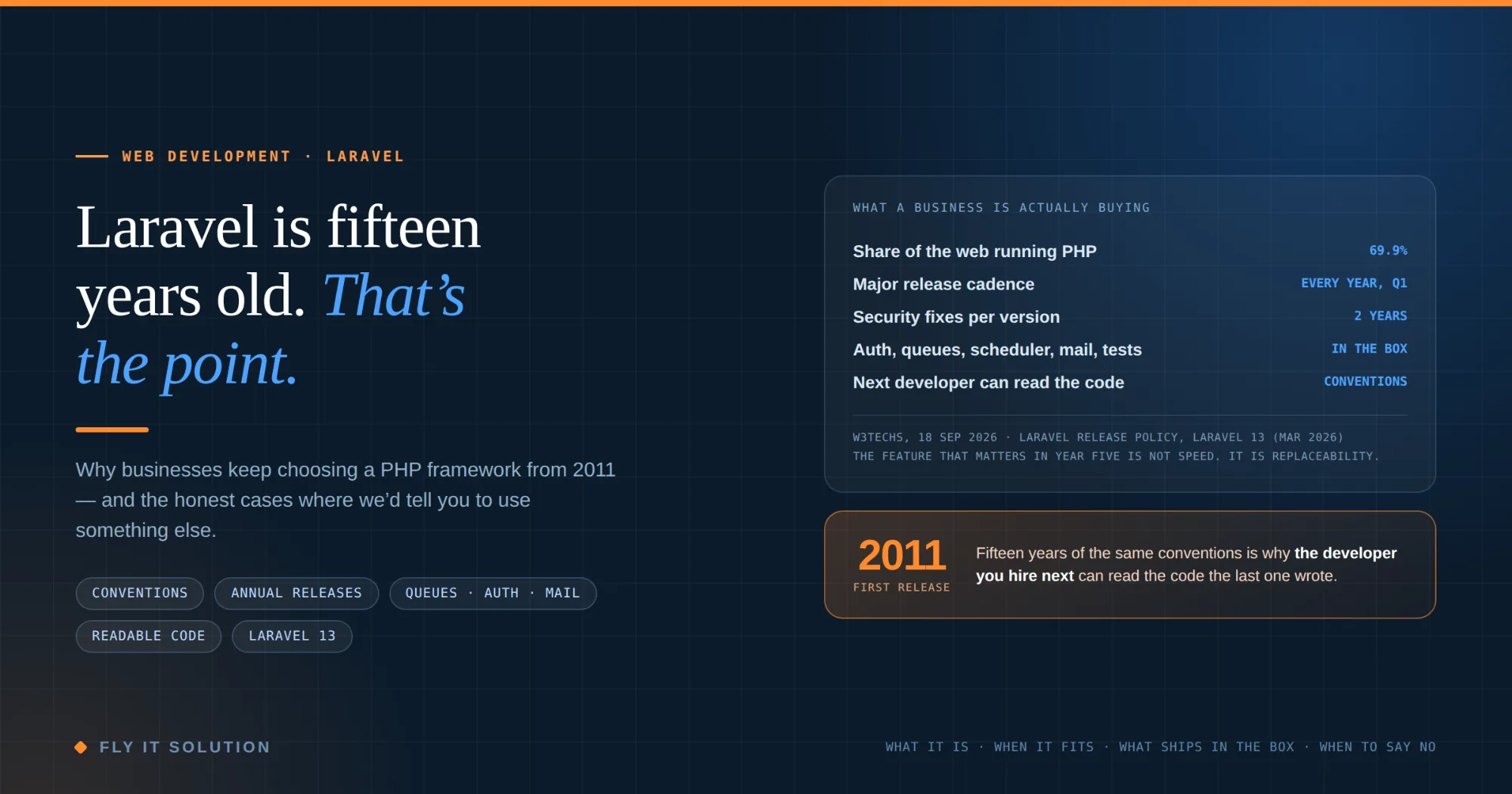
Laravel is an open-source framework for building web applications in PHP the language behind 69.9 percent of websites whose server-side language is known, according to W3Techs as of 18 September 2026. A framework is the scaffolding developers build on: it decides how a request reaches your code, how the code talks to the database, how users log in, how email is sent, how slow work is pushed to the background, and how all of it is tested. Laravel makes those decisions for you, consistently, and the result is code that is easy to read.
Is Laravel still relevant in 2026?
Yes, and the facts are simple. Laravel ships a major version every year; Laravel 13 was released on 17 March 2026. Each version gets bug fixes for eighteen months and security fixes for two years, on a schedule published in advance. That is what “still relevant” means for a business: somebody other than you is fixing security problems, and you know until when.
Why do businesses choose Laravel?
Five reasons, in the order they matter to a business rather than to a developer:
The next developer can read the code. Laravel has a conventional place for everything routes, database models, business logic, background jobs, tests so a new Laravel developer knows where to look on day one. That decides whether your application outlives the person who built it.
The essentials are in the box. User accounts and permissions, database access, background queues, a task scheduler, email, and a testing framework are all part of Laravel. On other stacks, several of those are libraries someone has to choose, wire in and keep updated.
It is maintained on a schedule. Annual releases, documented upgrade paths, and two years of security fixes per version. Upgrades are planned, not discovered.
The developer pool is large. Laravel developers are plentiful in India, the United States and Europe. For an Indian buyer that is a cost argument; for a North American buyer it is a continuity argument. It is the same pool either way.
It is built for the kind of software most businesses need. Forms, records, roles, workflows, reports, invoices, email and integrations that is what Laravel is optimised for, and it is what most business applications are.
When is Laravel the right choice?
When the hard part of your application is business logic. Think of two houses: one built to the standard building code, one built brilliantly by a builder who did everything his own way. Both work until something needs fixing and the original builder is gone. Laravel is the building code. If your product is a customer portal, a booking or scheduling system, a marketplace, an operations tool or a typical SaaS product, you are describing a house that should be built to code.
When is Laravel the wrong choice?
When the hard part is something other than business logic. Specifically:
Real-time collaboration with thousands of connections held open at once you will fight the framework rather than use it.
Data science or machine learning as the core product that work lives naturally in Python, and the web layer should be thin.
A small API behind a mobile app when your team already lives in another stack switching them to PHP to please a vendor is a poor trade.
A marketing site with no application behind it you do not need a framework at all.
A Laravel shop that will not say any of this is selling, not advising.
What does Laravel look like in a real project?
Two of ours. The shipping platform we built with three carrier integrations runs rate lookups and label generation on Laravel's queues so customers never wait on a carrier API. The creator platform runs its wallet ledger on Laravel's database transactions and its payouts on scheduled jobs. Neither did they need anything but the framework did not provide.
And here is the single most useful thing Laravel does for business, in seventeen lines. This is a test that proves a paid order is saved, the customer is sent to the right page, and the invoice email is queued and it runs automatically every time anyone changes anything:
CODE BLOCK render as a PHP code block:
public function test_a_paid_order_queues_the_invoice_email(): void
{
Mail::fake();
$customer = User::factory()->create();
$this->actingAs($customer)
->post('/orders', ['product_id' => 42, 'quantity' => 2])
->assertRedirect('/orders/confirmation');
$this->assertDatabaseHas('orders', [
'user_id' => $customer->id,
'status'=> 'paid',
]);
Mail::assertQueued(InvoiceMail::class);
}
Accounts, databases, request and email are all part of the framework, so they can be tested together in one place. A codebase with tests like this is one where a change to checkout in year three does not silently break invoicing.
FAQ
What is Laravel and why is it used for web development?
Laravel is an open-source PHP framework, first released in 2011, that gives a development team a standard way to build web applications: routing, database access, authentication, background jobs, scheduled tasks, email and testing are all part of the framework rather than things each project reinvents. Businesses use it because it produces conventional, readable code that another Laravel developer can pick up, and because it ships the piece’s most business applications need without third-party assembly.
Is Laravel still relevant in 2026?
Yes. Laravel ships a major version every year, with Laravel 13 released on 17 March 2026, and each version receives bug fixes for 18 months and security fixes for two years. PHP itself runs 69.9 percent of websites with a known server-side language, according to W3Techs as of 18 September 2026. Age in a framework is a benefit for a business rather than a defect, because it means a large pool of developers, stable conventions and a long record of what breaks and how to fix it.
How do I know if Laravel is the right choice for my project?
Laravel fits when your application is mostly forms, records, roles, workflows, reports, email and integrations - which describes most business software, from customer portals and booking systems to internal operations tools and SaaS products. It fits less well when the core of the product is real-time collaboration, heavy data science or machine learning pipelines, or a tiny static site. The test is whether the hard part of your application is business logic or something else; if it is business logic, Laravel is usually the right call.
Is Laravel good for large or long-running business applications?
It is one of the better choices for exactly that. The features that matter over five years are not speed of first build but whether new developers can read the code, whether the framework is still maintained, and whether upgrades are predictable. Laravel's conventions make code readable across teams, its release cadence is annual and published in advance, and the upgrade path between versions is documented. Companies run large, multi-year Laravel systems routinely; the risk is usually in how the application was written, not in the framework.
When should a business not use Laravel?
When the product's central difficulty is not business logic. Real-time collaborative tools where thousands of connections stay open, data pipelines and machine learning work that live naturally in Python, mobile-first products where the backend is a thin API and the team is already in another stack, and static marketing sites with no application behind them are all cases where something else fits better. A good Laravel shop will say so before quoting.
Does Fly IT Solution build web applications in Laravel?
Yes. Laravel is the framework behind a large share of our custom work - creator platforms, shipping and logistics systems, memorial and e-commerce integrations and repair workshop software among them - and we maintain long-running Laravel systems as well as building new ones. We work from Mohali, India and Minneapolis, Minnesota, and we will tell you plainly when a project would be better served by a different stack.
Closing
If you are deciding what to build on and want a straight answer including whether Laravel is wrong for you send us what you are planning. We build and maintain Laravel systems from Mohali, India and Minneapolis, Minnesota.
Sources: W3Techs, 18 September 2026; laravel.com release policy, checked the same day. Both change; re-check before relying on them.