Every brief we get for a creator platform describes the same thing. Creator profiles. A subscription feed. Pay-per-post unlocks. A wallet. Video calls. Usually a competitor is named, and usually the sentence is some version of “like that, but for our niche.”
Not one of those briefs has ever mentioned the things that kill these platforms. That is not criticism of the people, writing to them that the failures are invisible until you have been through one. They are also, almost without exception, cheap to solve during design and brutally expensive to solve after launch.
Here are eight of them, in roughly the order they will find you.
| Why do creator subscription platforms fail? |
|---|
Your app store takes its cut before your creator takes theirs
This is the one that turns a viable business model into a loss-making one, and it does it quietly, because the spreadsheet was built on web economics and the users arrived on mobile.
Apple's App Review Guidelines are not ambiguous about it. Guideline 3.1.1 reads:
| “If you want to unlock features or functionality within your app, (by way of example: subscriptions, in-game currencies, game levels, access to premium content, or unlocking a full version), you must use in-app purchase. Apps may not use their own mechanisms to unlock content or functionality, such as license keys, augmented reality markers, QR codes, cryptocurrencies and cryptocurrency wallets, etc.” |
|---|
Read that list again. In-game currencies. Access to premium content. A credits wallet that unlocks posts are both of those things at once.
Apple publishes the split on its own subscriptions page: during a subscriber's first year you receive 70 percent of the subscription price at each billing cycle, and after a subscriber accumulates one year of paid service that rises to 85 percent. Developers in the App Store Small Business Program no more than 1 million US dollars in total proceeds receive 85 percent throughout. In the European Union, developers on the alternative terms who are in the Small Business Program, and subscriptions past their first year, get a further reduced rate of 10 percent commission.
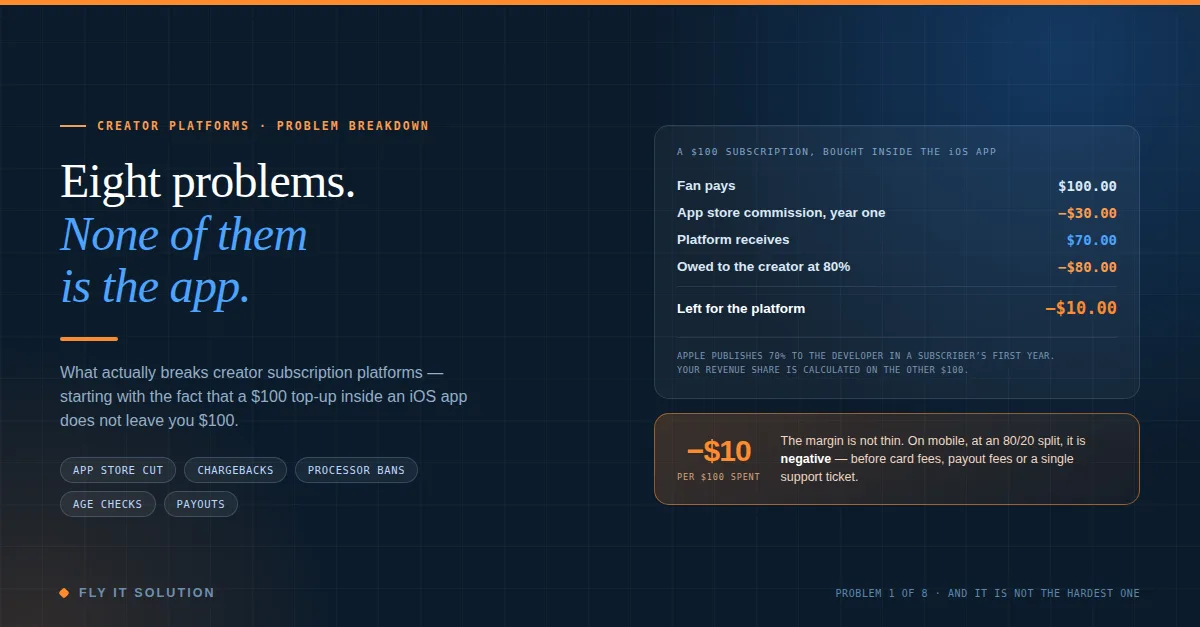
Now put that next to a creator revenue share. Suppose you promise creators 80 percent, which is roughly the market expectation:
| A $100 subscription bought inside the iOS app | Amount |
|---|---|
| Fan pays | $100.00 |
| App store commission, first year | -$30.00 |
| Your platform receives | $70.00 |
| Owed to the creator at 80% of what the fan spent | -$80.00 |
| Left for the platform | -$10.00 |
You are not operating on a thin margin. You are paying ten dollars for the privilege of processing every hundred before card fees on the web side, before paying out fees, before a single support ticket. And because web users are profitable, the blended number looks survivable right up until mobile becomes most of your volume, which it will.
There is one narrow way out, and it is narrower than most people assume. Guideline 3.1.3 says:
| “If your app enables the purchase of real-time person-to-person services between two individuals (for example tutoring students, medical consultations, real estate tours, or fitness training), you may use purchase methods other than in-app purchase to collect those payments. One-to-few and one-to-many real-time services must use in-app purchase.” |
|---|
So, a private one-to-one call can, in principle, be billed outside in-app purchase. A paid group cannot. And a credit top-up does not qualify at all, because credits can also be spent on content — the moment a balance can unlock a post, it is not a person-to-person service.
What that means in practice is that pricing and product must be designed together, before anyone writes code. Different credit pricing on mobile than on web. Top-ups steered to the browser where the rules allow it. One-to-one calls potentially structured outside the wallet. A creator split that is stated as a share of platform net revenue rather than of gross spend which is a business decision, not an engineering one, and it must be in the creator agreement from day one. Retrofitting it later means telling every creator you are cutting their rate.
The chargeback arrives after you have already paid the creator
A physical retailer facing a dispute has two things a creator platform does not: proof of delivery, and stock that may come back. You have neither. The content was delivered the instant it was bought, the evidence that it was delivered is a row in your own database, and the creator's share left your account weeks ago.
That timing mismatch is the whole problem. Card disputes can be raised long after the purchase. If your platform pays out on a short cycle and holds nothing back, every reversal is an unrecoverable loss and worse, a silent one, because nothing in a naive system connects the reversal to the invalidated payout. Operators usually discover the scale of it during a reconciliation, months in, when the money in the bank stops matching the money in the database.
There is a second-order risk that is easier to miss and harder to recover from. Card networks monitor the ratio of disputes to transactions at merchant level. A rising rate is not only a direct cost; sustained, it attracts fees and can put the merchant account itself at risk. For a platform whose entire revenue runs through one account, that is not a finance problem. That is the end of the company.
The fix is not clever, but it must be in the data model rather than in a report: creator earnings accrue immediately, become withdrawable only after a hold period, and a reversal reaches back into the specific entries it invalidates. That is not something you can add once money is already moving.
A wallet is a ledger, and a balance column is not a ledger
The obvious way to build a credits wallet is a number on the user record that goes up when they buy and down when they spend. It works perfectly until somebody asks a question about it.
A balance column cannot tell you where a particular credit came from, which purchase a refund should reverse, why a creator's earnings do not equal the sum of their sales, or what the platform owed its creators at close of business last Tuesday. It also does not survive two things happening at once a call debiting per minute while a subscription renews without either a lock or a bug, and in our experience, it is usually a bug.
The cost of this one never appears as a line item, which is why it survives so long. It shows up as a support team that cannot answer questions, a finance function reconciling by hand, and an operator who cannot give a straight answer when an acquirer asks for one.
The fix is to stop treating the balance as a fact and start treating it as a calculation. Every event a purchase, a spend, a commission split, a hold, a release, a refund, a payout is its own immutable row, and the balance is the sum of them. Nothing is ever edited; a correction is a new entry pointing at the old one. That is how we modelled it on the creator monetization platform we built, and it is the single decision that makes every later financial question answerable.
Your payment processor decides what your platform is allowed to be
Founders choose a processor the way they choose a hosting provider — late, on price, and on the assumption that one is much like another. For a creator platform the processor decision comes first, because it constrains what platform is permitted to host.
Stripe's published restricted businesses list excludes pornography, adult services and adult live-chat features. Square's payment terms list adult entertainment products and services in any medium as an unsupported industry. PayPal is different again and it is worth getting right: its acceptable use policy prohibits obscene material and certain sexually oriented material, and separately requires pre-approval for adult content delivered digitally, including video on demand and webcam activity. That is a permission process, not a ban.
Above the processors sit the card networks. Mastercard operates a Specialty Merchant Registration Program under which non-face-to-face adult content merchants require its prior consent. When Mastercard announced strengthened requirements for those merchants in April 2021, it set out what registered merchants must have: documented consent from everyone depicted, documented age and identity verification for people depicted and people uploading, a content review process before publication, a complaint process that resolves illegal or non-consensual content within seven business days, and an appeals process allowing anyone depicted to request removal.
Read that list as a product backlog, because that is what it is. A consent record. An uploader verification flow. A pre-publication review queue. A takedown workflow with a clock attached to it. None of those are legal documents. They are features, with database tables and screens, and they take engineering time that nobody budgeted.
The practical consequence: decide your category before you choose a processor and start the merchant account application before you start the building. It is the step you do not control and the one most likely to delay launch.
Age assurance is access control, not a checkbox on signup
Most teams’ picture age verification as a date-of-birth field, or at worst a document upload at registration. Regulators have moved well past that, and they have moved in three different directions at once.
United Kingdom. The Online Safety Act requires services that allow users to upload or share pornographic content to operate highly effective age assurance. Ofcom brought that duty into force on 25 July 2025. Its guidance is specific about what does not count: self-declaration is not sufficient, and neither is a payment method that does not itself require the user to be eighteen. That second point catches people out a credits purchase is not an age check.
United States. The Supreme Court decided Free-Speech Coalition v. Paxton on 27 June 2025, upholding Texas's age-verification law by six votes to three under intermediate scrutiny. The Court's own opinion noted that at least twenty-one other states had enacted materially similar requirements. Any US-facing platform is therefore building against a patchwork that varies by state, not a single federal rule.
European Union. There is no standalone age-verification statute for content platforms, but the Commission is enforcing age assurance through the Digital Services Act's duties on protecting minors. In March 2026 it issued preliminary findings against four major adult platforms, holding that self-declaration is not an effective measure.
The architectural consequence is the same in all three places, and it is the part that matters for a building. Age assurance must gate access at the content layer rather than at the signup form, because the obligation is about what a user can see and not about what they claimed once. And the verification method must be swappable, because the list of acceptable methods is still moving forward. A hard-wired platform to one provider will be rebuilding this within two years.
This is not legal advice and the rules above are current as of September 2026. Take advice on your own market and category.
The app store will demand moderation before any regulator does
Teams tend to treat content moderation as a phase-two concern, something to build once there is content worth moderating. If you are shipping a mobile app, that sequencing does not work, because review will stop you first. Apple's App Review Guideline 1.2 states that apps with user-generated content or social networking services must include:
| “A method for filtering objectionable material from being posted to the app |
|---|
Four bullet points, four features, and one of them is not a feature at all. “Timely responses to concerns” are a staffing commitment. Somebody must read reports and act on them, at a speed that satisfies a reviewer and, if you are in a registered category, a card network's seven-business-day window. That is an operating cost from launch day, on a platform that has no revenue yet.
The founders who handle this well decide early what the platform will not host and build the filtering to enforce it. The ones who struggle try to decide case by case, at volume, with two people.
Paying creators out is a harder problem than taking money in
Taking card payments is a solved problem with a hundred competing vendors. Sending money to several thousand individuals scattered across the world, each of whom wants it in a different form, is not.
A creator in the United States wants a bank deposit. One in the Philippines may want cash pickup. One in Nigeria may want a mobile wallet. One in Argentina may want stablecoin. None of them want to wait three weeks, and every failed payout becomes a support ticket that costs more to handle than the payout was worth.
Two mistakes arose. The first is treating a payout as a transfer instruction rather than a state machine: earnings accrue, clear, are requested, are checked, are submitted, and then either settle or fail and return to the balance and every one of those transitions needs to be recorded, or you cannot answer a creator asking where their money is. The second is leaving identity verification until the first withdrawal. Anyone receiving payouts must be verified and, depending on jurisdiction, has to have provided tax documentation. Discovering that now somebody is trying to get paid is the worst possible time for both of you. Do it onboard.
You budgeted for the wrong cost
Ask a founder what worries them about running costs and they will usually say video. It is the visible, expensive-sounding part. It is also, on the scale that most of these platforms operate, close to a rounding error.
Agora publishes 10,000 free minutes per account per month, then charges 0.99 US dollars per 1,000 minutes for audio and 3.99 US dollars per 1,000 minutes for HD video, with higher rates above HD and cloud recording priced separately. Because minutes are counted per participant, a ten-minute one-to-one HD video call consumes twenty minutes roughly eight cents. The free allowance alone covers around five hundred such calls a month before you pay anything.
Eight cents. Meanwhile the app store commission on a single hundred-dollar subscription is thirty dollars, one chargeback costs you the transaction plus a fee, and a moderator's salary runs every month whether anyone subscribes or not.
The lesson is not that video is free. It is that founders optimise the cost they can picture and ignore the ones they cannot, and in this category the costs you cannot picture are an order of magnitude larger. Figures are Agora's published rates as of September 2026; check them before building a business case on them.
And underneath all eight, the problem you cannot engineer away
A creator platform is a two-sided market with an unusually brutal cold start. Fans arrive for creators. Creators arrive for fans. Neither has any reason to be first, and the platform itself is not the draw — nobody has ever subscribed to a platform because its feed component was well built.
What that means, practically, is that your creators bring the demand and you supply the plumbing. Which in turn means the two things that will decide whether creators stay are the two things every problem above touches: how much of their money they keep, and how quickly they get it. A platform that is expensive to run and slow to pay will lose its creators to one that is neither, nor no amount of feature work will fix that.
It is also why getting the eight problems above right is not an engineering nicety. It is the product.
What we built, in brief
We have built one of these ends to end a creator subscription and monetization platform in PHP and Laravel with a native iOS app. The reason this article is mostly problems rather than features is that those problems are what shaped the build.
The wallet sits on an append-only ledger rather than a balance column, so every credit purchased, spent, split, held, reversed or paid out is its own immutable row and the balance is derived from them. Creator earnings accrue now of spend but become withdrawable only after a period of hold, so a reversal has something to reach back into. The commission split is configurable and written per transaction rather than recalculated later, which is what makes it possible to price mobile differently from web without the ledger becoming fiction.
Four revenue models run against that one wallet — recurring subscriptions, individually priced post unlocks, paid messaging, and audio and video calls metered by the minute rather than four parallel payment paths. Calling runs on Agora. Payouts run through Mass Pay, which publishes coverage of more than 180 countries and 80 currencies across bank deposits, mobile wallet, cash pickup and cryptocurrency rails.
The backend, the payment flow and the iOS application are complete, and the payments have been tested in live mode rather than only in sandbox a distinction that matters, because sandboxes do not produce declines, authentication challenges or chargebacks.
The full technical breakdown is on the project page: creator subscription and monetization platform.
A checklist before you commission anything
If you are about to brief an agency or a team, take this to the first meeting. The third column is the one that matters almost every item has to be settled before code, not after.
| Problem | What it costs if ignored | Where it has to be solved |
|---|---|---|
| App store commission | A negative margin on every mobile transaction | Pricing model and creator agreement, before build |
| Chargeback timing | Unrecoverable losses, and eventually the merchant account | Data model — hold periods and reversal linkage |
| Wallet as a balance column | Unanswerable questions, manual reconciliation | Schema design, before any money moves |
| Processor category rules | A rejected merchant account weeks before launch | Category decision, before choosing a processor |
| Age assurance | Regulatory exposure and a rebuild of your access layer | Access control at the content layer, swappable provider |
| Moderation requirements | App review rejection; blocked launch | Product backlog, plus a staffing plan |
| Payout operations | Support load and creators leaving | Payout state machine, and KYC at onboarding |
| Cost modelling | Budget aimed at the wrong line | Financial model, before fundraising or pricing |
Why do creator subscription platforms fail?
Rarely because the product is bad. They fail because the money does not work. The app store takes its commission before the platform takes anything, so a revenue share that looked generous on a spreadsheet becomes a loss on mobile. Chargebacks land months after creators have already been paid. Payment processors decline categories the founder never checked. Age assurance and moderation turn out to be architecture rather than settings. Each of these is cheap to solve during design and expensive to solve after launch.
Does Apple take a commission on creator platform payments?
Yes, wherever the purchase unlocks content or features in the app. App Review Guideline 3.1.1 states that unlocking features or functionality within an app, including subscriptions, in-game currencies and access to premium content, must use in-app purchase. Apple's own subscriptions page states that a developer receives 70 percent of the subscription price during a subscriber's first year and 85 percent after a subscriber accumulates a year of paid service, with participants in the App Store Small Business Program receiving 85 percent throughout. That commission is taken before any revenue share with the creator.
Can a paid one-to-one video call avoid in-app purchase?
In a narrow case, yes. App Review Guideline 3.1.3 permits purchase methods other than in-app purchase where an app enables the purchase of real-time person-to-person services between two individuals, giving tutoring, medical consultations, real estate tours and fitness training as examples. The same guideline states that one-to-few and one-to-many real-time services must use in-app purchase. So a private one-to-one call may qualify while a paid group broadcast does not, and a credits top-up that can also be spent on content is not a person-to-person service at all.
Why do chargebacks hurt creator platforms more than ordinary e-commerce?
Because the goods are delivered instantly and the money has usually already left the building. A physical retailer can show proof of delivery and still holds stock. A creator platform delivered the content the moment it was bought and paid the creator their share soon after, so a reversal weeks or months later is an unrecoverable loss unless the platform held the earnings first. Card networks also monitor chargeback ratios, so a rising rate is not only a direct cost but a risk to the merchant account itself.
What age verification is required for a content platform in the UK and the US?
In the United Kingdom, the Online Safety Act requires services allowing users to upload or share pornographic content to use highly effective age assurance, a duty Ofcom brought into force on 25 July 2025. Ofcom's guidance states that self-declaration is not sufficient and that payment methods which do not themselves require the user to be 18 do not qualify. In the United States the Supreme Court upheld Texas's age-verification law in Free Speech Coalition v. Paxton on 27 June 2025 by six votes to three, and the Court's opinion noted that at least twenty-one other states had enacted materially similar requirements.
Do I need a special payment processor for a creator platform?
It depends entirely on what your platform permits. Mainstream creator platforms covering coaching, fitness, music, education or paid consultation can usually use ordinary processors. Stripe's published restricted businesses list excludes pornography, adult services and adult live-chat features, and Square's payment terms list adult entertainment products and services as an unsupported industry. PayPal's acceptable use policy prohibits obscene material and requires pre-approval for adult content delivered digitally. Mastercard operates a Specialty Merchant Registration Program under which non-face-to-face adult content merchants require its prior consent. Decide the category before choosing the processor, because it changes the integration.
Closing
None of the eight is unsolvable. Every one of them is materially cheaper to handle in a design document than in production, and almost every one of them is invisible in a feature list which is exactly why briefs never mention them.
If you are planning a creator platform and want a second opinion on the parts that are not the app, we are happy to have that conversation before you have decided to work with us. We build these from offices in Mohali and Minneapolis, mostly for operators working across more than one market.
Sources and dates. App Review Guidelines and commission figures are quoted from Apple's own developer documentation. Processor policies are from each vendor's own published terms. UK duties and guidance are Ofcom's; the US case is the Supreme Court's own opinion; the EU position is the European Commission's. Real-time pricing is Agora's published rate card, checked 14 September 2026. Vendor pricing and platform policy both change without much notice, so re-check anything you intend to rely on.