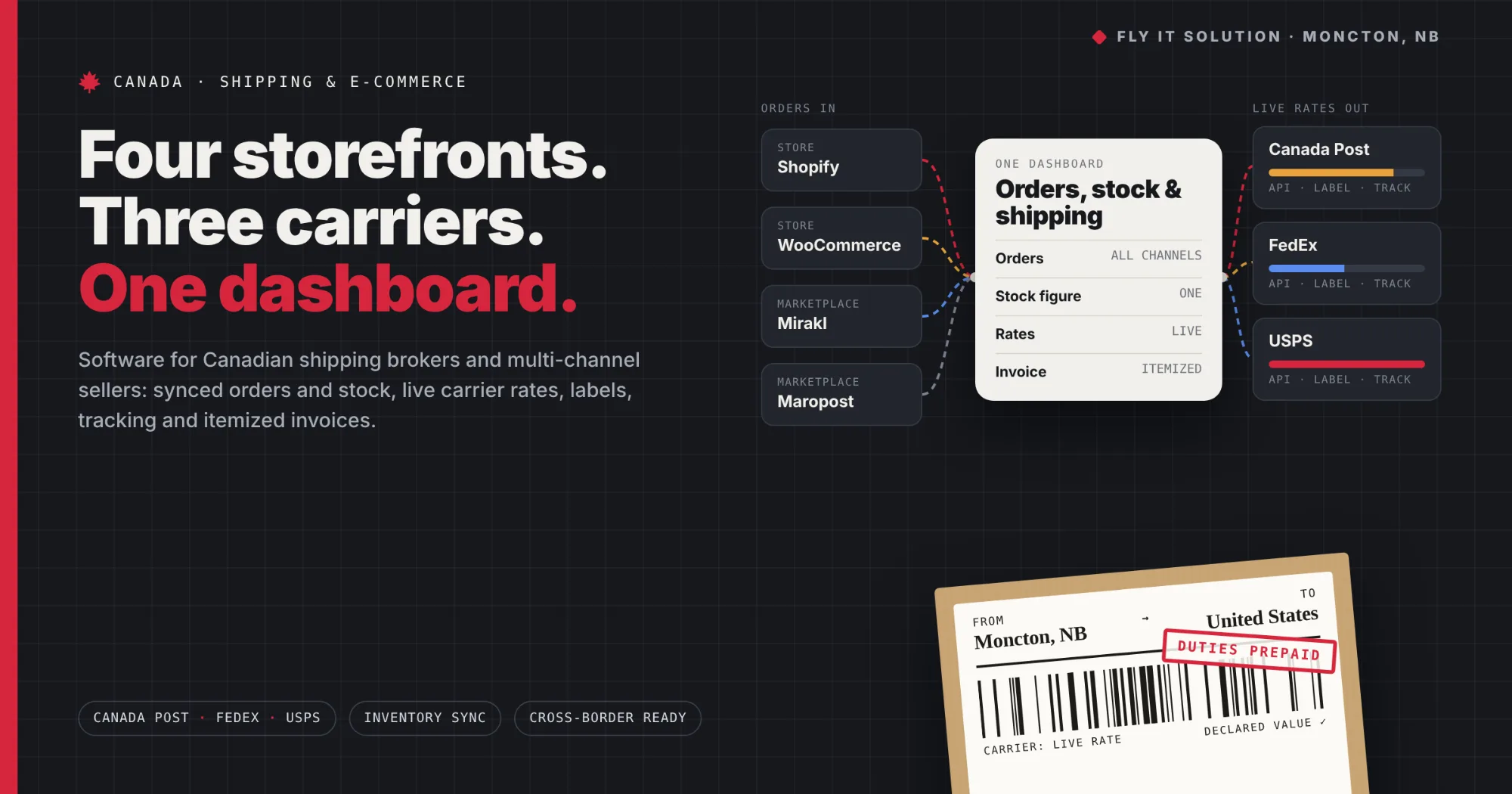
Canadian shipping brokers and multi-channel sellers need one platform that pulls orders and stock from every storefront, requests live rates from every carrier including Canada Post, prints labels, tracks every parcel in one view and produces an itemized invoice. Most businesses we talk to do those five jobs across four storefront logins, three carrier websites and a spreadsheet.
Cross-border rules have made the gap more expensive. The United States suspended its US$800 duty-free de minimis for all countries on 29 August 2025, so shipments to the U.S. now need duties prepaid, according to Canada Post's summary of the U.S. change. Every parcel's value and contents now have to be right the first time.
This post covers what brokers and sellers tell us about their current set-up, the two systems that fix it, how cross-border rules fit, when to buy and when to build, and a five-step plan. The two projects behind it are our multi-channel e-commerce aggregator and our multi-carrier shipping platform.
What Canadian shipping brokers and sellers tell us
Six sentences come up in almost every first conversation. Each one points to the same gap: orders, stock and carriers live in separate places, and a person connects them by hand.
“We copy rates from three carrier websites.”
A customer asks for a price, and someone opens Canada Post, then FedEx, then a U.S. carrier, and pastes the cheapest into an email.
What it tells us: rates are looked up, not requested. Live rate calls to every connected carrier at quote time, shown side by side with service levels, turn a ten-minute quote into a screen.
“Orders come in from four storefronts, and we key them into the shipping tool.”
Shopify, WooCommerce and one or two marketplaces each have their own order screen, and every order is retyped before it can ship.
What it tells us: there is no single order list. Syncing orders from every channel into one dashboard removes the retyping and the typos that come with it.
“We sold the last unit twice.”
Stock is updated on one channel and not the others, so a marketplace keeps selling an item the website already sold.
What it tells us: inventory is held per channel instead of once. One stock figure pushed to every channel stops oversells before they happen.
“Customers ask where their parcel is, and we check three tracking sites.”
Every carrier has its own tracking page, so a single “where is it?” becomes several logins.
What it tells us: tracking is not unified. One tracking view across every carrier answers the question in one place, for staff and for customers.
“The store won't ship to the customer's address.”
A U.S. retailer will not deliver to Canada, or a Canadian one will not ship south, and the customer turns to a forwarder.
What it tells us: the order needs two legs. Virtual warehouse addresses split an undeliverable order into a domestic delivery and an onward shipment, with a firm estimate once the parcel is weighed on arrival.
“Invoices and our handling fee live in a spreadsheet.”
The carrier charge, the broker's margin and the handling fee are added up by hand after the parcel has gone.
What it tells us: billing is a separate job from shipping. An itemized invoice generated from each shipment, with a configurable handling fee in the quoted total, removes the spreadsheet.
Shipping broker software: the multi-carrier platform
Shipping broker software requests live rates from every connected carrier, books and labels the parcel, tracks it and bills it, with the broker's fee built in. We built this as a shipping platform for a package forwarder serving U.S. and Canadian customers. It contains the following.
Three carrier integrations. Live API calls to Canada Post, FedEx and USPS at quote time, not a stored rate table.
Side-by-side rate comparison. The same parcel priced with every connected carrier, with service levels, so the customer compares cost and speed.
Virtual warehouse addresses. Two U.S. warehouses and one Canadian warehouse, splitting an undeliverable order into two deliverable legs.
Indicative price check and estimate on arrival. An indicative warehouse-to-destination price before ordering, then a firm estimate from the measured weight and dimensions at check-in for the customer to approve.
Warehouse check-in. Staff log what arrived against the expected shipment before anything is forwarded.
Shipping labels and unified tracking. Carrier-compliant labels printed from the platform, and tracking from all three carriers in one view.
Invoicing, email and handling fee. Itemized per-shipment invoices and transactional email, with a handling fee set in the admin panel and shown in the quoted total.
Three levels of access. A super admin for the whole platform, a separate admin panel per warehouse, and customer logins; warehouse staff see only their own site's parcels.
It is built on PHP and Laravel with MySQL, hosted on AWS, using the Canada Post, FedEx and USPS APIs and SendGrid for email. Additional carriers are added through their own APIs.
Multi-channel e-commerce software: the aggregator
A multi-channel e-commerce aggregator syncs products, inventory, orders and shipping across several storefronts and marketplaces from one dashboard. The e-commerce aggregator we built is a Laravel and Angular SaaS platform that does this across Shopify, WooCommerce, Mirakl, Virtualstock, Maropost and Dropshipzone.
For a Canadian seller, that means one product catalogue, one stock figure and one order list, whichever channel the order came from. Mirakl, Virtual stock and Dropship zone matter here because marketplace and dropship connections are usually the first thing an off-the-shelf shipping app does not support.
How the two fit together
For a business that both sells on several channels and ships for others, the architecture we would propose connects the two: orders and stock come in through the aggregator, and each order is rated, labelled, tracked and invoiced through the shipping engine.
One order then takes five steps with no retyping: it arrives from any channel, stock updates everywhere, carriers are rated live, a label prints, and the itemized invoice is generated when it ships. Where a business also needs purchasing, warehouse and reporting in the same system, that becomes custom ERP software development rather than a shipping tool.
Cross-border rules Canadian shippers need to plan for
Cross-border shipping between Canada and the U.S. now depends on accurate declared values in both directions. For courier imports into Canada from the United States or Mexico, CBSA applies the CUSMA thresholds set out in CBSA Customs Notice 20-18: duties and taxes are waived up to CAD 40; from CAD 40.01 to 150, duties are waived but taxes apply; above CAD 150, both apply.
Those thresholds apply to courier shipments only, not mail, and orders cannot be split into several packages to stay under them. In the other direction, since 29 August 2025, shipments from Canada to the U.S. need duties prepaid regardless of value, through Canada Post or any courier.
Software does not make a shipper compliant, but it keeps the records that compliance depends on: declared value and contents captured once at quote time, carried onto the label, and itemized on the invoice. Duty and tax estimates in the quote can be added as a module where a business needs them. Confirm your own obligations with CBSA or a licensed customs broker; this section is a summary, not advice.
Off-the-shelf app or custom platform?
Buy an off-the-shelf shipping app if you sell on one or two mainstream storefronts, ship with carriers it already supports, and do not resell shipping. It will be cheaper and faster than anything custom.
Build custom when you are a broker or forwarder reselling carrier rates with your own fee and brand, when you run warehouses that check parcels in before forwarding, or when your channels include marketplaces and dropship partners the apps do not connect to. Start with MVP software development: orders plus one or two carriers in real use, then add the rest.
If you already run an older in-house shipping or order system, legacy code migration moves it to a modern stack in phases while it keeps shipping.
What it costs
Custom shipping and e-commerce software in Canada costs what its scope demands: how many channels, carriers and warehouse locations it connects. We quote it in phases after a discovery call, so the first phase, usually order and inventory sync with one or two carriers, is in use while the rest is built.
The fair comparison is the quote against what you pay today: per-order or per-label fees on several tools, plus the hours spent copying rates, re-keying orders and reconciling invoices. You own the source code of everything we build, with no licence fee to us afterwards.
A five-step plan to one dashboard
Most businesses have orders and their first carrier connected within the first phase. The order matters more than the speed.
1. List every channel and carrier you use. Write down each storefront and marketplace that sends you orders, and each carrier you quote or book with, including Canada Post, and note which ones offer an API.
2. Trace one order end to end. Follow a single order from the moment it is placed to the invoice, and mark every place someone copies, re-keys or checks something by hand.
3. Connect orders and inventory first. Bring orders and stock levels from every channel into one dashboard, so nothing is re-keyed and the same unit cannot be sold twice.
4. Add live carrier rates, labels and tracking. Connect the carriers so each parcel is rated live at quote time, labels print from the same screen, and tracking from every carrier appears in one view.
5. Automate invoicing and fees, then expand. Generate itemized invoices with your handling fee from each shipment, then add channels, carriers or warehouse locations one at a time.
How this works in Canada
Fly IT Solution is a software development company in New Brunswick with an office on Gordon Street in Moncton. Khushpinder Kaur, our Business and Software Consultant for North America, is the direct contact for Canadian clients in Atlantic business hours, on +1 (647) 913-9073 or by video, wherever in Canada the business is based.
We scope a phased build, show working software every two weeks and hand over the code. Engineering is delivered from our development centre in Mohali, India, with design and delivery support from Minneapolis; our custom software services page lists the rest of what we build.
If one of the six sentences at the top of this post sounded like your business, talk to Khushpinder. Bring the list of channels and carriers you use and one order traced from checkout to invoice; it is the most useful thing for a first call.
Frequently asked questions
What software does a Canadian shipping broker need?
A Canadian shipping broker needs a platform that requests live rates from every connected carrier at quote time, including Canada Post, shows them side by side, books and prints carrier-compliant labels, tracks every parcel in one view, and produces an itemized invoice with the broker's own handling fee. Brokers with warehouses also need check-in, so a parcel's measured weight and dimensions produce a firm onward estimate before it is forwarded.
What is a multi-channel e-commerce aggregator?
A multi-channel e-commerce aggregator is a platform that syncs products, inventory, orders and shipping across several storefronts and marketplaces from one dashboard. The aggregator we built does this across Shopify, WooCommerce, Mirakl, Virtual stock, Maropost and Dropship zone, so a seller manages every channel in one place instead of logging in to each.
Can shipping software integrate with Canada Post?
Yes. The multi-carrier shipping platform we built requests live rates from Canada Post, FedEx and USPS at quote time through their APIs, compares them side by side, generates labels and shows tracking from all three in one view. Other carriers are added through their own APIs during scoping.
How do cross-border rules affect Canadian shipping software?
They make accurate values and itemized records more important. For courier imports into Canada from the United States or Mexico, CBSA applies CUSMA thresholds: duties and taxes are waived up to CAD 40, duties are waived but taxes apply from CAD 40.01 to 150, and both apply above that. In the other direction, the United States suspended its US$800 duty-free de minimis for all countries on August 29, 2025, so shipments to the U.S. need duties prepaid. Software that records declared values and itemizes every shipment keeps those obligations manageable; confirm your own obligations with CBSA or a customs broker.
Should I buy an off-the-shelf shipping app or build custom software?
Buy an off-the-shelf app if you sell on one or two channels, ship with the carriers it already supports and do not resell shipping. Build custom when you are a broker or forwarder reselling carrier rates with your own handling fee and brand, when you run warehouses that check parcels in before forwarding, or when your channels include marketplaces the app does not connect to. A phased build starting with orders and one carrier keeps the first version small.
How much does custom shipping and e-commerce software cost in Canada?
It depends on how many channels, carriers and warehouse locations the platform must connect, not on the province. We scope it after a discovery call and quote it in phases, usually starting with order and inventory sync plus one or two carriers, so the first version is in use while the rest is built. You own the source code.
How does Fly IT Solution work with shipping and e-commerce businesses in Canada?
From our Moncton office on Gordon Street, Khushpinder Kaur, our Business and Software Consultant for North America, is the direct contact for Canadian clients in Atlantic business hours, on +1 (647) 913-9073 or by video. We scope a phased build, show working software every two weeks and hand over the source code. Engineering is delivered from our development centre in Mohali, India, with design and delivery support from Minneapolis.