
Accuro EMR Integration for a HIPAA-Compliant Patient Flow Platform
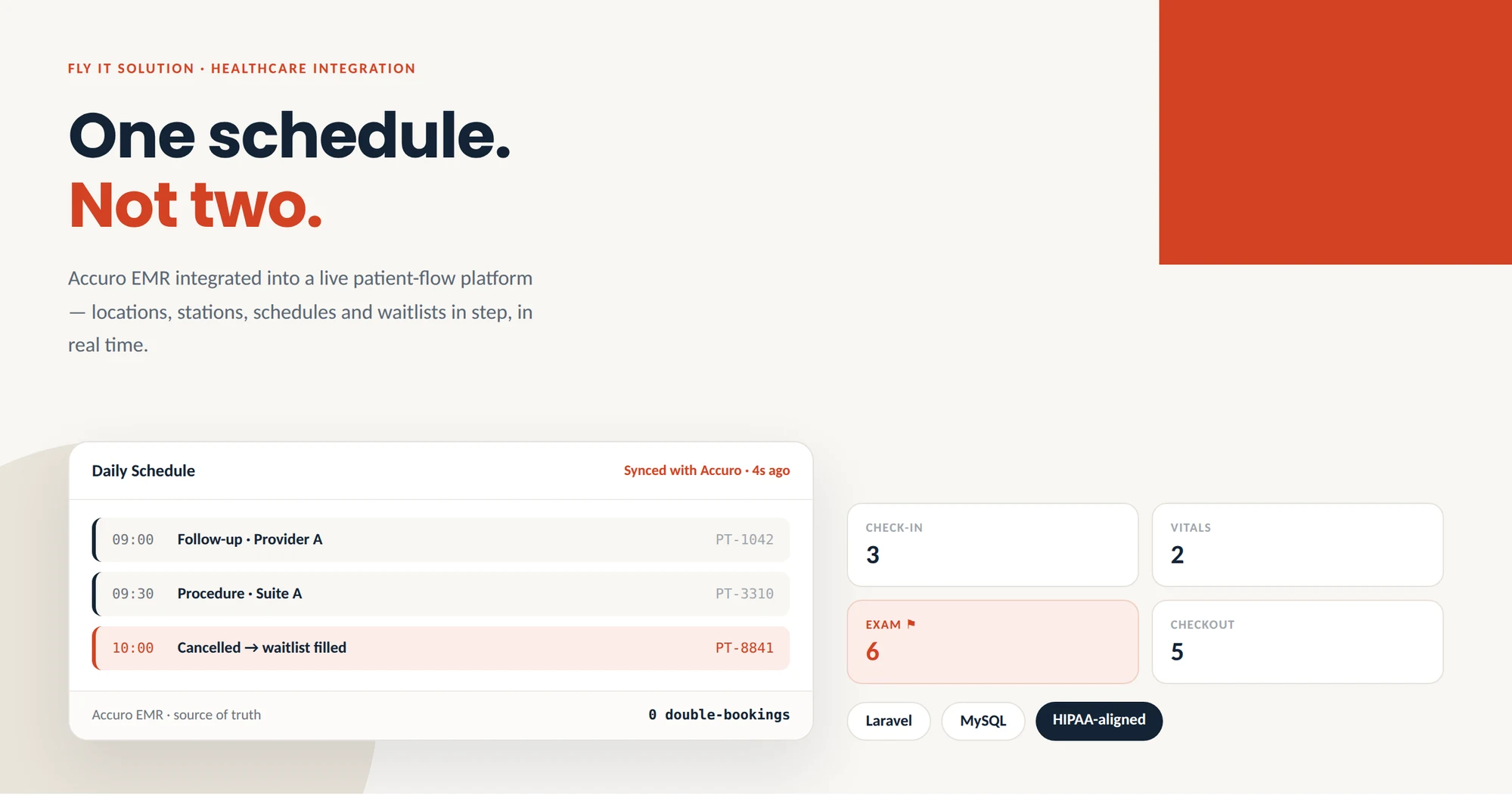
A clinic group was already running its own patient-flow application, but every location, provider schedule and walk-in queue still lived separately inside Accuro EMR. We connected the two systems with a Laravel service layer so appointments, stations and waitlists stay in step in real time — without asking front-desk staff to change how they work.
Project Overview
- Industry
- Healthcare / Clinical Operations
- Engagement
- Dedicated backend developer embedded in the client's product team
- Duration
- September 2024 – April 2025
- Services
- EMR/API integration, backend engineering, database design, real-time sync, analytics
- Integration
- Accuro EMR API (QHR Technologies) — REST, OAuth 2.0 scoped access
- Tech Stack
- PHP 8, Laravel, MySQL, REST API, OAuth 2.0, Queues & Scheduler, Redis
- Status
- Live in production
The Challenge
The client's platform handled the parts of the day that the EMR was never designed for - moving patients between rooms, filling gaps left by cancellations, and showing managers where the day was running late. The clinical record itself stayed in Accuro EMR.
That split created daily friction. A schedule changed in Accuro did not reach the floor display until somebody re-keyed it. Locations and rooms were maintained twice, under two sets of names, so reports never quite reconciled. Same-day cancellations left slots empty while a waitlist sat in a separate spreadsheet. Nobody could answer a simple operational question — how long are patients actually waiting at each station? — without exporting data by hand.
The brief we picked up had four hard constraints:
The EMR stays the source of truth. Accuro holds the clinical record; our layer mirrors and enriches, it never quietly overwrites.
No downtime. The platform was already live in clinics. Integration had to land behind feature flags, clinic by clinic.
PHI safety is non-negotiable. Every field pulled across had to be justified, encrypted, access-controlled and logged.
Staff workflows stay untouched. If front-desk teams had to learn a second booking screen, the project would have failed on day one.
The Solution
We built a dedicated integration layer inside the existing Laravel application rather than bolting on a separate middleware product. Accuro's REST API is wrapped in a single service client that handles OAuth 2.0 token exchange, scope-limited requests, retries and rate-limit backoff in one place. Every domain — locations, stations, schedules, waitlists - then talks to that client through its own sync service, so a change in one area can be deployed and rolled back on its own.
Data moves on two tracks. A queued scheduler reconciles reference data (locations, providers, station definitions) on a low frequency, because it rarely changes. Appointment and waitlist activity moves on a much tighter loop with change-detection, so the floor display and the EMR agree within seconds rather than at the end of a shift. Writes back to Accuro are deliberately narrow, idempotent, and always confirmed against the EMR's response before the local record is marked authoritative.
Key Features & Modules
Location Management
Clinic locations, rooms and provider–location assignments are pulled from Accuro and mapped to the platform's own hierarchy, with a reconciliation report that surfaces unmapped or orphaned records instead of failing quietly.
Station Management
Check-in, vitals, exam room, procedure and checkout are modelled as ordered steps a patient moves through, each one tied to a real EMR encounter so staff can see who is where and which station is creating the queue.
Schedule Management
Real-time, two-way scheduling against the Accuro calendar. Every new or moved appointment is validated against the EMR first, so double bookings and room clashes are rejected with an explanation rather than cleaned up later.
Waitlist Management
When a cancellation opens a slot, candidates are ranked by clinical priority, provider and location fit, and time waiting — so the front desk gets a short, ordered call list, and filled slots write straight back into Accuro.
Analytics & Operational Reporting
Arrival versus scheduled time, time spent at each station, provider utilisation and no-show patterns, pre-aggregated into reporting tables so managers get fast dashboards without querying live operational data.
How We Built It
Accuro's API is gated: access runs through a formal agreement with QHR Technologies, and every endpoint is protected by OAuth 2.0 scopes that mirror EMR role permissions. That shaped the build more than any other factor — we could not assume broad read access, so each module was scoped to the minimum set of permissions it needed and tested against those limits early.
Engineering decisions worth naming
One API client, many consumers. Token refresh, scope handling, retry with exponential backoff and rate-limit awareness live in a single Laravel service. No module talks to Accuro directly.
Queued, idempotent jobs. Sync runs on Laravel queues with unique job keys, so a retry after a timeout cannot create a duplicate appointment.
Change detection over full pulls. Checksums on mirrored records mean a sync cycle touches only what moved, which keeps the loop tight and the API call budget low.
Explicit mapping tables. Every EMR identifier is stored beside the local identifier with its own audit row — no guessing by name match.
Dead-letter handling. Failed syncs land in a reviewable queue with the request context attached, so an operations lead can see exactly which record is stuck and why.
Staged rollout. Feature flags per clinic let us run the integration in parallel with the old manual process until the two agreed, then switch over.
Security & Compliance
The application handles protected health information, so compliance was a design input rather than a release checklist. Our work sat inside the client's existing HIPAA-compliant environment and had to keep it that way.
Minimum necessary data. We pulled only the fields the operational features needed. Clinical notes, documents and billing records were deliberately left in the EMR.
Encryption in transit and at rest. TLS for all API traffic; encryption at rest for the database, with identifying fields encrypted at the application layer.
Scoped, role-based access. OAuth scopes on the EMR side, role-based permissions on the platform side, so a station display cannot read what a scheduler can.
Audit trails. Every read and write against PHI is logged with actor, timestamp, record and purpose — which is also what makes an access review possible later.
No PHI in logs. Request and error logging is redacted at the formatter level, so debugging output can never leak identifiers.
Secrets outside the codebase. API credentials and tokens are held in environment-level secret storage with rotation, never in the repository.
Results & Impact
The integration went live across the client's clinics and has been running in production since. What changed day to day:
One schedule, not two. Bookings and changes made in Accuro appear on the floor in near real time. The re-keying step is gone, and with it the class of errors that came from it.
Fewer empty slots. Cancellations trigger a ranked waitlist match instead of a scramble, so same-day gaps get filled while the day is still recoverable.
Visible bottlenecks. Station-level timing turned “today felt busy” into a number managers can act on — which station backs up, when, and under which provider mix.
Reporting without exports. Wait times, utilisation and no-show patterns come from pre-aggregated tables rather than manual spreadsheet work.
Room to grow. Onboarding an additional location is now a configuration and mapping exercise, not a rebuild.
Services We Provided
- Accuro EMR API integration
- Laravel / PHP backend engineering
- MySQL database design & optimisation
- Real-time scheduling & conflict resolution
- Waitlist matching logic
- Operational analytics & reporting
- HIPAA-aligned architecture review
- Staged production rollout & support
Client Feedback
PHP Microservices Developer for healthcare application with EMR integration
“I am incredibly pleased with the work provided by Hitesh. From the moment we began collaborating, it was clear that he is not only highly skilled but also extremely reliable and dependable. His deep understanding of PHP, Laravel, along with his problem-solving abilities, has made him an invaluable member of my team. He consistently meets deadlines, communicates effectively, and ensures that every task is completed to the highest standard.”
“His technical expertise and attention to detail have greatly contributed to the success of our projects. Hitesh has become a trusted team member who I can always count on for support when needed. I highly recommend him to anyone looking for a top-tier PHP, Laravel developer – his dedication and exceptional skills will undoubtedly exceed your expectations. Thank you Hitesh!”
Endorsed by client
- Reliable
- Clear Communicator
- Solution Oriented
- Detail Oriented
- Collaborative
Accuro EMR Integration — FAQs
Common questions about EMR access, timelines, HIPAA and working with platforms other than Accuro.
Can Accuro EMR be integrated with a custom application?
Yes. QHR Technologies exposes a REST API for Accuro EMR, secured with OAuth 2.0 scopes that mirror EMR role permissions. Access requires a formal agreement with QHR before credentials are issued, so the commercial step usually needs to start before development does. Once access is granted, locations, providers, schedules and appointment data can be read and, within scope, written back.
How long does an EMR integration like this take?
This engagement ran from September 2024 to April 2025, covering the full patient-flow platform alongside the integration. A focused integration of scheduling and location data typically takes 8 to 14 weeks depending on how much of the EMR access process is already complete, how many locations need mapping, and whether write-back is in scope. Read-only integrations move considerably faster than two-way ones.
Does the integration keep the system HIPAA compliant?
Compliance belongs to the whole environment, not to a single component. What an integration can do is avoid weakening it: pull only the minimum necessary data, encrypt in transit and at rest, enforce role-based access, log every PHI access for audit, keep identifiers out of application logs, and hold credentials in managed secret storage. That is the standard we built to, inside the client's existing HIPAA-compliant environment.
How do you prevent double bookings when two systems share a schedule?
By treating the EMR as the source of truth and validating every write against it before committing it locally. Conflict checks for provider availability, appointment type rules, room and station capacity and working hours run server-side, and sync jobs are idempotent so a network retry cannot duplicate an appointment. Where the two systems still disagree, the record reconciles toward the EMR and raises a flagged exception for review rather than resolving itself silently.
Can you work with EMRs other than Accuro?
Yes. The same architecture — a single scoped API client, per-domain sync services, explicit identifier mapping and idempotent queued jobs — carries across EMR platforms and FHIR-based APIs. What changes is the vendor's access process, the endpoints available, and the write permissions they grant.
Planning an EMR Integration?
If your clinical data is stuck in one system and your operations run in another, we have done this before. Send us the EMR you use and the workflow you want to fix, and we will come back with a scoped approach — no obligation.
Ready to Start Your Project?
Let's discuss how we can help transform your business with our expertise
Send us a message
We respond within 24 hours
Quick Contact
Our Offices
Mohali
Cabin 1, E 279 (Biggbang), Industrial Area, Sector 75, Sahibzada Ajit Singh Nagar, Punjab 140307
Minneapolis
Unit B11, St Louis Park, MN 55426, United States
Moncton
Gordon Street, Moncton, NB E1C 5K9, Canada
Fast Response Guarantee
We respond to all inquiries within 24 hours. Most queries get a response within 2-4 hours during business hours.