
Creator Subscription & Monetization Platform
A platform where creators earn directly from their own audience through recurring subscriptions, individually priced posts, paid messaging and metered audio and video calls, all settled through a credits wallet and paid out worldwide. Laravel backend, native iOS app, payment flow tested in live mode.
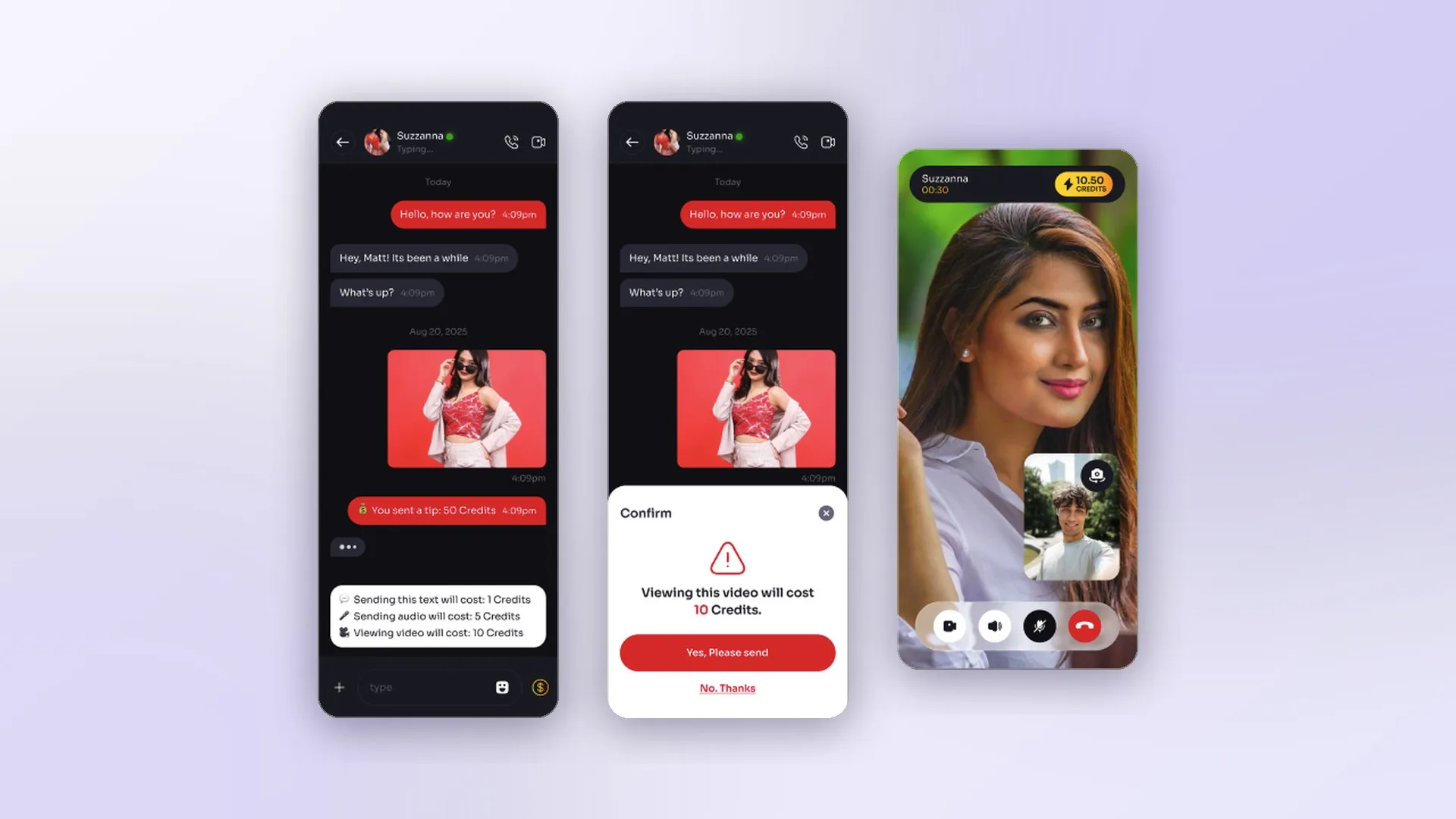
What we built
A creator monetization platform: creators publish to a gated feed, fans buy credits once and spend them on subscriptions, individual post unlocks, direct messages and per-minute audio or video calls. Every transaction writes a commission split to a ledger, earnings clear after a hold period, and creators withdraw through a global payout network covering more than 180 countries. Built in PHP and Laravel with MySQL and a native iOS application.
At a glance
- Client
- A creator platform operator
- Our role
- Full product build: backend, database, payment and wallet architecture, real-time calling, payout pipeline and the native iOS application
- Product type
- Creator subscription and monetization platform
- Revenue models
- Recurring subscription · pay-per-post unlock · paid messaging · paid audio and video calls
- Platforms
- Responsive web · native iOS
- Stack
- PHP · Laravel · MySQL · native iOS
- Integrations
- Agora (real-time audio and video) · MassPay (global creator payouts) · card payments
- Status
- Backend, wallet and payment flow complete and tested in live mode. Remaining work on a new deployment is brand-level interface design.
The video calls were the easy part
Almost everyone who briefs us on a creator platform describes the same two things first: the feed, and the video calling. Both are visible, both demo well, and neither is where these projects fail.
Real-time audio and video are a solved problem you rent. Drop in a mature SDK, handle tokens and channel lifecycle properly, and it works. It is a couple of weeks of careful engineering, not a couple of months.
What is genuinely difficult is money. A creator platform is a payments product that happens to have a social feed on top of it. It takes money from thousands of anonymous buyers in small amounts, splits each of those amounts between two parties, holds one party's share against a chargeback window that outlasts most people's patience, and then pays out to individuals in countries where a bank transfer is not how anyone gets paid. Get that wrong and the platform does not degrade gracefully. It becomes unreconcilable, and you find out during a dispute.
So that is what we built first, and it is what this page is mostly about.
Four ways a creator earns
Most platforms in this category start with one revenue mechanism and bolt the others on later, which is how you end up with four incompatible pricing systems. We implemented all four against a single wallet and a single ledger from the beginning.
| Revenue model | How it works | Priced by |
|---|---|---|
| Subscription | Recurring access to a creator's whole feed for a set period. Renews automatically from the wallet. | The creator |
| Pay-per-post unlock | A single post priced on its own, visible as a locked preview until it is unlocked. Works for creators with no subscriber base yet. | The creator, per post |
| Paid messaging | Direct messages charged per message or per exchange, including paid attachments. | The creator |
| Paid calls | Audio or video calls metered by the minute and debited continuously while the call is connected. | The creator, above a platform minimum |
The fourth row is the one that forces the architecture. A metered call cannot be a card transaction, because you do not know the amount until it ends, and you cannot authorise a card every sixty seconds. It must be a debit against a balance the platform already holds. Once you accept that for calls, it is obviously the right answer for a two-dollar post unlock as well, and you have arrived at a wallet.
One top-up, five ledger entries
A single twenty-dollar top-up does not produce one database update. It produces a chain of events that must remain reconcilable months later, when somebody disputes a charge and you need to say exactly where that money went.
| # | Event | What the system does |
|---|---|---|
| 1 | Credits purchased | The card is charged once. Credits are issued to the fan's wallet, and the fiat sits with the platform as a liability, not as revenue. |
| 2 | Credits spent | A subscription renews, a post unlocks, a message sends or a call ticks over. The wallet is debited at the moment of consumption. |
| 3 | Split written | The same spend writes two entries: the creator's gross earning and the platform's commission. The split is configurable, and it is recorded per transaction rather than recalculated later. |
| 4 | Earnings clear | Creator earnings are held before they become withdrawable. This is not the platform being slow. It is the window in which a card issuer can still reverse the original purchase. |
| 5 | Payout | The creator withdraws. The payout provider settles to a bank account, mobile wallet, cash pickup point or crypto address depending on where the creator is. |
Row four is where most builds are naive. A chargeback can arrive long after the creator has been paid, and if the platform has no hold period it absorbs the loss every single time. Worse, it absorbs it silently, because nothing in the system connects the reversal back to the payout it invalidated.
Why we built a ledger instead of a balance column
The intuitive way to build a wallet is a number on the user record that goes up and down. It works perfectly until the first time someone asks a question about it.
A balance column cannot tell you where a credit came from, which purchase a refund should reverse, why a creator's earnings differ from the sum of their sales, or what the platform owed anybody last Tuesday. It also cannot survive two things happening at once, such as a call debiting per minute while a subscription renews, without either a lock or a bug, and in our experience, it is usually a bug.
So the wallet is a view, not a field. Every event (a purchase, a spend, a commission split, a hold, a release, a refund, a payout) is an immutable row with its own reference. Balances are derived by summing those rows. Nothing is ever edited; a correction is a new entry that points at the old one.
The practical result is that the platform can answer any financial question after the fact, including ones nobody anticipated. That matters commercially more than it sounds. It is what lets an operator respond to a card scheme's enquiry with a straight answer, and it is the difference between a dispute being a nuisance and a dispute being an existential problem.
Live calling, and what a minute costs
Calling runs on Agora. Rather than rehearse the integration, here is the thing people want to know and almost nobody publishes: the running cost.
Agora bills by the minute, per participant, and prices by the aggregate resolution a participant is subscribed to rather than per stream. There is a free allowance before any of it is chargeable.
| Service | Per 1,000 minutes | Notes |
|---|---|---|
| Free allowance, per account | 10,000 minutes / month | Resets monthly |
| Audio | $0.99 | Voice-only rooms and calls |
| HD video, up to 921,600 px | $3.99 | The normal tier for one-to-one calling |
| Full HD, 921,600 to 2,073,600 px | $8.99 | Aggregate, not per stream |
| 2K, 2,073,600 to 3,686,400 px | $15.99 | Rarely needed for this use case |
| Cloud recording, HD | $5.99 | Priced separately from the call itself |
Work a real call through that. A ten-minute one-to-one HD video call involves two participants, so it consumes twenty minutes. Twenty minutes at $3.99 per thousand is roughly eight cents. The free monthly allowance covers around five hundred such calls before a platform pays anything at all.
Put that next to what a creator charges per minute and the point becomes obvious: real-time video is not the cost centre anyone assumes it is, and it should never be the reason a feature is cut. The costs that matter on a platform like this are card processing, chargebacks and payout fees.
Rates are Agora's published prices as of September 2026. Check them before you build a business case on them: vendor pricing moves, and an aggregate-resolution billing model behaves differently from a per-stream one at scale.
Paying creators is a harder problem than charging fans
Taking money is a solved problem with a hundred vendors. Sending money to several thousand individuals scattered across the world, each of whom wants it in a different form, is not.
A creator in the United States wants an ACH deposit. One in the Philippines may want cash pickup. One in Nigeria may want a mobile wallet. One in Argentina may want stablecoin. None of them want to wait three weeks, and every failed payout becomes a support ticket that costs more than the payout.
We integrated MassPay for this, which publishes coverage of more than 180 countries and 80 currencies across bank deposit, mobile wallet, cash pickup and cryptocurrency rails behind one integration. MassPay does not publish rate cards, and payout pricing is quoted per account, so treat it as a commercial conversation rather than a line item you can look up.
On the platform side, a payout is not a transfer instruction. It is a state machine: earnings accrue, clear after the hold period, are requested, are checked against identity and tax requirements, are submitted, and then either settle or fail and return to the balance. Every one of those transitions is a ledger entry, which is why the ledger came first.
Compliance belongs in the build, not in the launch checklist
Content platforms carry obligations that a normal marketplace does not, and several of them are architectural. Bolting them on after launch means rebuilding the parts of the system that touch identity, access and takedown, which is most of it.
Age assurance
In the United Kingdom, the Online Safety Act requires services that allow users to upload or share pornographic content to operate highly effective age assurance, a duty Ofcom brought into force on 25 July 2025. Ofcom's guidance is specific about what does not count: self-declaration is not sufficient, and neither is a payment method that does not itself require the user to be eighteen. A credits purchase is not an age check.
In the United States, the Supreme Court decided Free Speech Coalition v. Paxton on 27 June 2025, upholding Texas's age-verification law by six votes to three under intermediate scrutiny. The Court's own opinion noted that at least twenty-one other states had enacted materially similar requirements, so any US-facing platform is building for a patchwork rather than a single rule.
In the European Union there is no standalone age-verification statute for content platforms, but the Commission is enforcing age assurance through the Digital Services Act's duties on protecting minors. In March 2026 it issued preliminary findings against four major adult platforms, holding that self-declaration is not an effective measure.
Architecturally the consequence is the same everywhere: age assurance has to gate access at the content layer, not at the signup form, and it has to be swappable, because the acceptable methods are still changing.
Card schemes and processors
Which processor will accept you depends on what your platform permits, and that decision must be made before the integration rather than after it.
For mainstream creator platforms such as coaching, fitness, music, education and paid consultation, ordinary processors are usually available. Where a platform permits adult content the position changes sharply. Stripe's published restricted businesses list excludes pornography, adult services and adult live-chat features. Square's payment terms list adult entertainment products and services as an unsupported industry. PayPal's acceptable use policy prohibits obscene material and certain sexually oriented material and requires pre-approval for adult content delivered digitally.
Mastercard operates a Specialty Merchant Registration Program under which non-face-to-face adult content merchants require its prior consent. When Mastercard announced the strengthened requirements in April 2021 it set out what registered merchants must have in place: documented consent from everyone depicted, documented age and identity verification for people depicted and people uploading, a content review process before publication, a complaint process resolving illegal or non-consensual content within seven business days, and an appeals process allowing anyone depicted to request removal.
Those five controls are product features. Consent documentation, uploader verification, a pre-publication review queue and a takedown workflow with a clock on it are things that get designed and built, not things a legal team adds later.
Creator identity
Separately from content rules, anyone receiving payouts has to be verified. That means identity checks at onboarding rather than at first withdrawal, tax documentation collected in the right form for the creator's country, and sanctions screening. Doing it at onboarding is kinder to the creator and much kinder to the support team than discovering a problem at the moment somebody is trying to get paid.
Rules cited above are current as of September 2026 and several are actively moving. Take advice for your own jurisdiction and category. This is a description of what we built against, not legal advice.
What is finished, and what is not
This is worth stating plainly because it is the commercially useful part. The backend is complete. The wallet, the ledger, the four revenue models, the calling integration, the payout pipeline and the admin tooling are all built. The payment flow has been tested in live mode, not just in sandbox, which is a meaningful distinction, because sandbox environments do not produce declines, 3-D Secure challenges or chargebacks. There is a native iOS application.
What a new deployment needs is interface design in your brand, your content policy and age assurance configuration, a merchant account that suits your category, and app store review for the iOS build.
That ordering matters. The merchant account is the step you do not control and the one most likely to delay a launch, so it should be started first, not last. Everything else runs in parallel with it.
Technology
| Layer | What we used, and why |
|---|---|
| Backend | PHP with Laravel. Queues, scheduled jobs and database transactions are first-class, which is what a ledger and a recurring billing cycle need. |
| Database | MySQL, with the wallet modelled as append-only transaction rows rather than mutable balances. |
| Mobile | A native iOS application rather than a wrapper, because calling, background audio and push behaviour are where hybrid builds show their seams. |
| Real-time audio and video | Agora, for one-to-one and group calling, with per-minute metering wired into the wallet. |
| Creator payouts | MassPay, for bank deposit, mobile wallet, cash pickup and cryptocurrency payouts across 180+ countries. |
| Payments | Card payments for credit purchases, tested and live. The acquirer is category-dependent and is selected per deployment. |
Who this is built for
The architecture is category-neutral. Anywhere an individual sells access to their own work and their own time, the same four mechanisms apply: subscription, one-off unlock, paid message, paid call.
We have seen it wanted for fan clubs and membership communities, fitness and nutrition coaching, music and independent media, tutoring and course platforms, and paid professional consultation. Astrology and tarot platforms being a surprisingly large market with exactly this shape.
If your model is brands paying creators for campaigns, this is not that product and we would tell you so. That is an influencer marketing marketplace, and it is a different build.
Frequently asked questions
The questions we get asked most about creator monetization builds.
What is a creator monetization platform?
A creator monetization platform is a subscription and content service where independent creators sell access to their own work and earn directly from their audience rather than from advertising. The common revenue mechanisms are a recurring subscription to a creator's feed, individually priced pay-per-post unlocks, paid direct messaging and paid audio or video calls. The platform takes a commission on each transaction, holds the money until it clears, and pays the remainder out to the creator.
How does a credits and wallet system work on a creator platform?
A fan buys credits once with a card, and those credits sit in a wallet until they are spent on a subscription, an unlock, a message or a call. Decoupling the card charge from the purchase means one payment covers many small transactions, which avoids paying a card fee on every two-dollar unlock and makes per-minute calling practical. Behind the wallet there should be an append-only ledger rather than a balance column: every credit purchased, spent, split, held or paid out is its own immutable row, and the balance is calculated from those rows.
Can this be used to build a platform like OnlyFans, Patreon or Fanvue?
Yes. The mechanics behind those platforms are the same ones this build implements: creator profiles, a gated feed, recurring subscriptions, individually priced posts, a wallet, a commission split and creator payouts. What differs between them is category, brand and policy rather than architecture. Because the backend is already complete and the payment flow has been tested in live mode, a new deployment is mainly a question of interface design, content policy and getting the right merchant account in place for the category you intend to serve.
How much does it cost to add audio and video calling to an app?
Less than most people expect. Agora publishes 10,000 free minutes per account per month, then charges 0.99 US dollars per 1,000 minutes for audio and 3.99 US dollars per 1,000 minutes for HD video, with higher rates above HD resolution and cloud recording priced separately. Because each participant's minutes are counted, a ten-minute one-to-one HD video call uses twenty minutes and costs roughly eight cents. Figures are Agora's published rates as of September 2026 and should be re-checked before you rely on them.
How do creators get paid, and in which countries?
Earnings accrue to the creator's ledger balance as fans spend, become withdrawable after a hold period that protects the platform against chargebacks, and are then paid out through a global payout provider. This build uses MassPay, which publishes coverage of more than 180 countries and 80 currencies across bank deposit, mobile wallet, cash pickup and cryptocurrency rails. MassPay does not publish rate cards, so payout pricing is quoted per account.
Why can I not just use Stripe for a creator platform?
For a mainstream creator platform you often can. The constraint is category. Stripe's published restricted businesses list excludes pornography, adult services and adult live-chat features, and Square's payment terms list adult entertainment products and services as an unsupported industry. PayPal's acceptable use policy prohibits obscene material and certain sexually oriented material, and requires pre-approval for adult content delivered digitally. If your platform permits adult content you will need a specialist acquirer and, on Mastercard, registration under its Specialty Merchant Registration Program. Decide the category before you choose the processor, because it changes the integration.
How long does it take to launch if the backend is already built?
The work that remains on an existing codebase is brand-level interface design, merchant account approval, content policy and age assurance configuration, app store review for the iOS build, and load testing. None of that is trivial, but it is a fraction of building subscriptions, a wallet ledger, metered calling and a payout pipeline from nothing. Timelines depend most on the merchant account, which is the step outside your control and the one worth starting first.
Start from a built platform, not a blank repository
The subscriptions, the wallet, the ledger, the metered calling and the payout pipeline already exist and have been through a live payment flow. If you are planning a creator platform, the useful conversation is not about whether it can be built. It is about which category you are serving, which acquirer will take you, and what it should look like in your brand. We are happy to have that conversation before you have decided to work with us.
Ready to Start Your Project?
Let's discuss how we can help transform your business with our expertise
Send us a message
We respond within 24 hours
Quick Contact
Our Offices
Mohali
Cabin 1, E 279 (Biggbang), Industrial Area, Sector 75, Sahibzada Ajit Singh Nagar, Punjab 140307
Minneapolis
Unit B11, St Louis Park, MN 55426, United States
Moncton
Gordon Street, Moncton, NB E1C 5K9, Canada
Fast Response Guarantee
We respond to all inquiries within 24 hours. Most queries get a response within 2-4 hours during business hours.