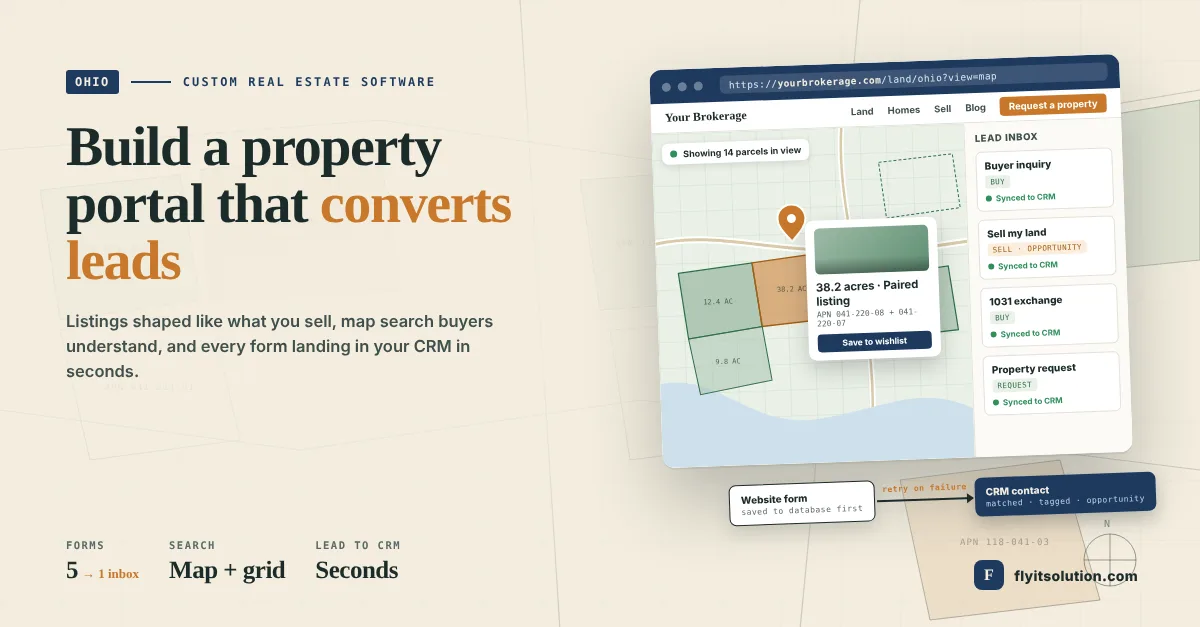
Custom real estate software development in Ohio means building a property portal around the way your business actually sells, not fitting your inventory into a template built for someone else's. A portal that converts leads does four things a template rarely does: it stores listings in the shape of what you sell, it lets buyers search the way they think, it captures every inquiry from every form in one place, and it pushes each one into your CRM without anyone retyping it.
Ohio gives this more urgency than most states. Active listings statewide were 31,489 in March 2026, up 1.9 percent on the year, according to the Ohio REALTORS March 2026 report, and central Ohio inventory was up 6.8 percent in August 2026 with a median of 30 days on market, per Columbus REALTORS. More listings competing for the same buyers means the website that answers fastest wins the inquiry.
This post covers what Ohio brokers, land companies and investors tell us about their current websites, how Ohio's own advertising rule fits, the property portal we built and how it works, what a portal costs, and a six-step plan. If you want the proof first, it is our land property listing and management platform.
What Ohio real estate businesses tell us
Six statements come up in almost every first conversation, from brokerages in Columbus to land sellers in rural counties. Each points to the same gap: the website shows property, but it does not run the sale.
“Our leads come in from five places and we chase them by hand.”
A buyer form, a seller form, a contact page, a listing inquiry and a 1031 exchange question each land in a different inbox, and someone copies them into the CRM on Monday.
What it tells us: lead capture and the CRM are two systems with a person in between. When every form saves to one lead inbox and a server function pushes each lead into the CRM the moment it arrives, the Monday job disappears and so do the leads that used to fall out of it.
“Buyers filter by county, get nothing, and leave.”
A buyer who wants land within an hour of Cincinnati does not know which of six counties to pick, so the dropdown returns nothing useful and the visit ends.
What it tells us: the search is built around your database, not the buyer's head. Buyers think in areas; a map that reloads results as they pan and zoom, with the grid updating beside it, lets them find property the way they already look for it.
“The template can't describe what we actually sell.”
Rural land has no street address, a parcel has an APN and a boundary, and two adjoining parcels sell together at one price while each keeps its own acreage. A template built for three-bedroom houses has nowhere to put any of that.
What it tells us: the listing data model is wrong for the inventory. A custom portal stores the parcel as the source of truth, with APN, county, acreage, boundary and media, and lets a listing reference one parcel or group several under one page and one price.
“Someone filled in the form on Friday and we found out on Monday.”
The form emailed a shared inbox, the email went to a folder, and by Monday the buyer had spoken to someone else.
What it tells us: the form is the end of the website's job instead of the start of the sales process. A portal that stores the lead first, syncs it to the CRM second and retries if the CRM is down turns a Friday form into a Friday contact with a tag and an owner.
“The brokerage name is missing from half the pages.”
Agent pages were added over time, a landing page was built by a marketing contractor, and nobody checked whether the brokerage name appears on each one or when the site was last updated.
What it tells us: compliance is being handled page by page instead of once in the template. Ohio's advertising rule, covered below, is met at the template level in a custom build: the brokerage name lives in the shared header or footer and the CMS maintains the last-updated date.
“We pay for a website, a CRM and a blog tool, and none of them talk.”
Listings are updated in one place, blog posts in another, press coverage is a PDF somewhere, and the CRM has its own copy of every contact.
What it tells us: the business runs on three admin panels. One portal with role-based access lets staff publish listings, leads and content from the same admin, while the CRM stays the system of record for contacts and receives every lead automatically.
How Ohio's website rules fit
Ohio Administrative Code 1301:5-1-02 sets the advertising rules for real estate licensees, and it reaches websites directly. In summary: all internet advertising of real estate services must show the brokerage name on every viewable web page; on sites the licensee owns or controls the brokerage name must appear with equal prominence to the salesperson's name; a licensee's own website must show the date its information was most recently updated; and outdated or expired information must be updated within fourteen days. The rule itself is Ohio Administrative Code 1301:5-1-02.
A custom portal does not make a brokerage compliant, but it removes the page-by-page work. The brokerage name sits in one shared layout component, so every listing, agent and blog page carries it automatically; the CMS writes the last-updated date when staff save a change; and listings that expire are archived from the admin rather than left live. Confirm your own obligations with the Ohio Division of Real Estate and Professional Licensing or your counsel; this paragraph is a summary, not legal advice, and the rule applies to licensees rather than to unlicensed land sellers.
What a property portal that converts leads contains
A lead-converting property portal is one system that takes a property from record to listing to inquiry to CRM contact, with every role seeing its own view. These are the parts, in the order a buyer meets them.
A listing model that matches the inventory. Houses carry an address; parcels carry an APN, state, county, acreage, boundary, photos and video; groups of parcels sell as one listing without losing each parcel's data.
Map plus grid search. Buyers browse a grid, a map, or both side by side, and panning or zooming the map requests only the properties in view and updates the grid.
Buyer accounts, wishlists and property requests. Logged-in buyers save listings and describe the property they want, and staff see those requests alongside leads.
One lead inbox for every form. Every website form saves to the portal's own database with filtering and follow-up, so no inquiry depends on an email arriving.
CRM sync built for failure. Leads are matched to existing contacts by email or phone, tagged by type, and sellers open a pipeline opportunity with the asking price and property details filled in; failed syncs retry.
Role-based admin. Admin manages users and settings, staff manage properties, leads and content, clients see only their own account, and permissions are enforced on the server.
A CMS on the same domain. Blog posts, press coverage and announcements publish from the same admin as listings, which keeps content and inventory on one site for search engines.
Template-level compliance. Brokerage name, disclosures and the last-updated date live in the layout, not on individual pages.
If your leads already flow into GoHighLevel or another CRM, the integration pattern is the part most agencies get wrong, and we have written it up step by step in website forms to GoHighLevel in real time.
The solution we implemented: a land property portal with map search and CRM sync
We built a full-stack property portal for a US land sales company that buys and sells parcels, and it is live in production today. The company had the first four problems above in exactly those words: parcels without addresses, land sold in pieces or together, leads from five forms landing in five places, and buyers who search by region rather than by county dropdown.
The build is React on the front end, Supabase for the database, authentication and server functions, the Google Maps JavaScript API for boundaries and search, embedded Land id maps on listings, and the GoHighLevel API for lead sync. Three roles, Admin, Staff and Client, each see their own interface, and permissions are enforced on the server rather than only hidden in the UI.
A property moves through it in six steps. Staff create the parcel record with APN, state, county, acreage, photos, video, boundary and Land id map in one form; the parcel becomes an individual listing or a paired listing that groups neighboring parcels under one price; buyers find it on a map that stays in sync with the grid; logged-in buyers save it to a wishlist or submit a property request; every inquiry from all five forms saves to the platform's database first; and buy and sell leads reach GoHighLevel matched, tagged and, for sellers, with a pipeline opportunity already filled in.
Four decisions made it hold up. Listings reference parcels instead of copying them, so there are no duplicate APNs and no data drift; the server returns only properties inside the map's edges, so the browser never loads the whole inventory; leads are saved before they are synced, with visible sync status and automatic retries, so a CRM outage does not lose a lead; and CRM credentials stay on the server and never reach the browser.
The result is one inbox for five forms, every property carrying its APN, county, acreage and boundary, grouped land selling as one property without losing parcel data, buyers browsing by region, and the team publishing blogs, press and announcements from the same admin. The client rated the engagement 5.0 out of 5 on Upwork; the full case study has screenshots and the complete feature list.
Custom portal or template website?
Use a template if you sell standard homes, your leads arrive from one form, and your CRM already has a plug-in for the platform. Build custom when the inventory does not fit an address, when leads come from several forms and must reach the CRM on their own, when buyers need map search over your own listings, or when staff with different permissions need to run the site from one admin.
The decision is the same one agencies face in other fast markets; we wrote about the seven signs in real estate website development in Dubai, and the signs translate directly to Ohio. If the CRM itself is the weak point rather than the website, start with what custom CRM software development is and the custom CRM software development service page.
What a custom property portal costs and how long it takes
A portal is quoted after a free discovery call, in writing within 24 hours, because the price follows the listing model, the search and the number of integrations rather than a menu. Fixed-price and hourly billing are both available, and you own the code and the deployment.
Most portals should start as an MVP: one listing type, search, the forms and the CRM sync, in production and taking leads before wishlists, requests and the CMS follow. Our MVP software development engagements typically run four to six weeks, with weekly progress reports from kick-off.
A six-step plan to a portal that converts
The order matters more than the speed, and the first two steps need no developer at all.
1. Count your lead sources and where each one lands. List every form, phone line, portal and inbox a buyer or seller can reach you through, and write down where each inquiry ends up today. The gap between those two lists is the first thing the portal closes.
2. Decide what a listing is for your business. A house has an address; a parcel has an APN, a county and a boundary; a development has units and phases. Write the fields a listing must carry before any design work, because the data model decides what the search can do.
3. Choose the search buyers actually use. If your buyers think in areas, build a map that reloads results as they pan and keep a grid in sync with it; if they think in specifications, lead with filters. Test the choice with three real buyers before building it.
4. Connect the CRM so every lead is stored first. Each form writes to the portal's own database, then a server function creates or updates the CRM contact, tags the lead and opens an opportunity for sellers. Failed syncs retry, and credentials stay on the server.
5. Build Ohio's website rules into the template. Put the brokerage name in the shared header or footer so it appears on every viewable page, and show a last-updated date that the CMS maintains, so the rule's fourteen-day update window is met without anyone remembering it.
6. Launch one listing type and measure form-to-contact time. Go live with your main listing type, map search, the forms and the CRM sync, then measure how long a submitted form takes to become a CRM contact and how many inquiries convert to a conversation. Add wishlists, property requests and the CMS in the following release.
Real estate software development in Ohio: how we work here
Fly IT Solution is a software development company in Ohio with a consultant in Westerville, in the Columbus metro area. Karrie Short meets brokers, land companies and investors in person across central Ohio, or by video from Cleveland, Cincinnati, Dayton, Toledo or Akron, to walk through one property from record to lead.
Projects start within 48 hours of agreement. Our engineering teams in Minneapolis and Mohali build and maintain the portal, with weekly reports and a named consultant in Ohio as your point of contact.
If one of the six statements at the top sounded like your business, talk to Karrie. Bring one listing and one lead, in whatever form they exist today, and we will trace where each one goes; it is the most useful thing for a first conversation.
Frequently asked questions
What is custom real estate software development?
Custom real estate software development is building a property platform around the way one brokerage, land company or investor actually sells, instead of fitting that business into a template. It usually covers a listing data model that matches the inventory, map or filter search, buyer accounts, lead capture from every form on the site, a CRM connection, and a content section, all managed from one admin with role-based access.
How much does a custom property portal cost in Ohio?
It depends on the listing model, the search, and the number of integrations, so we quote in writing within 24 hours of a free discovery call rather than publishing a flat price. Most portals start as an MVP, which is one listing type, search, forms and CRM sync, and our MVP engagements typically run four to six weeks. Fixed-price and hourly billing are both available, and you own the code.
Do I need IDX or MLS integration for a property portal?
Only if you sell listings that live in an MLS, which a brokerage marketing other members' listings usually does and a land company, builder or investor selling its own inventory usually does not. The portal we describe in this post ran on the company's own parcel inventory with no MLS feed. Where an IDX or MLS feed is required, it is scoped in discovery as a data integration alongside the CRM.
How does a property portal connect to GoHighLevel or another CRM?
Every form saves to the portal's own database first, then a private server function sends the lead to the CRM: it matches existing contacts by email or phone, tags the lead by type, and for sellers opens a pipeline opportunity with the property details filled in. If the CRM is unavailable the sync retries, so no lead is lost, and the CRM credentials never reach the visitor's browser.
What does Ohio require on a real estate website?
Ohio Administrative Code 1301:5-1-02 requires the brokerage name on every viewable page of a licensee's internet advertising, with equal prominence to the salesperson's name on sites the licensee controls, a last-updated date on the licensee's own website, and updates to outdated or expired information within fourteen days. A custom portal meets this at the template level: the brokerage name sits in the shared header or footer and the CMS maintains the last-updated date. Confirm your own obligations with the Division of Real Estate or your counsel.
Custom portal or a template real estate website?
Use a template if you sell standard homes, your leads come from one form, and your CRM has a plug-in for it. Build custom when the inventory does not fit an address-based template, when leads arrive from several forms and need to reach the CRM automatically, when buyers need map search over your own inventory, or when the site must be managed by staff with different permissions. The signs that it is time to move are the six statements at the top of this post.
Does Fly IT Solution build real estate software in Ohio?
Yes, with a software consultant, Karrie Short, in Westerville in the Columbus metro area and engineering teams in Minneapolis and Mohali. Projects start within 48 hours of agreement, with weekly progress reports, fixed-price or hourly billing and full code ownership. The property portal described in this post, with parcel records, map search, client accounts and GoHighLevel lead sync, is live in production for a US land sales company and is documented in our portfolio.