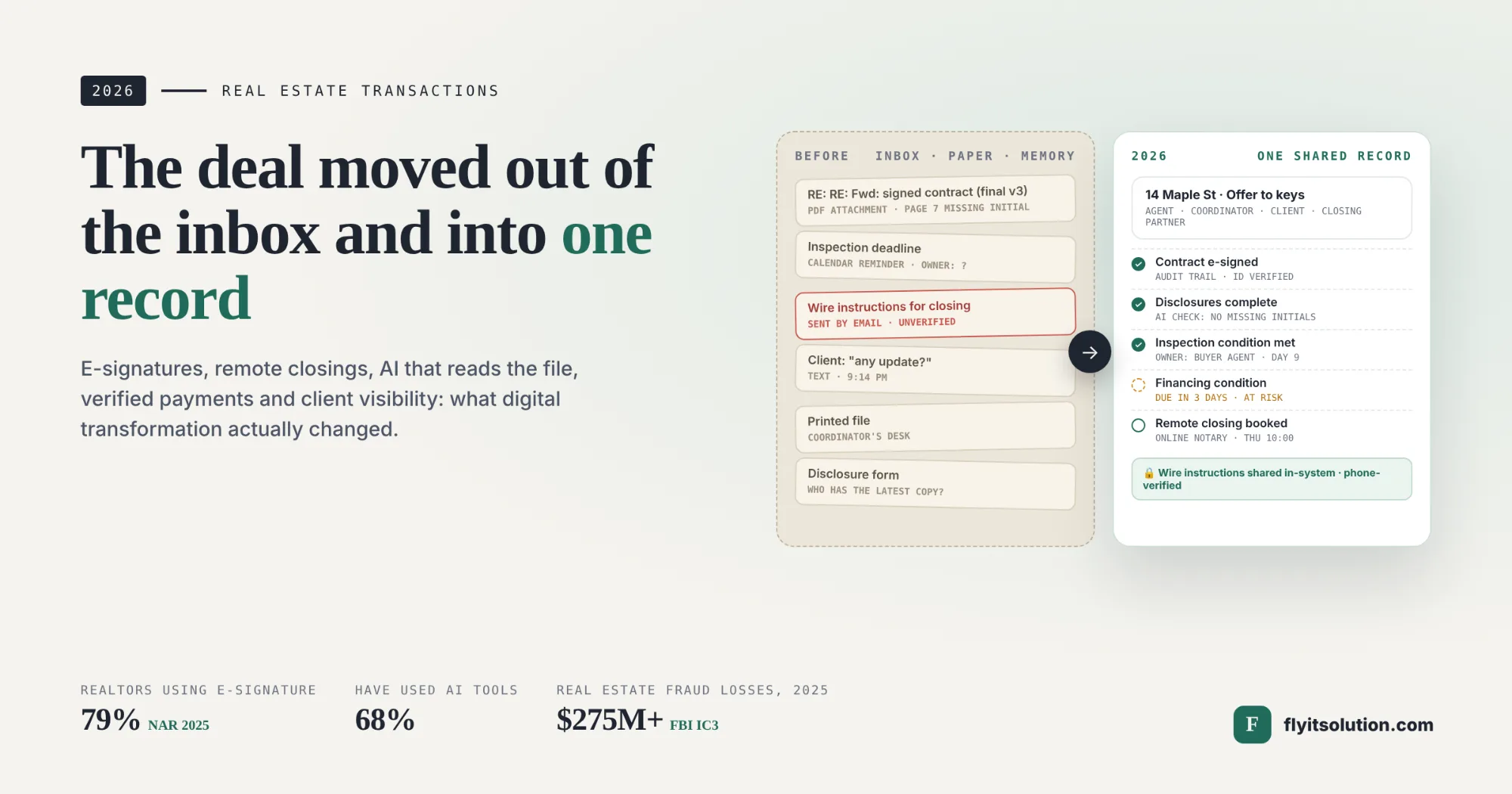
Digital transformation is changing real estate transaction management in 2026 by moving the deal out of email, paper and memory and into one shared, verified record that every party can see. Signatures, notarization, deadlines, document checks and payment instructions now happen inside that record, which makes transactions faster, harder to defraud and easier for clients to follow.
This post explains what that means in plain language: the problem the old way created, the six changes that define 2026, what has not changed, how to start, and the questions people ask most.
What transaction management is, and why it was a problem
Transaction management is everything between an accepted offer and the keys: contracts, disclosures, inspections, financing conditions, deadlines, signatures, deposits and closing documents, plus the people responsible for each.
For most of the industry's history, that work lived in an agent's inbox. The contract was a PDF attachment, the deadline was a calendar reminder, the deposit instructions were an email, and the file was whatever the coordinator had printed.
The problem was not effort. It was that nothing was in one place, so a missed signature, a forgotten condition or a fake wire instruction could sit unnoticed until it cost someone money.
The six changes that define 2026
1. Documents are signed electronically by default
E-signature is now the normal way to execute a real estate contract. NAR's 2025 Technology Survey found 79 percent of REALTORS use e-signature tools, the most used technology in the survey, per Housing Wire's summary of NAR's 2025 Technology Survey.
The change is bigger than convenience. A signed document now carries a time stamp, an audit trail and an identity check, which paper never did.
2. Closings can happen remotely
Remote online notarization lets a notary witness a signature over video, and it is now permitted in most US states. Combined with electronic closing documents, a buyer can complete a purchase without visiting an office.
The rules differ by state and by document, so remote closing is not universal yet. But in 2026 it is an option in most transactions rather than an exception.
3. The file lives in one shared place
The biggest shift is structural. Instead of each party keeping its own version, the transaction has one record with every document, deadline and approval in it, and the agent, coordinator, client and closing partner see the same thing.
When a condition is met, everyone knows. When a deadline is at risk, it is visible before it is missed.
4. AI reads the documents before people do
AI in transaction management is mostly about reading, not deciding. It pulls dates and conditions out of a contract, flags a missing initial or disclosure, summarizes an inspection report and drafts the status update.
The same NAR survey found 68 percent of REALTORS had used AI tools, mostly for content and communication. Document review is the newer use, and it still needs a person to check the result.
5. Money moves only after verification
Wire fraud is the reason this change matters most. The FBI's Internet Crime Complaint Center recorded more than $275 million in real estate fraud losses from 12,368 complaints in 2025, according to NAR's report on the FBI's 2025 figures, most of it tied to diverted closing funds.
The digital response is simple: wire instructions are shared inside a verified system rather than by email, the buyer confirms them by phone to a known number, and identities are checked before closing. The process records who sent what and when.
6. Clients can see progress without asking
Buyers and sellers now expect the same visibility they get from a parcel or a food order. A client portal that shows which step the deal is at, what is waiting on them and what comes next replaces the weekly phone call for an update.
This changes the agent's job less than people fear. The agent still explains and negotiates; the portal just answers the question the client would otherwise have texted at 9 pm.
What has not changed
The law has not changed. A contract still needs the right parties, terms and signatures, and some documents still have state-specific rules; the post on custom real estate software development in Ohio covers one state's advertising rules as an example of how local they can be.
Judgment has not changed. Software can flag a missing disclosure; it cannot decide whether to walk away from a deal. The people in the transaction are still the point of it.
And the hardest part has not changed either: getting every system to agree on one record. Listing data, the CRM, the e-signature tool and the closing partner each hold a piece, and connecting them is where most digital projects actually spend their time. The post on how a lead becomes a CRM contact without retyping shows what that connection looks like for the first step of the journey.
What it means for agents, brokerages and clients
| Who | What changes in practice |
|---|---|
| Agents | Less chasing signatures and status; more time on pricing, negotiation and advice. The audit trail also protects them in a dispute. |
| Brokerages | One record per transaction means compliance review, reporting and training all get easier, and the risk of a wire-fraud loss drops when verification is built into the process. |
| Transaction coordinators | The role shifts from collecting documents to managing exceptions: the file that is stuck, the deadline at risk, the condition nobody has met. |
| Buyers and sellers | Fewer in-person appointments, clearer timelines, and a safe channel for payment instructions. |
How to start, without buying anything first
The order matters more than the tools. These five steps work for a two-agent team and a two-hundred-agent brokerage alike.
1. Map one transaction from offer to keys. Write down every document, approval, payment and hand-off in a recent deal, and who did each one. Most teams find more than thirty steps and at least five places where the file lives.
2. Pick the one hand-off that fails most often. Usually it is a missing signature, a deadline nobody owned, or wire instructions sent by email. Fix that one first; it proves the approach to the team.
3. Put every document and deadline in one shared file. One place per transaction that the agent, the coordinator, the client and the closing partner can all see, with a single checklist of deadlines.
4. Add verification before money moves. A phone call to a known number and identity verification before any wire, every time, written into the process rather than left to memory.
5. Measure days to close and errors per file. Track how long each stage takes and how many files need a correction. The numbers show which step to digitize next.
Markets with faster cycles have been through this already; the post on real estate website development in Dubai describes what agencies there asked for once the basics were in place, and what custom CRM software development is explains the system most brokerages end up connecting everything to.
Where Fly IT Solution fits
We are a custom software company, and most of the brokerages and property businesses we talk to do not need new software first. They need the map from step one above, and an honest view of which hand-offs are worth automating.
If you want that map, map your transaction process with us. Bring one recent deal's paperwork, from offer to keys; a free consultation is enough to trace where the file breaks, and you keep the map whatever you decide to do next.
Frequently asked questions
What is real estate transaction management?
Real estate transaction management is everything that happens between an accepted offer and the keys changing hands: contracts, disclosures, inspections, financing conditions, deadlines, signatures, deposits, closing documents and the people responsible for each. Digital transaction management means those steps are tracked and completed in a shared online system rather than in email, paper and separate spreadsheets.
What has changed in real estate transactions in 2026?
Six things: most documents are now signed electronically, remote online notarization and electronic closings are available in most US states, the transaction file lives in one shared place instead of an inbox, AI reads and summarizes documents and flags missing items, verification steps protect against wire fraud, and clients expect to see progress themselves instead of asking for an update.
Are electronic signatures legal for real estate contracts?
Yes, in the United States under the federal ESIGN Act and state UETA laws, and in most other countries under equivalent legislation. Some documents, such as certain deeds and notarized instruments, have extra rules that vary by state, which is why remote online notarization laws matter. Check your state's requirements for the specific document.
How is AI used in real estate transaction management?
Mostly for reading and checking rather than deciding: extracting dates and conditions from a contract, flagging a missing initial or disclosure, summarizing an inspection report, drafting a status update, and predicting which deadline is at risk. NAR's 2025 Technology Survey found 68 percent of REALTORS had used AI tools, mainly for content and communication; AI that reviews transaction documents is newer and should always be checked by a person.
How does digital transaction management reduce wire fraud?
By taking wire instructions out of email. Instructions are shared inside a verified system, the buyer confirms them by phone to a known number, identities are verified before closing, and the process records who sent what and when. The FBI's IC3 report counted more than $275 million in real estate fraud losses in 2025, most of it tied to diverted wires, which is why this step matters more than any other.
Does a small brokerage need custom software for this?
Usually not at first, because most teams start with the tools they already have and a clearer process. Custom software makes sense when the brokerage runs a workflow that off-the-shelf tools cannot model, when several systems must share one transaction record, or when the business wants its own client portal. The first step is mapping the process, not choosing a product.