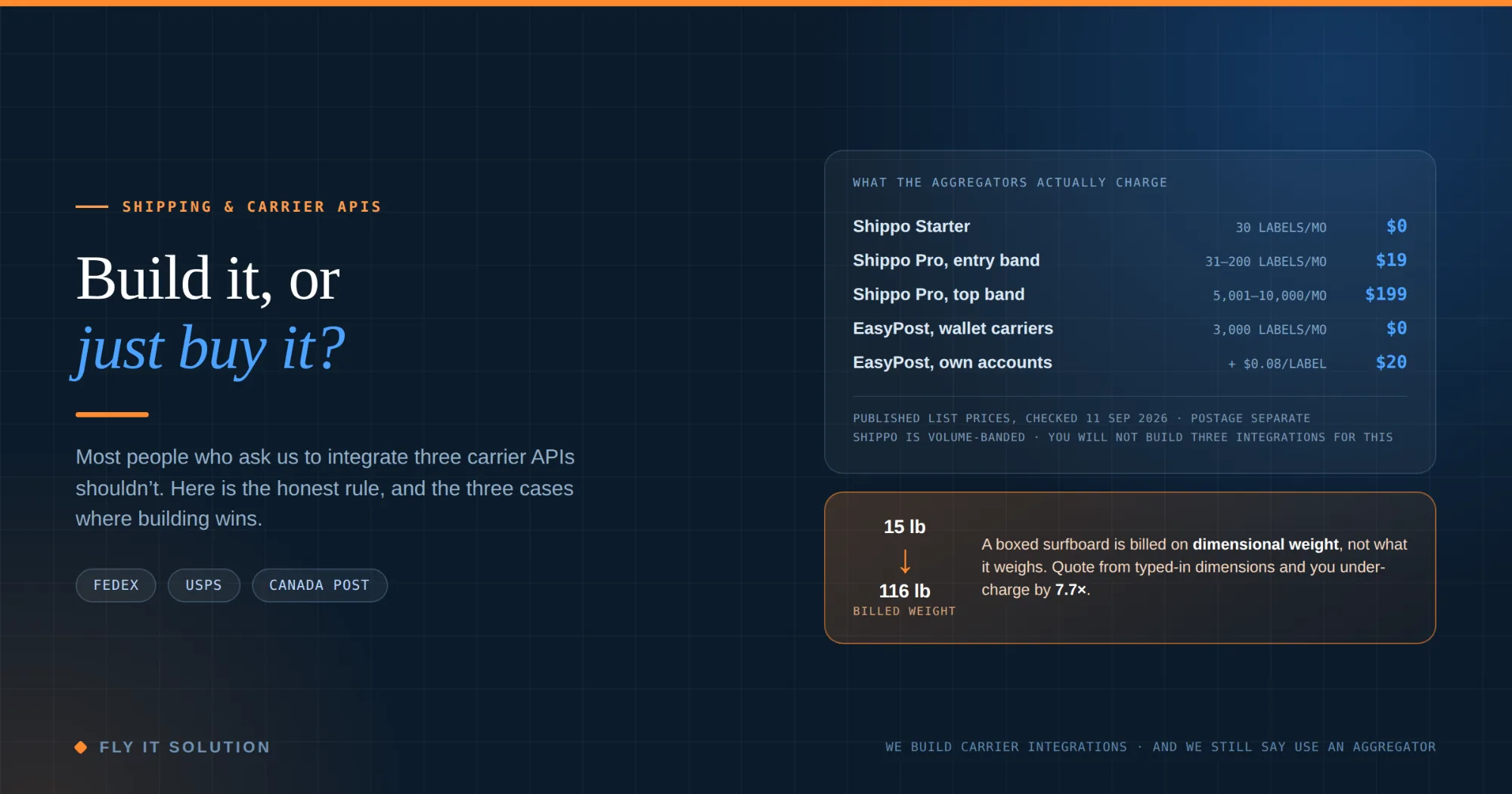
| Short answer: Most businesses should use an aggregator. Both Shippo and EasyPost start free — Shippo covers 30 labels a month at $0, and EasyPost covers up to 3,000 labels a month free on its own carrier accounts. Paid tiers are volume-banded: Shippo runs from $19 a month up to $199 at 10,000 labels, and EasyPost charges $20 a month plus $0.08 a label to bring your own carrier accounts. Against that, integrating FedEx, USPS and Canada Post yourself is months of work you will maintain forever. Direct integration earns its keep in three specific situations: you have negotiated carrier rates worth protecting, your shipping flow is not a normal shipping flow, or label volume makes per-label fees the largest line in your bill. If none of those describe you, buy. We build these systems and we still say that. |
|---|
Every few weeks someone asks us to "integrate the shipping APIs". It is almost always the wrong first question.
The right one is whether you should be touching carrier APIs at all, because there are three ways to solve this and only one of them involves your engineers writing carrier code.
The three options, honestly described
Use a shipping aggregator. Shippo, EasyPost, ShipEngine and others sit between you and the carriers. You integrate once, they maintain the carrier connections, and you get rates, labels and tracking through a single interface. This is the default and it is the right answer more often than any agency will tell you.
Buy a platform. Shipping functionality inside a broader e-commerce or warehouse system you already run. Least work, least control, and fine until your process stops looking like the process the vendor imagined.
Integrate the carriers directly. You talk to FedEx, USPS and Canada Post yourself. Total control, no middle layer, no per-label fee — and every ounce of the maintenance is yours.
What aggregators actually cost
Published list prices from the vendors' own pricing pages, checked 11 September 2026. Carrier postage is separate in all cases these are platform fees on top of what you pay the carrier. Note that Shippo's paid plan is volume-banded rather than a single price, which is the detail most comparisons get wrong.
| Plan | Monthly | Labels included | Beyond |
|---|---|---|---|
| Shippo Starter | $0 | Up to 30/month | 5c/label on own carrier acct |
| Shippo Pro, entry band | $19 | 31–200/month | $17/mo equivalent annually |
| Shippo Pro, mid band | $79 | 1,001–2,500/month | Bands step at 500/1k/2.5k/5k |
| Shippo Pro, top band | $199 | 5,001–10,000/month | $0.08/label beyond 10,000 |
| EasyPost, wallet carriers | $0 | Up to 3,000/month | Their carrier accounts only |
| EasyPost, own accounts | $20 | — | Plus $0.08/label |
| EasyPost Tracking API | — | — | $0.01–$0.03/shipment |
Work your own volume through that before you commission anything. A business shipping 2,000 parcels a month sits on Shippo's $79 band about $950 a year or pays nothing at all on EasyPost's wallet carriers, since 2,000 is inside the free 3,000-label monthly allowance. Even at the top of Shippo's published range, 10,000 labels a month is $199, or roughly $2,400 a year. You will not build, test and maintain three carrier integrations for that.
Four things the table does not show, and they all push the real figure up. Shippo bills API calls that are not attached to a Shippo label rating, tracking, address validation separately at its API rates, so a rate-shopping-heavy application costs meaningfully more than its label count suggests. Shippo's Starter plan also charges 5 cents a label if you use your own carrier account, which is free on paid plans. EasyPost's free allowance is conditional on using EasyPost's own wallet carrier accounts, and it resets monthly rather than being a one-off. And exceeding a Shippo plan allowance does not trigger an overage charge it moves you up a band automatically, so the bill steps rather than creeps.
What building costs you
Not money. Attention, indefinitely.
Nobody who has integrated one carrier is surprised by the next one. The surprise is that the three carriers agree on almost nothing:
Authentication differs per carrier, and rotates on their schedule rather than yours.
Address validation has its own rules, its own idea of what a valid address is, and its own opinions about apartment numbers.
Service levels are named differently everywhere. Normalising "2-day" across three carriers so a customer sees one comparable list is real design work, not a mapping table you write once.
Label formats vary by carrier and by printer, and they are exacting.
Tracking arrives by webhook, by polling, or by both, with different event vocabularies.
The APIs change. Carriers deprecate versions and reissue credentials on their own timetable. Your integration is not finished when it ships; it is finished when you stop shipping.
None of this is hard. All of it is permanent. That is the actual trade.
The thing that breaks shipping quotes: dimensional weight
This one deserves its own section because it silently wrecks more shipping features than every API quirk combined.
Carriers do not bill on what a parcel weighs. They bill on the greater of actual weight and dimensional weight a volume figure calculated as length x width x height divided by a DIM divisor.
The divisor is not one number, which trips people up. FedEx divides by 139 for US, Puerto Rico and international shipments. UPS uses 139 for Daily Rates but 166 for Retail Rates. Negotiated contracts often differ again, so check your own rate agreement rather than assuming. Rounding differs too: FedEx rounds each measurement to the nearest whole inch before multiplying, while UPS rounds the resulting weight up to the next whole pound.
Flat-rate products such as FedEx One Rate and UPS Simple Rate sit outside dimensional pricing entirely.
Here is what that does to real parcels, using 139
| Item | Box (inches) | Actual | Billed on | Multiple |
|---|---|---|---|---|
| Longboard surfboard | 84 x 24 x 8 | 15 lb | 116 lb | 7.7x |
| Shortboard | 76 x 22 x 7 | 12 lb | 84 lb | 7.0x |
| Boxed bicycle | 54 x 30 x 9 | 28 lb | 105 lb | 3.7x |
| Framed artwork | 40 x 30 x 6 | 9 lb | 52 lb | 5.8x |
| Shoebox | 13 x 9 x 5 | 3 lb | 4 lb | 1.4x |
A surfboard weighs fifteen pounds and ships as a hundred and sixteen.
| Any quote built from customer-entered dimensions is a guess, and for bulky-light items it is a wildly optimistic one. If your product ships shoeboxes, you can get away with it. If it ships anything long, flat or awkward, a quoting feature that trusts typed-in measurements will under-quote, and someone eats the difference. |
|---|
The fix is not a better form. It is to price properly at the point where you physically have the parcel and can measure it.
When an aggregator is the right answer
Most of the time. Specifically:
You ship normally parcels go from you to a customer, one leg, standard services.
Your volume is modest, or steady enough that per-label fees stay small relative to engineering time.
You have no negotiated carrier rates worth protecting.
You have no in-house engineer who wants to own carrier credentials for the next five years.
You want to add a fourth carrier without a project.
If you recognise yourself in that list, buy the aggregator and spend the saved months on the part of your business that is actually yours.
When direct integration earns its place
Three situations, and they are narrower than most vendors admit.
You have negotiated rates. If you have fought for your own carrier pricing, you want it applied exactly, on your own accounts, without a layer in between deciding how to present it. Aggregators support this it is what EasyPost's bring-your-own-carrier tier is for but the closer you are to the carrier, the less translation happens.
Your flow is not a normal flow. This is the big one. Aggregators are built around the assumption that a parcel goes from a sender to a recipient. The moment your model involves multiple legs, a warehouse in the middle, re-measuring on arrival, pricing a second leg separately, or splitting charges between parties, you are no longer using the product the way it was designed. You will spend more energy bending it than you would writing the integration.
Per-label fees have become your biggest line. At eight cents a label, 100,000 labels a month is $8,000. At that volume you would be on custom enterprise pricing rather than list, so treat the figure as directional but the shape holds. There is a volume at which owning the integration is simply cheaper, and it is worth knowing roughly where your crossover sits before you scale into it.
A decision table you can actually use
| If this is true | Do this |
|---|---|
| Standard parcels, modest volume, no negotiated rates | Use an aggregator |
| You need it working next month | Use an aggregator |
| Shipping is a feature of a product you already run | Buy the platform capability |
| Multi-leg routing, warehouse in the middle, re-quoting on arrival | Integrate directly |
| Negotiated rates you need applied precisely | Integrate directly, or bring your own accounts to an aggregator |
| Very high label volume | Model both; the crossover is real |
| You are not sure | Use an aggregator. You can always move later; you cannot un-spend four months |
What we built, and why it was the direct route
We built a multi-carrier shipping platform on Laravel integrating FedEx, USPS and Canada Post directly, with virtual warehouse addresses across two US locations and one in Canada.
It qualified on the second test. The flow was not a normal flow: an order a store will not deliver goes to a virtual warehouse address, gets checked in, is re-measured on arrival, and the onward leg is quoted from the real parcel before it moves. That middle step physically measuring what turned up, then pricing the second leg is exactly what the dimensional weight table above demands, and it is not a shape an aggregator is built around.
The project also started from a trust problem rather than a technical one: customers suspected the delivery charge included a markup, and the only durable answer was to stop quoting a single number and show live rates from three carriers instead.
Frequently asked questions
Should I use a shipping aggregator or integrate carriers directly?
Use an aggregator unless one of three things is true: you have negotiated carrier rates you need applied precisely, your shipping flow is not a standard sender-to-recipient parcel movement, or your label volume makes per-label fees your largest cost. Aggregators start free, and even at 10,000 labels a month the published platform fee is around $199 — far less than building and maintaining three carrier integrations.
How much does a shipping API cost?
Platform fees are separate from carrier postage. As of September 2026, Shippo publishes a free Starter plan covering 30 labels a month, then a volume-banded Pro plan running from $19 a month for 31 to 200 labels up to $199 a month for 5,001 to 10,000 labels, with $0.08 per label beyond 10,000. EasyPost publishes free access for up to 3,000 labels a month using its own wallet carrier accounts, and $20 a month plus $0.08 per label to bring your own carrier accounts.
What is dimensional weight and why does it matter for shipping quotes?
Carriers bill on the greater of a parcel's actual weight and its dimensional weight, calculated as length x width x height divided by a DIM divisor. FedEx divides by 139; UPS uses 139 for Daily Rates and 166 for Retail Rates, and negotiated contracts vary. Using 139, a boxed surfboard weighing 15 lb has a dimensional weight of about 116 lb and is billed on the larger figure. Any quote built from customer-entered dimensions will therefore under-quote bulky-light items, sometimes by a factor of seven.
How long does it take to integrate FedEx, USPS and Canada Post?
Longer than the API documentation suggests, and it never entirely ends. Each carrier has its own authentication, address validation rules, service-level naming, label format and tracking mechanism, and each deprecates and reissues on its own schedule. The build is a project; the maintenance is permanent. That ongoing ownership, not the initial development, is what you are really deciding about.
Can I use my own negotiated carrier rates with an aggregator?
Usually yes. EasyPost, for example, publishes a bring-your-own-carrier-accounts tier at $20 a month plus $0.08 per label, which applies your contracted pricing rather than the aggregator's. Shippo supports your own carrier accounts too, though its Starter plan charges 5 cents a label to do so. Confirm with the specific vendor, because which carriers and which account types are supported varies.
When is a shipping aggregator the wrong choice?
When your model is not one parcel going from a sender to a recipient. Multi-leg routing, a warehouse in the middle, re-measuring a parcel on arrival, quoting a second leg separately, or splitting charges between parties all sit outside what aggregators are designed around. At that point you spend more effort working around the product than you would integrating the carriers yourself.
The bottom line
The honest position from a company that builds carrier integrations: most people asking for one do not need one.
Aggregators are cheap, quick and maintained by someone else, and for standard parcel shipping they win comfortably. Direct integration is for negotiated rates, unusual flows and serious volume — and if you are in that third category you already know it, because you have been fighting a tool that was not built for your process.
If you are not sure which one you are, that uncertainty is itself the answer. Start with the aggregator.
Fly IT Solution builds custom software and white-label platforms from Mohali, India and Minneapolis, Minnesota, with more than a decade of delivery across logistics, e-commerce, healthcare, EdTech and field services. We have integrated FedEx, USPS and Canada Post directly for a shipping and package forwarding operator, and we have also told clients to use an aggregator instead.
Aggregator prices above are list prices published by those vendors and were checked on 11 September 2026; they change, and your quoted price may differ. Dimensional weight divisors vary by carrier, rate type and contract — verify yours with your carrier rather than relying on a published figure. Carrier rate guides and aggregator pricing both carry effective dates and can change at short notice. This is general commercial guidance, not shipping or financial advice.
Sources: Shippo published pricing, goshippo.com/pricing; EasyPost published pricing, easypost.com/pricing.