
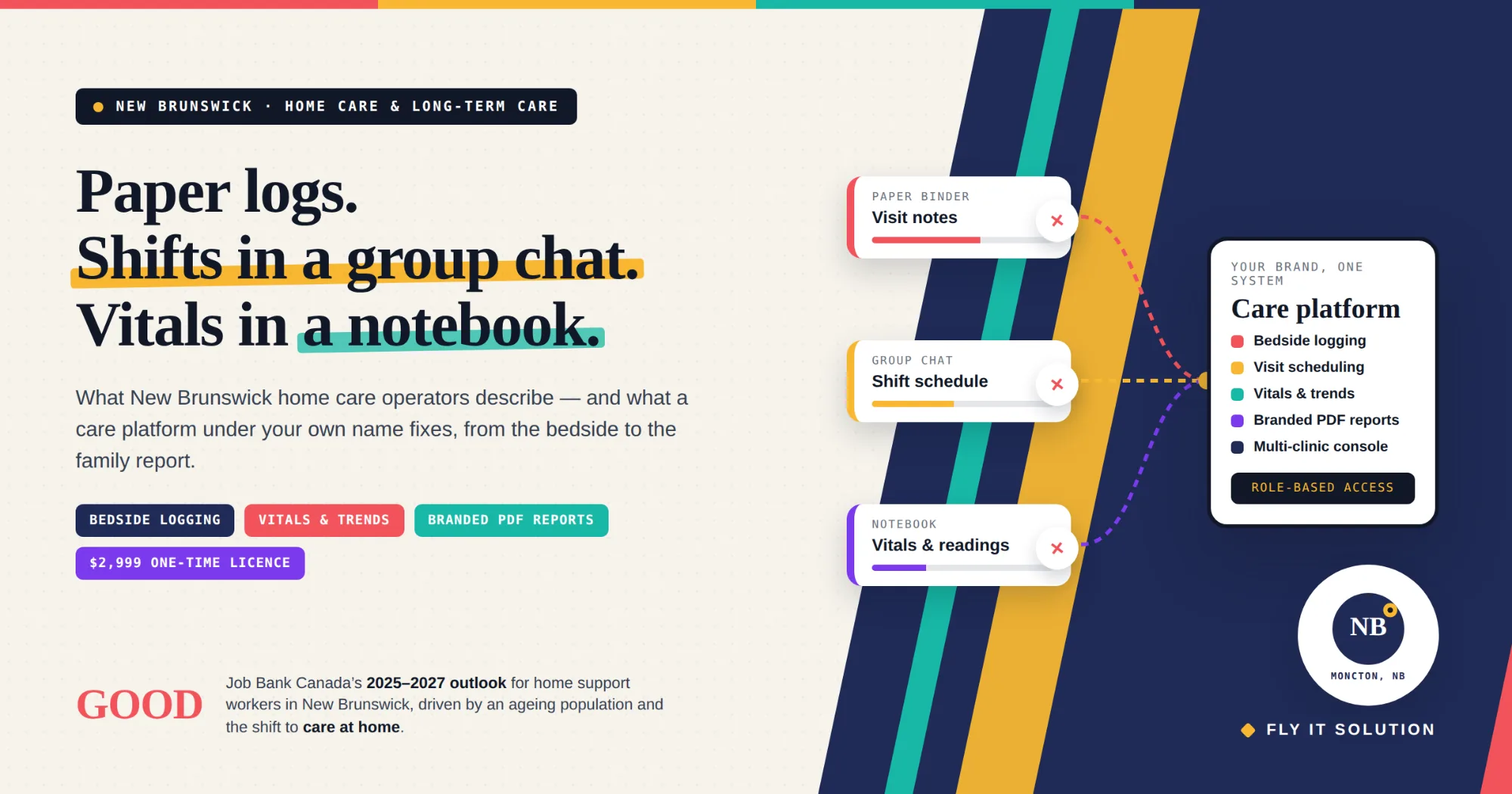
A New Brunswick home care agency needs software that does four things: schedule visits, let care workers log care at the bedside, produce reports families and funders accept, and keep each client's record private, all under the agency's own name. Most agencies we talk to have those four things spread across paper, a group chat, a notebook and a spreadsheet.
Demand is not the problem. Job Bank Canada rates the 2025–2027 outlook for home support workers in New Brunswick as good, driven by an ageing population and the shift toward providing health services at home, according to its outlook for home support workers in New Brunswick. The Public Policy Forum's Help Wanted report, as reported in April 2026, puts the province's health care positions to fill by 2035 at 30,100.
More clients and fewer hands means the admin has to get smaller. This post covers what operators tell us about their current set-up, what a branded care platform contains, how privacy and EMR integration fit, and a five-step plan to move off paper. If you want the product first, it is our white-label homecare management platform.
What New Brunswick home care operators tell us
Six sentences come up in almost every first conversation, and each one points to the same gap: care is recorded in one place and managed in another.
“Visit notes are on paper and get typed up on Friday.”
Care workers write in a binder at the client's home, and someone in the office transcribes it at the end of the week. By Friday, Monday's detail is gone.
What it tells us: there is no way to record care where it happens. Bedside logging from a phone, against the client's record, at the time of the visit, is the fix.
“Scheduling lives in a group chat.”
Shifts are confirmed by message, changed by message, and missed when a message is buried. Nobody can see the whole week.
What it tells us: scheduling is a conversation, not a system. Visits assigned per care worker, with reminders and notifications, replace the chat.
“Vitals are in a notebook. Trends are in someone's head.”
Blood pressure, glucose or weight gets written down each visit, but nobody looks across visits until something goes wrong.
What it tells us: readings are captured but not compared. Real-time vitals with trends per client turn a notebook into an early warning.
“Families call the office for updates.”
A daughter in Fredericton wants to know how her mother in Bathurst was today, and the only answer is a phone call and a search through the binder.
What it tells us: there is no report that can be produced on demand. Branded PDF reports, generated from the logged care, answer the call before it is made.
“We run three sites and three spreadsheets.”
Each location keeps its own records, and the owner reconciles them at month end to see the whole operation.
What it tells us: there is no console above the sites. A super admin view across every clinic, with each clinic's data isolated, is what a multi-site operator needs.
“We want our own name on it, but a custom build is out of budget.”
Operators have seen the subscription tools, and they have seen custom quotes, and neither fits: one carries a vendor's brand and a monthly bill, the other costs more than a small agency can justify.
What it tells us: the middle path is a finished platform licensed once and branded as the agency's own. That is what a white-label homecare platform is for.
What home care software a New Brunswick agency needs: the platform, in one list
A branded care platform is one system that holds client records, bedside logs, vitals, schedules and reports, with each person seeing only what their role allows. HealthSync, our white-label homecare management platform, contains the following.
Patient management. Every client's record, care plan and history in one place, per clinic.
Bedside logging. Care workers record care, notes and readings on a phone at the time of the visit, against the client's record.
Real-time vitals and trends. Readings build into trends per client, visible to the nurse and the administrator as they are logged.
Branded PDF reports. Reports generated from logged care, carrying your logo, for families, funders and inspections.
Scheduling and reminders. Visits assigned per care worker, with reminders so nothing depends on a chat message.
Notifications. Push notifications from the clinic admin to the team.
Multi-clinic console. A super admin oversees every site from one place; each clinic admin manages their own nurses, clients and reports.
Analytics dashboard. Activity and care metrics across clinics, without a spreadsheet.
Role-based access and per-clinic data isolation. A care worker sees assigned clients, an administrator sees their clinic, and no clinic sees another's data.
It is built for homecare agencies, nursing homes and long-term residential facilities, multi-site clinic groups and specialised care teams such as diabetes, respiratory, post-operative recovery and feeding support. The longer explanation of how a white-label homecare platform works for a care business is on our blog.
Privacy: what a New Brunswick provider should ask
Client health information in New Brunswick falls under the province's Personal Health Information Privacy and Access Act, so the questions to ask any software vendor are who can see what, where the data is hosted, and how long it is kept.
On the platform, access is role-based and each clinic's data is isolated, the deployment sits on your own domain, and you own it. Hosting location and retention are walked through on the discovery call so the answers are written down before launch, not assumed.
Clinics and EMR integration
Clinics that already run an EMR do not need a second system; they need the two to talk. We built an Accuro EMR integration for a clinic group that keeps locations, stations, two-way scheduling and waitlists in sync with Accuro while the EMR stays the source of truth, and reports arrival-versus-scheduled time and no-show patterns.
For a New Brunswick clinic group, that is the usual shape: the EMR holds the clinical record, a patient-flow or care platform holds the operation, and an integration layer moves appointments and status between them without anyone retyping.
White-label or custom?
Licence the platform if your agency runs the way most home care agencies run: clients, care workers, visits, logs, reports. It is a one-time licence of $2,999 with no monthly subscription, and it includes branding, deployment on your domain, configuration of clinics, roles, services and log sheets, training, documentation, a post-launch support period and three months of free maintenance, server setup and deployment.
Build custom when your model is genuinely different, for example a new kind of care marketplace, or when you need a workflow no platform contains. Even then, start with MVP software development: one core workflow in front of real care workers before the rest, with custom software services added on top of the platform where that is cheaper than building from zero.
A five-step plan from paper to platform
Most agencies can be live on one site within the first six weeks. The order matters more than the speed.
1. List what is recorded today and where. Write down every visit note, vitals sheet, schedule, incident form and report your team produces, and whether it lives on paper, in a chat app or in a spreadsheet.
2. Map your roles. Decide who needs to see what: administrators, nurses and care workers, and, if you run more than one site, who oversees all of them. This becomes the role-based access setup.
3. Configure the log sheets and services. Turn your current paper forms into bedside log sheets and your service list into the platform's services, so care workers record the same things they record today, on a phone.
4. Brand it and train the team. Add your logo, colours and domain, then run a short training session with administrators and nurses on real client records before go-live.
5. Go live one site at a time. Launch with one clinic or team, keep paper as a backup for the first week, then move the remaining sites onto the same console.
How this works in New Brunswick
Fly IT Solution is an app development company in New Brunswick with an office on Gordon Street in Moncton. Khushpinder Kaur, our Business and Software Consultant for North America, is the person New Brunswick clients deal with directly, in Atlantic business hours, on +1 (647) 913-9073 or by video.
We work with providers across the province: Moncton, Dieppe and Riverview, Saint John, Fredericton, Bathurst, Miramichi and Edmundston. Because the platform is deployed remotely and the launch runs in four steps, discovery call, branding and setup, testing and training, and go-live, a provider in Edmundston gets the same timeline as one in Moncton.
Engineering is delivered from our development centre in Mohali, India, with design and delivery support from Minneapolis, which is how a one-time licence stays at $2,999 while the person you call is in Moncton.
If one of the six sentences at the top of this post sounded like your agency, talk to Khushpinder. Bring one week of visit notes, in whatever form they exist today; that is the most useful thing for a first conversation.
Frequently asked questions
What is home care management software?
Home care management software is a system that holds client records, lets nurses and care workers log care at the bedside, tracks vitals and trends, schedules visits with reminders, and produces reports, with each person seeing only what their role allows. A white-label version carries the agency's own name, logo and domain, so clients and families see the agency's brand rather than a software vendor's.
How much does home care software cost in New Brunswick?
Our white-label homecare management platform, HealthSync, is a one-time licence of $2,999 with no monthly subscription. It includes custom branding, deployment on your own domain, configuration of clinics, roles, services and log sheets, team training and documentation, a post-launch support period, and three months of free maintenance, server setup and deployment. Customisation beyond the standard package is scoped on the discovery call.
Can care workers log visits from a phone?
Yes. The nurse dashboard gives each care worker their assigned clients, and bedside logging records care, vitals and notes at the time of the visit instead of being typed up later. Administrators see the entries as they are made, and vitals build into trends per client over time.
How is client health information kept private?
Access is role-based, so a care worker sees only assigned clients while an administrator sees their clinic, and each clinic's data is isolated from the others on a multi-site console. The platform is deployed on your own domain and you own the deployment. New Brunswick providers are subject to the province's Personal Health Information Privacy and Access Act, so we walk through access rules, hosting location and retention with you on the discovery call.
Does it work for nursing homes and multi-site providers, not only home care agencies?
Yes. The platform is built for homecare agencies, nursing homes and long-term residential facilities, multi-site clinic groups and specialised care teams such as diabetes, respiratory, post-operative recovery and feeding support. A super admin console oversees every site from one place, while each clinic admin manages their own nurses, clients and reports.
Is the platform available in French for New Brunswick?
Tell us on the discovery call. New Brunswick is a bilingual province, and language requirements for the interface, log sheets and reports are scoped together with branding and configuration before launch, so you know exactly what is included before you commit.
How does Fly IT Solution work with health care providers in New Brunswick?
From our Moncton office on Gordon Street, Khushpinder Kaur, our Business and Software Consultant for North America, is the person New Brunswick clients deal with directly, in Atlantic business hours, by phone on +1 (647) 913-9073 or by video. Launch runs in four steps: discovery call, branding and setup, testing and training, and go-live. Engineering is delivered from our development centre in Mohali, India, with design and delivery support from Minneapolis.