Every repair shop owner who outgrows paper and WhatsApp reaches the same fork.
Build software around how your shop works, or launch a platform that already works and put your name on it.
Both are right for someone. This post is about telling which one is right for you. If you are still working out what repair shop software actually needs to do, read that first.
| Most repair shops should launch white-label repair workshop management software: it already handles intake, QR job tracking, quotes, approvals, repairs, quality photos, invoices and customer updates, it carries your brand, and it costs a one-time fee rather than a build. Build custom repair shop software only when your process is the business itself, when no platform can represent it, or when you plan to sell the software to other shops. |
|---|
What is the difference between custom and white-label repair shop software?
Custom software is built from scratch for one shop. Every screen and rule is designed for you. You pay for the build, and you wait for it.
White-label software is a finished platform deployed under your brand: your logo, your colors, your domain, your job cards and invoices. You pay a license, and you launch in weeks.
The third option, which most people miss, is white-label plus one custom module. More on that below.
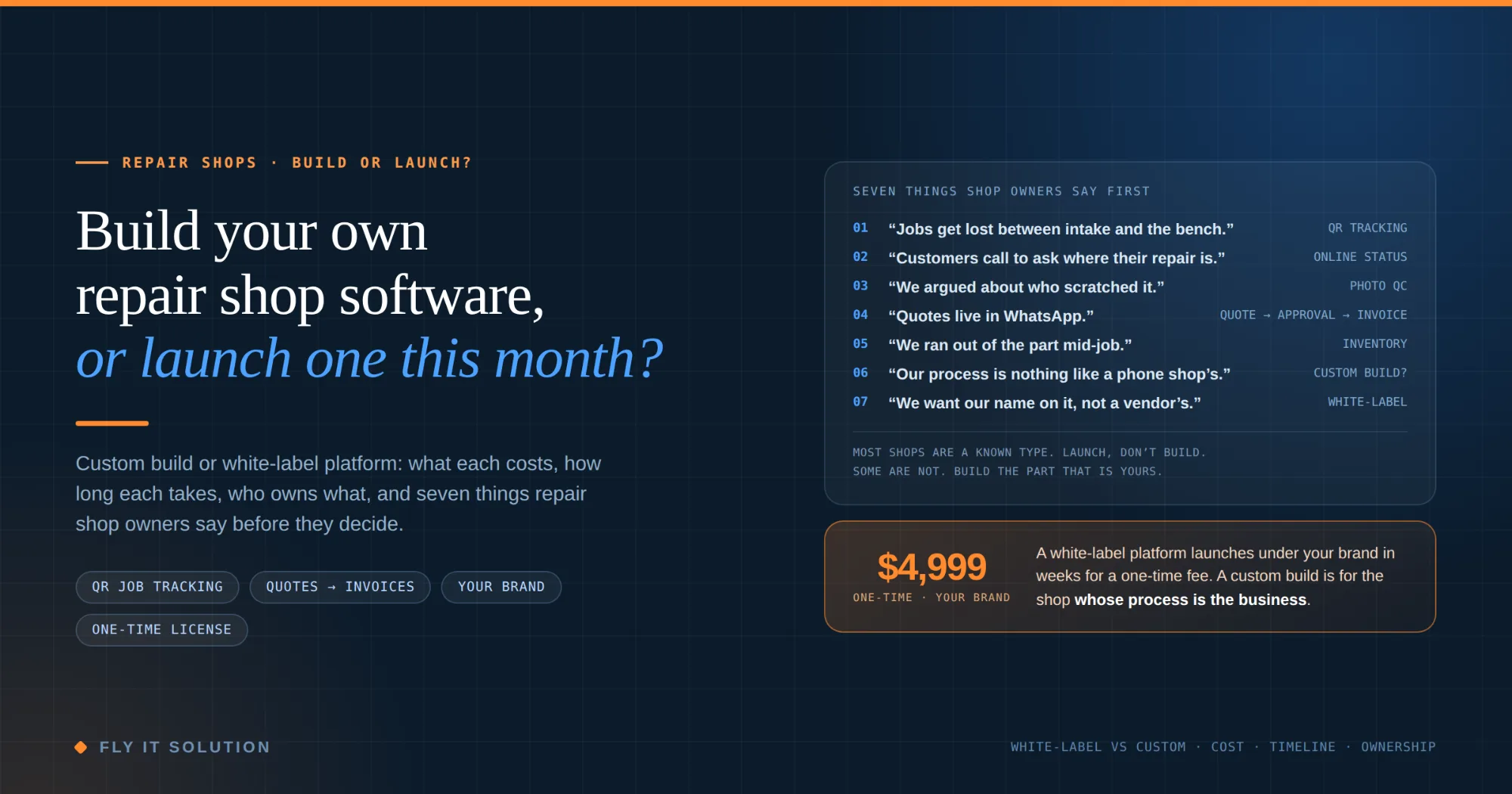
Seven things repair shop owners tell us first
Before anyone talks about building or buying, they describe the problem. These are the seven we hear most, what each one means, and which option answers it.
1. “Jobs get lost between intake and the bench.”
What it means: nobody knows where an item is until someone goes looking for it.
Which option: white-label. QR code order tracking prints a code on the job card at intake; technicians scan it from a phone at every stage, so the system always knows where every item is.
2. “Customers call to ask where their repair is.”
What it means: your front desk is a status page with a phone attached.
Which option: white-label. Customers see the same status online that your team sees inside. The calls stop.
3. “We argued with a customer about who scratched it.”
What it means: there is no record of the item's condition at intake.
Which option: white-label. Quality control requires repair photos, so the condition at intake and at completion is on file before the dispute starts.
4. “Quotes live in WhatsApp.”
What it means: the approval that lets you start work is a chat message nobody can find in a month.
Which option: white-label. A quote goes to the customer, the customer approves it, and the approved quote becomes the branded invoice. One thread, in one place.
5. “We ran out of the part halfway through the job.”
What it means: inventory is in someone's head.
Which option: white-label. Materials are logged against jobs and stock levels are visible, so the part is ordered before the job stalls.
6. “Our process is nothing like a phone repair shop's.”
What it means: you might be the exception, or you might just think you are.
Which option: usually white-label with a custom module. A surfboard repair workshop runs on the same platform as an electronics shop; the stages and fields are configured, not rebuilt. If a core step cannot be configured at all, that step is where you build a first version as an MVP and attach it.
7. “We want our name on it, not a vendor's.”
What it means: the software is part of how customers see your shop.
Which option: either. White-label gives you your brand on the login, the job card, the invoice PDF and the customer status page from day one. Custom gives you that too, later and at more cost.
Custom build or white-label: side by side
| White-label platform | Custom build | |
|---|---|---|
| What you get | Finished repair workshop platform under your brand: ERP and CRM in one | Software designed around your exact process, feature by feature |
| Cost | $4,999 one time, including 3 months of maintenance, server setup and deployment | Depends on scope; a first version as an MVP costs less than a full platform, a full platform costs more than the license |
| Time to launch | Weeks: discovery call, branding and setup, review and training, go live | Weeks for an MVP, months for a complete system |
| Ownership | Full ownership of your deployment; no hourly meter | You own the source code and the data |
| Best for | Shops that run the way most repair shops run | Shops whose process is the business, or who will sell the software |
| Risk | Low: the platform is already running in live workshops | Higher: scope, timeline and the unknowns every new build has |
| Changing it later | Custom modules can be added on top | Anything, at build cost |
When white-label is the right call
If your jobs move through intake, quote, approval, repair, quality check, invoice and collection, you are a known type of business, and a repair workshop management platform already does your job well.
You get the whole system on day one: QR tracking, technician phones, customer status, quotes to invoices, inventory, SLA alerts, roles and a live WIP dashboard.
Whether to pay once or subscribe is a separate question, and we wrote up the math on whether to rent or own it. The short version: a one-time license stops costing you money; a subscription never does.
When a custom build is the right call
Three situations, and they are rarer than owners think.
Your process is the product. The way you quote, route or price work is why customers choose you, and no configurable platform can express it.
You are building software to sell to other shops. Then you are a software company, and you want to own the roadmap.
You need something that does not exist yet. In that case, start small: MVP software development gets a first version in front of your own technicians before you commit to a full system. If you go that way, read how to choose an MVP development company first.
The middle path most shops end up on
Launch the white-label platform. Run it for a month. Then build the one thing it does not do.
Because we build and run the platform ourselves, a custom module can sit on top of it: a pricing rule for your trade, an integration with your accounting tool, a step in the workflow nobody else has.
You get the speed and low risk of white-label, and the one piece of custom software that is actually yours. That is cheaper than building everything and better than bending a generic tool.
Frequently asked questions
Should I build custom repair shop software or use a white-label platform?
Use a white-label platform if your shop runs the way most repair shops run: intake, quote, approval, repair, quality check, invoice, collection. It launches under your brand in weeks for a one-time fee and you own the deployment. Build custom only when your process is the business itself and no existing platform can represent it, or when you plan to sell the software to other shops. Many shops end up with a white-label platform plus one custom module.
How much does white-label repair shop software cost?
Our white-label repair workshop management software is $4,999 one time, set up and launched under your brand, with three months of maintenance, server setup and deployment included. There is no monthly platform fee and no per-user charge. Customization beyond the standard package is scoped and quoted on the discovery call.
How much does it cost to build custom repair shop software?
It depends on scope. A focused first version built as an MVP, with one core workflow, a technician view and invoicing, costs far less than a full platform with QR tracking, inventory, quality control, SLA alerts, customer portal and reporting, which is what a white-label product already contains. Before pricing a custom build, compare your feature list with what the white-label platform includes; the difference is usually smaller than owners expect.
What is QR code repair tracking?
Each repair job gets a QR code printed on its job card or ticket at intake. Technicians scan it from a phone to open the job, log work, add photos and move it to the next stage, so the system always knows where every item is between intake and delivery. Customers can check the same status online instead of calling.
Can I run repair shop software under my own brand and still customize it?
Yes. A white-label deployment carries your logo, colors, domain and branded job cards and invoices. Because we build the platform ourselves, custom modules can be added on top, for example a pricing rule, an integration with your accounting tool, or a workflow step specific to your trade. That is often the sensible middle path between buying and building.
How does Fly IT Solution help repair shops decide?
We offer both: a white-label repair workshop management platform you can launch under your brand, and custom MVP software development for shops whose process does not fit any existing system. On a discovery call we walk through how your shop runs, show you the platform, and tell you honestly whether to launch it, customize it or build. We work from Minneapolis, Minnesota and Mohali, India.
Tell us how a job moves through your shop, from the moment it arrives to the moment the customer pays. We will show you the platform, tell you whether to launch it under your brand, customize it, or build, and give you a straight answer if the honest one is “you don't need us yet”.
We work with repair businesses from Minneapolis, Minnesota and our development team in Mohali, India. The first conversation is free.