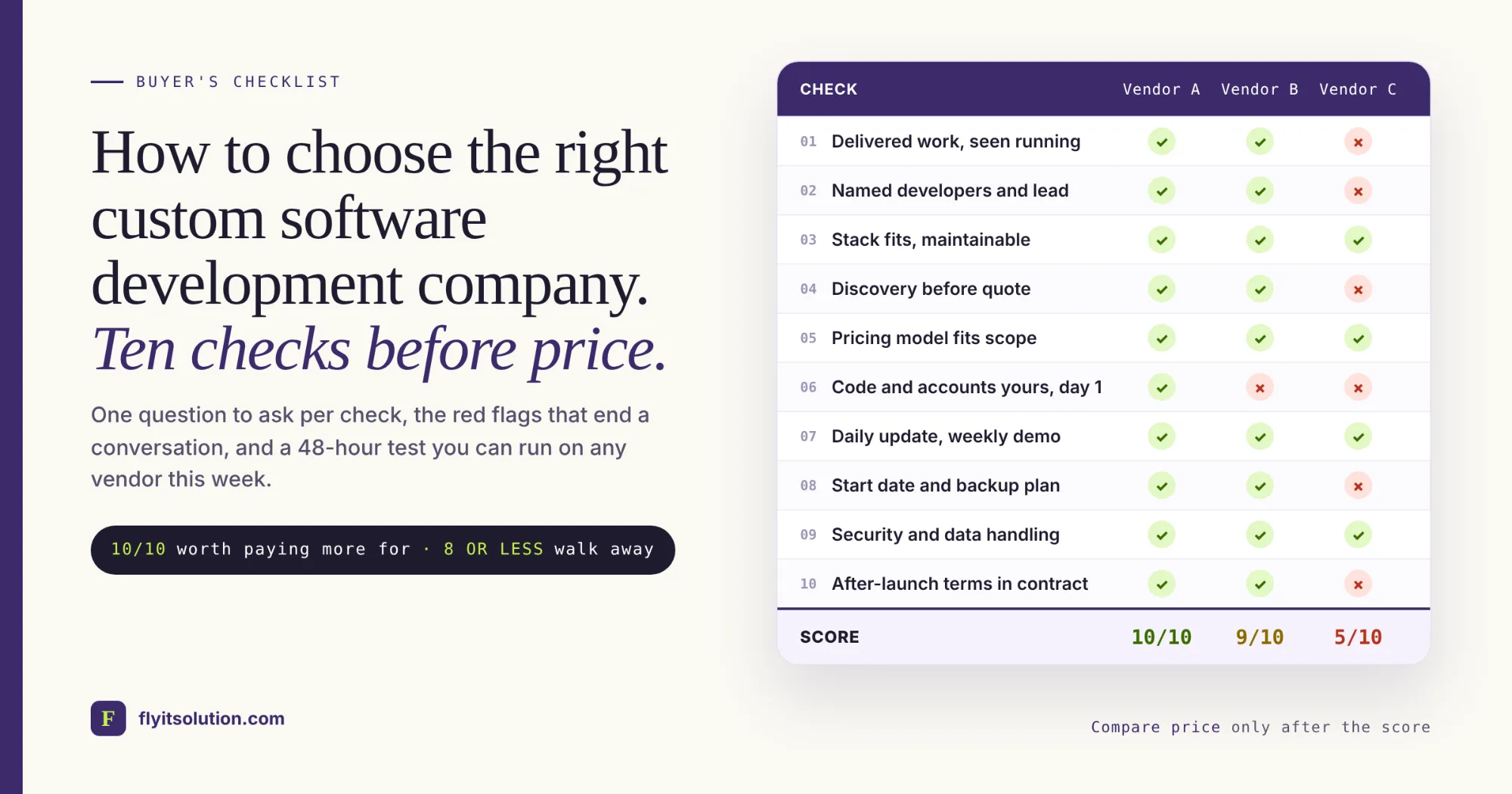
To choose the right custom software development company, run ten checks before you compare a single price: delivered work you can see running, the named people on your project, a stack that fits, discovery before any quote, a pricing model that matches how certain your scope is, ownership of code and accounts from day one, a written communication cadence, a start date with a continuity plan, security and data handling, and what happens after launch. Score each vendor out of ten and only then look at cost.
Most comparisons go wrong because they start at the end. Three quotes arrive, the middle one wins, and the questions that decide whether the project succeeds get asked after the contract is signed.
This checklist reverses the order. Each point has one question to ask, the answer you want, and what a bad answer sounds like.
Why price is the last thing to compare
Price is the least reliable signal in a software quote because it measures what the vendor understood, not what you need. Two companies quoting the same brief can differ by half, and the cheaper one is usually the one that read less.
A quote only becomes comparable after discovery, when both sides have the same written scope. Until then, treat every number as a guess, including the one you like.
The 10-point checklist
Give one point per check passed. A company that scores ten is worth paying more for; a company that scores eight or below is not worth any price, because the two misses are where your project will fail.
1. Ask to see delivered work running, not a logo wall
A real case study shows the problem, the screens, the stack and what changed for the client. Ask: can you show me a product you built that is live today, and walk me through one screen?
2. Find out who will actually write your code and who will manage it
The company's age tells you nothing about the three people on your project. Ask: who is the named project lead, who are the developers, and can I speak to them directly?
3. Check the stack matches what you need and what you can maintain
A vendor who builds everything in one framework will build your project in it too, whether it fits or not. Ask: which stack would you use for this and why, and who else could maintain it after you?
4. Insist on discovery before a quote
A price given on the first call is a guess that becomes a change request later. Ask: what do you need from us before you can quote, and what does your discovery produce in writing?
5. Match the pricing model to how certain the scope is
Fixed price suits a fully specified scope; hourly or sprint-based pricing suits a product that will change as you learn. Ask: which model do you recommend for us, and what happens to the price when scope changes?
6. Confirm ownership of code, repository, hosting and accounts from day one
The repository, cloud account, domain and app store accounts should be in your company's name before the first sprint, not released after the last invoice. Ask: what is in our name on day one, and is there any fee to leave?
7. Set the communication cadence and the time-zone overlap in writing
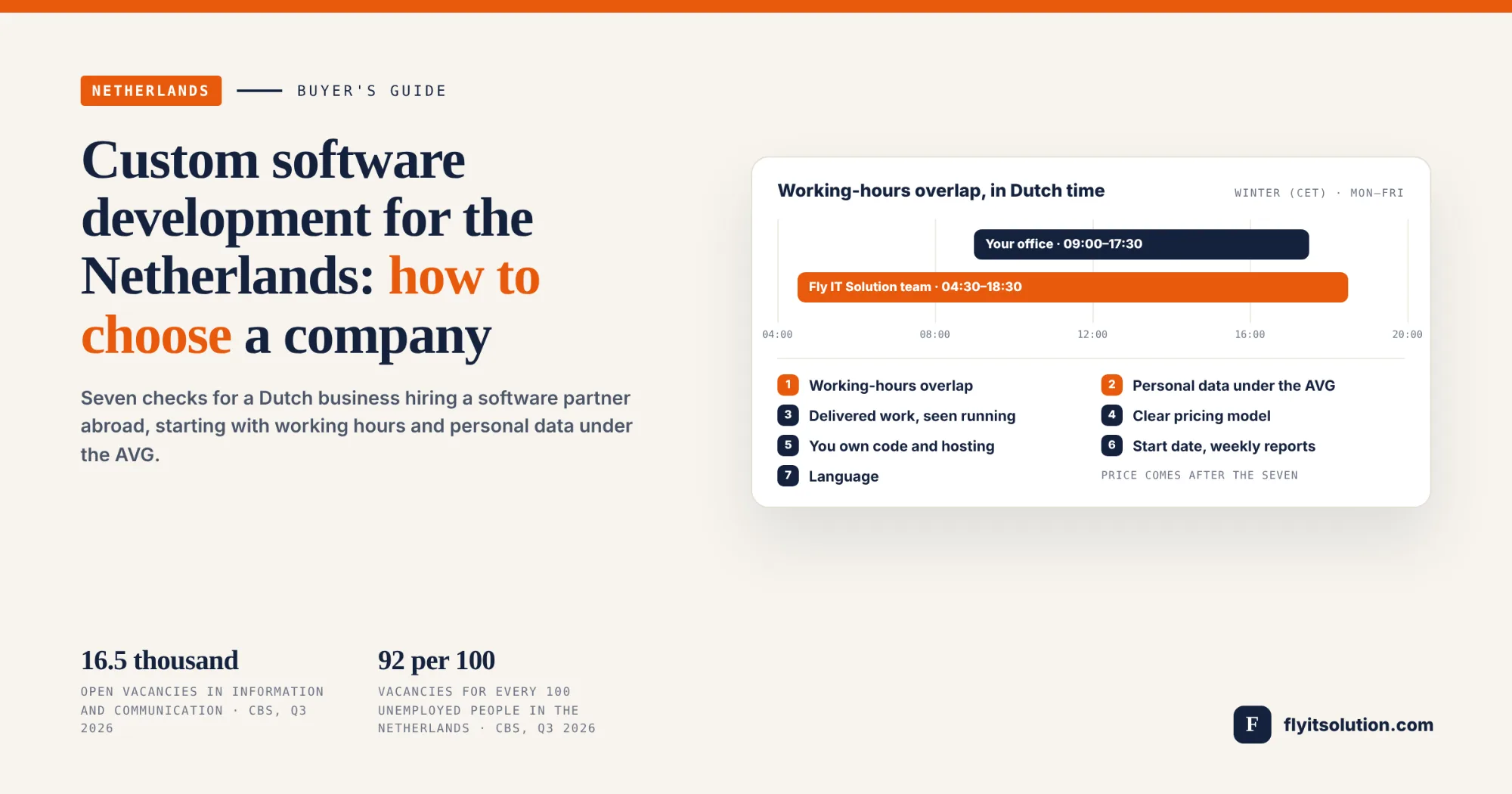
You want a daily update, a demo every week and hours of overlap with your working day. Ask: what will I receive each day and each week, and which hours can I reach the team live?
8. Get a start date and a continuity plan
Ask when the team can begin and what happens if a developer leaves mid-project. A company that can start within days and names the backup has the bench to deliver.
9. Check how they handle security and your data
Staging environments, tested backups, access controls, a signed NDA and, where personal data is involved, a data processing agreement are basics. Ask: how is production data protected from the development team?
10. Agree what happens after launch before you sign
Support window, maintenance terms, documentation and a handover that lets you leave should be in the contract. Ask: if we stop working with you after launch, what do we walk away with?
A worked example of check one: our portfolio shows the multi-carrier shipping platform with its carrier integrations and warehouse flow, and the land property listing platform with its map search and parcel data. Ask any vendor for the same level of detail; a logo wall is not evidence.
Red flags that should end the conversation
One red flag is a reason to pause and ask again. Two together are a reason to walk away, however good the price.
| Red flag | Why it matters |
|---|---|
| A price on the first call | The scope has not been read, so the price will move; the change requests start at week two. |
| No written scope before the contract | Nothing to hold either side to, so every disagreement becomes a negotiation. |
| Code ownership released only after final payment | The vendor holds your product hostage during the one dispute that matters. |
| No staging or demo environment | You will see the product for the first time in production, with customers watching. |
| No named developers or project lead | You are buying a brand, and the brand will assign whoever is free. |
| One developer, no backup | A single resignation or illness stops the project with no plan. |
| Contract stops you adding or removing people | The team size is set to the vendor's revenue, not your roadmap. |
The 48-hour test
The first 48 hours after your inquiry predict the whole engagement, because a company that is slow and vague before it has your money will not speed up after. Send the same two-paragraph brief to each vendor on the same day and watch what comes back.
A good company replies within a working day, proposes a call rather than a price, and in the call asks about your process, your users and your existing systems before it asks about features. After the call, you receive written next steps, not a PDF brochure.
A weak company replies with a quote, a slide deck, or a request for your budget before it has asked a single question about your business.
Fit the company to the project, not the other way around
The right company for a CRM is not always the right company for an ERP or a first product release, so match the vendor's delivered work to your project type. Our custom CRM software development, custom ERP software development and MVP software development pages each show the process and the kind of work involved, which is the level of specificity to expect from anyone you shortlist.
Two earlier posts go deeper for specific situations: choosing a software development company in Ohio covers the local-versus-remote question, and whether you need a custom ERP at all is worth reading before you shortlist anyone for one.
How Fly IT Solution answers the ten checks
We publish the checklist because we pass it, and you should hold us to it. Delivered work is on the portfolio with screens, stack and outcomes; every project has a named lead and developers you can talk to; the stack is chosen per project across React, Node.js, Laravel, Python, React Native and the cloud you already use.
Discovery comes before any quote. We reply within 24 hours, hold a free consultation, run discovery over the first days, and deliver a roadmap and written quote, with fixed-price and hourly options and a clear answer on what happens when scope changes.
The repository, hosting account, domain and app store accounts are in your name from the start, with no fee to leave. Projects can kick off within 48 hours of agreement, run in sprints with daily updates and a demo every week, and the team has a bench, so a change of developer does not stop the work.
Production data is kept away from the development team through staging environments, tested backups and access controls, with an NDA and a data processing agreement where personal data is involved. After launch you get documentation, a support window and maintenance terms in the contract, and 10+ years, 30+ client reviews at a 5.0 average and 98% client satisfaction are the record behind it.
Score us against the list on a call. Book a free consultation, bring the brief you sent everyone else, and you will have a written next step within one business day. Teams that only need capacity can hire dedicated developers on the same terms.
Frequently asked questions
How do I choose the right custom software development company?
Run ten checks before comparing prices: delivered work you can see running, the named people on your project, a stack that fits, discovery before any quote, a pricing model that matches scope certainty, ownership of code and accounts from day one, a written communication cadence, a start date with a continuity plan, security and data handling, and post-launch terms. A company that passes all ten is worth paying more for; one that fails two or more is not worth any price.
What questions should I ask a custom software development company?
Ask who will write and manage the code, which product they built that is live today, which stack they recommend and why, what discovery produces before a quote, what happens to the price when scope changes, what is in your name on day one, what you will receive daily and weekly, when they can start, how production data is protected, and what you walk away with if you leave after launch.
What are the red flags when choosing a software development vendor?
A price on the first call, no written scope, code ownership released only after final payment, no staging or demo environment, no named developers, a single developer with no backup, and contract terms that stop you adding or removing people. Any one of these is a reason to pause; two together are a reason to walk away.
Is a fixed-price contract a good idea for custom software?
Fixed price works when the scope is fully written down and will not change; it is the wrong model for a product you expect to learn from and adjust. Hourly or sprint-based pricing with a written estimate per sprint suits evolving scope. The right vendor offers both and tells you which fits your project.
Should I choose a local company or a remote team?
Choose on the ten checks, not on the map. A remote team with hours that overlap your working day, a daily update and a weekly demo is easier to work with than a local company that goes quiet for a month. Where a visit matters, pick a company with an office you can reach and a delivery team that works your hours.
How does Fly IT Solution handle a first inquiry?
We reply within 24 hours and set up a free consultation, run discovery in the first days, and deliver a roadmap and written quote. Projects can kick off within 48 hours of agreement, run in sprints with daily updates and a demo every week, and the repository and accounts are in your name from the start.