Most funeral home websites are built by generalist agencies who have never spoken to a grieving family at 2am. It shows.
Over the past few years the Fly IT Solution development team has built websites and applications for funeral businesses in the United States and Europe: a full-service funeral home website, an independent funeral director's site, and a QR memorial builder that families use to share a loved one's story. Client names are withheld under NDA, but the lessons are not.
This article covers what families actually need from a funeral home website, what we built and why, and what funeral operations management software should do for the director behind the desk. If you run a funeral home, crematorium, cemetery or memorial products business, it is written for you.
What families actually need from a funeral home website
A family does not browse a funeral home website. They arrive in crisis, usually on a phone, often late at night, and they need four things within seconds.
- A phone number they can tap. Immediate-need help has to be the first thing on the screen, not buried in a footer.
- Proof they can trust you. Who you are, how long you have served the community, a real face and a real name. Grieving people choose the director who feels like a neighbour.
- Obituaries that work. Families share obituaries more than any other page. They need to load fast, look dignified on mobile, and let visitors send flowers, leave condolences or sign up for notifications.
- Honest answers about cost. In the US this is a legal requirement under the FTC Funeral Rule (a General Price List). In Europe it is a trust signal. Either way, hiding prices loses the family.
Everything else, including pre-planning forms, grief resources, veterans' benefits information and livestreaming, matters, but it sits behind those four. A funeral home website that gets the first four right converts calls. One that leads with stock photos of doves does not.
A funeral home website is used at midnight, on a phone, by someone who is grieving. Design for that person first.
Case study 1: a full-service funeral home website (United States)
A locally owned funeral home serving a rural parish needed a website that worked as hard as its staff. The previous site was slow, hard to update, and did not reflect a business built on personal attention and local tradition.
What we built:
- Obituary system with a recent list, full archive, and email notifications for the community
- Send Flowers integration tied to each obituary
- Immediate-need section with tap-to-call, plus burial, cremation and personalisation pages
- Veterans' services section covering honours and benefits
- Online pre-planning form, a pre-plan checklist and a published General Price List
- Grief and resources hub: what to do when a death occurs, Social Security benefits, children and grief
- Mobile-first design in a warm, compassionate tone that matches how the owner speaks to families
The result is a site a family can use at midnight without help, and a staff that can post an obituary in minutes.
Case study 2: an independent funeral director's website (Netherlands)
A solo funeral director in the Amsterdam region competes with national chains and insurer-owned providers. His edge is that one person handles everything, reachable around the clock. The website had to carry that promise.
What we built:
- A Dutch-language site written in the director's own calm, direct voice
- Clear starting prices for cremation and burial, with what is included, so families know before they call
- 24/7 contact by phone and WhatsApp, prominent on every page
- Guidance for families insured with national funeral insurers, including the right to choose their own provider
- Service pages for personal ceremonies, small private funerals and home funerals
- Pre-need planning and a service-area list covering a dozen surrounding towns
- Google reviews surfaced on the homepage
Independent directors across Europe face the same problem: the chains outspend them on marketing. A website that explains the personal alternative clearly, in the local language, is how they win the family's trust first.
Case study 3: a QR memorial and tribute builder application
Families want somewhere permanent to gather memories, and funeral homes want a product they can hand to every family. We built a memorial platform that does both.
How it works:
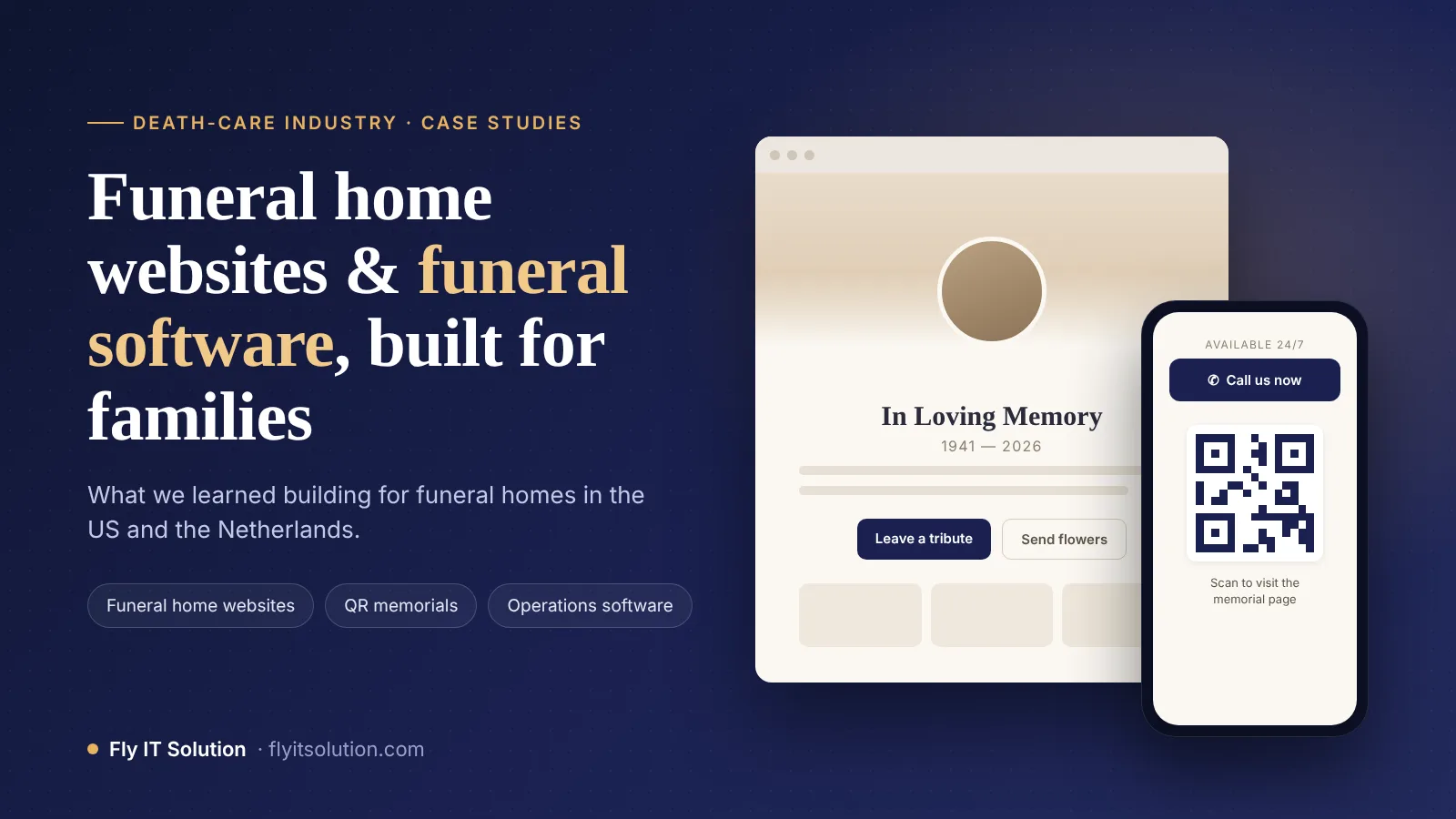
- The family (or the funeral director on their behalf) creates a memorial page from a template, choosing colours, images and text.
- They add a photo gallery, a places gallery linked to maps, and a slideshow with music.
- Service details display until the day of the service; online attendance is supported for those who cannot travel.
- Friends and family post tributes, viewable as a list, a map or a wall of tiles, and printable as a keepsake.
- A QR code links to the page and can be printed on service programs, memorial cards, keepsakes or a headstone plaque.
For the funeral home this becomes a white-label QR memorial product: a new revenue line, a reason for families to recommend you, and a living page that carries your brand for years.
Funeral operations management software: what it should cover
The website is what families see. The operations software is what keeps a funeral home running, and most directors are still doing it with paper files, spreadsheets and a whiteboard.
A funeral operations management system worth building covers the whole case, from first call to final invoice:
| Module | What it does for the funeral director |
|---|---|
| Case management | One record per decedent: family contacts, service type, documents, notes, status |
| First-call intake | Capture details from the first phone call on any device, day or night |
| Scheduling | Services, viewings, transport, staff and vehicles on one calendar; crematorium and cemetery slots |
| Documents & compliance | Death certificates, permits, authorisations, General Price List, e-signatures |
| Arrangement & pricing | Build the arrangement with the family, generate the itemised statement automatically |
| Invoicing & payments | Statements, deposits, insurance assignments, online payment links |
| Family portal | Families upload photos, approve the obituary, sign forms, pay, without visiting the office |
| Obituary & memorial sync | Publish to the website and the QR memorial page from the case record in one click |
| Inventory | Caskets, urns, keepsakes, flowers, with supplier ordering |
| Reporting | Cases per month, revenue by service type, pre-need pipeline |
Fly IT Solution builds these as web applications with a mobile-friendly interface, hosted securely, with role-based access for directors, staff and families. Off-the-shelf funeral software exists, but it rarely fits how an individual firm works. Custom software fits the business instead of the other way round.
How Fly IT Solution works with funeral businesses
You run the funeral home. Fly IT Solution runs the development phase, end to end.
- Discovery call. We learn how your firm serves families, what your current website or software does badly, and what you want to be true in six months.
- Scope and fixed quote. A written plan of pages, features and integrations, with a price and a timeline. No surprises.
- Design. Mobile-first layouts in your brand, in your language, in a tone that suits a grieving reader. You review and approve before any code is written.
- Development. The Fly IT Solution in-house team builds the website, QR memorial builder or operations application. You see progress weekly.
- Content and migration. We move your obituaries, pages and records across so nothing is lost.
- Launch and training. We go live, train your staff, and hand over documentation.
- Ongoing support. Hosting, security updates, new features and SEO for your local area, on a monthly plan or as needed.
Fly IT Solution is based in India and works with clients in the US, UK, Netherlands and wider Europe. Time zones work in your favour: changes requested in your evening are often done by your morning.
Talk to Fly IT Solution about your funeral home website or software
If your website was built before smartphones, or your case files still live in a filing cabinet, we would like to show you what is possible. We handle the full development phase so you can keep serving families. Book a free 30-minute consultation and we will share an anonymised portfolio.
Frequently asked questions
How much does a funeral home website cost?
A professional funeral home website with obituaries, pre-planning forms and flower integration typically starts at a fixed project fee, with optional monthly hosting and support. We quote after a short discovery call.
How long does funeral home website development take?
Most funeral home websites launch in four to eight weeks. A QR memorial builder or funeral operations application takes longer depending on scope.
Can you add a QR memorial product to our existing website?
Yes. The QR memorial builder can run alongside your current site or be integrated into it, under your brand.
Do you build funeral software for crematoria and cemeteries?
Yes. Scheduling, slot booking, records and invoicing modules apply to crematoria, cemeteries and memorial parks as well as funeral homes.
Do you work with funeral homes outside the US?
Yes. We have delivered for the US and the Netherlands and work with funeral businesses across the UK and Europe, in the local language.
Will the website be compliant with the FTC Funeral Rule?
For US clients we build the General Price List and related disclosures into the site structure. Your legal adviser confirms the content; we make sure it is published correctly.