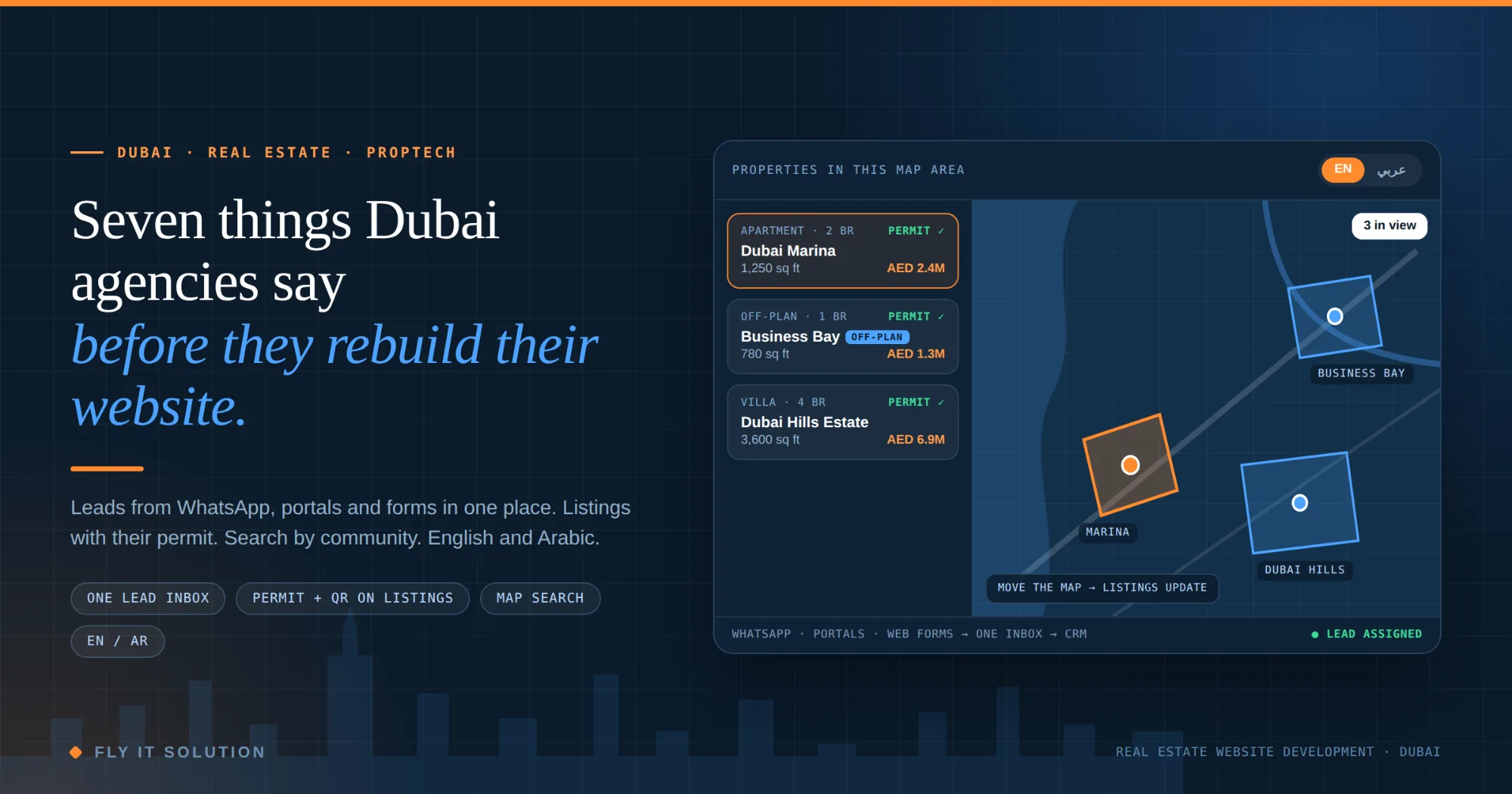
Dubai real estate moves fast, and most agency websites are not keeping up with it.
The listings look good. The photography is excellent. But the leads are in WhatsApp, the portals and an email inbox, the permits are in a spreadsheet, and the Arabic version of the site was last updated in spring.
Before anyone rebuilds, they usually tell us the same handful of things. Here are seven of them, what each one really means, and what a property platform should do about it.
| A Dubai real estate website should do five things a brochure site does not: put every lead, from the website, WhatsApp and the portals, into one inbox and the CRM; carry each listing's DLD advertising permit and QR code; let buyers search by community on a map; show off-plan projects as projects with units; and keep English and Arabic in sync from one record. Leads should belong to the agency, not to the agent who answered first. |
|---|
What is a real estate platform, as opposed to a website?
A real estate website shows listings. A real estate platform runs the business behind them.
It holds the property records, captures every enquiry, routes it to the right agent, and keeps the team, the CRM and the buyer looking at the same information.
The difference is not the design. It is whether your team works inside the system or around it.
Why Dubai raises the bar
Volume, for a start. The Dubai Land Department recorded more than 270,000 real estate transactions worth AED 917 billion in 2025, up 20 percent on the year before.
The buyers are new and widely spread. Around 129,600 of the year's 193,100 investors were new to the market, and resident investors made up 56.6 percent of the total, which leaves a large share buying from outside the UAE.
And the rules are specific. Property advertising in Dubai needs a DLD marketing permit through the Trakheesi system, and the Madmoun service issues a QR code for each permit that agencies are required to display on their ads.
A generic template was not built for any of that.
The seven things Dubai agencies tell us
These are the sentences we hear. Under each one is what it usually means.
1. “Our leads come from WhatsApp, the portals and the website, and none of it is in one place.”
What it means: nobody can see the full pipeline, so nobody can manage it.
A buyer messages on WhatsApp, enquires on a portal a day later, then fills in your website form. That is three leads in three places, and possibly three agents calling the same person.
Every channel should land in one inbox, matched to one contact, and flow into your CRM. That is the core of good real estate CRM integration.
2. “Every listing needs its permit, and we track them in a spreadsheet.”
What it means: compliance depends on someone remembering.
If the permit number and QR code live outside the listing, sooner or later a listing goes live without them, or stays live after the permit has lapsed.
The permit belongs on the listing record itself, and a listing should not be able to publish without it.
3. “Our buyers are overseas and have never seen the community.”
What it means: your search assumes local knowledge your buyers do not have.
A buyer in London or Mumbai does not know whether JVC is near the Marina. A dropdown of community names does not help them.
A map does. Let them move it to the area they care about and show only what is inside it.
4. “An off-plan project has 300 units, and our website shows it as one page.”
What it means: the data model is flat, and the project is not.
Buyers want to filter by unit type, floor, view and price inside a project. Sales want to mark units sold without rewriting a page.
That needs a project record with units underneath it, each with its own details and status.
5. “We need English and Arabic, and the Arabic always lags behind.”
What it means: two versions of the truth.
When the Arabic site is a separate copy, prices and availability drift apart. The buyer who notices does not call.
Both languages should read from one property record, with right-to-left layouts built in from the start.
6. “When an agent leaves, their leads leave with them.”
What it means: the leads were never really the agency's.
If enquiries go to personal phones and inboxes, the client history walks out of the door with the agent.
Role-based access fixes it. Agents see and work their own leads; the agency owns all of them.
7. “The portals own our buyers.”
What it means: your website gives buyers no reason to come back.
Portals are essential for reach. But a buyer who saves a property on a portal is the portal's buyer.
Buyer accounts, saved properties and a way to say “find me something like this” turn your own site into somewhere worth returning to, and the content you publish their builds your name instead of someone else's.
How to tell it is time
Think of a busy brokerage as a building with one front desk and five side doors. Leads come in through all of them, and only the front desk keeps a log.
If three or more of the seven statements sounded familiar, you do not need a new design. You need one front door.
What we build for each one
We recently built a land listing and property management platform for a US company that buys and sells land. Different market, same problems. You can read the full land listing platform case study. Here is how its building blocks map to Dubai, and what we would add for this market.
| What they tell us | What we build | Proven on the land platform? |
|---|---|---|
| 1. Leads in three places | One lead inbox; every lead saved first, then synced to the CRM from the server, matched by phone or email, tagged, retried if the CRM is down. WhatsApp and portal lead capture added for Dubai. | Yes for forms and CRM sync; WhatsApp and portals are Dubai additions |
| 2. Permits in a spreadsheet | Permit number and QR code fields on every listing; publishing blocked without them; an alert before a permit lapses. | Dubai addition |
| 3. Overseas buyers | Grid plus interactive map search that shows only properties inside the visible area. | Yes |
| 4. Off-plan with 300 units | Parent and child records: project holds what is shared, each unit holds its own details and status. | Yes, as parcels grouped under one listing |
| 5. Arabic lags behind | One property record, two languages, right-to-left layout. | Dubai addition |
| 6. Leads leave with agents | Admin, staff and client roles with server-enforced permissions; leads owned by the agency. | Yes |
| 7. Portals own the buyer | Buyer accounts, wishlists, property requests, and a CMS for blogs, market updates and press. | Yes |
The lead sync is the part most agencies underestimate. We wrote up how we connect website forms to a CRM without losing leads in a separate guide.
A closer look: searching Dubai by map
Map search sounds simple. The detail is what makes it work.
The map sends its current edges to the server, which returns only the properties inside them. Pan from Dubai Marina to Business Bay and the list changes with you. The site stays fast because the browser never loads every listing at once.
Each property can also store its Makani number, Dubai Municipality's 10-digit code for a building's entrance. It is a small field, but it gets a viewing appointment to the right door.
When you do not need a custom platform
If you are a small team listing a few properties a month, a good template, your portal accounts and your CRM's own forms will serve you well.
Custom work earns its cost when the workarounds have become somebody's full-time job: when leads are being missed, permits are being chased, and the Arabic site is a copy nobody trusts.
FAQ
What should a real estate website in Dubai include?
At minimum: listings that carry their Dubai Land Department advertising permit and QR code, search by community on a map, one inbox for leads from the website, WhatsApp and the portals, a proper structure for off-plan projects with many units, and English and Arabic versions that stay in sync. Behind that, agents need role-based access so leads belong to the agency, not to whoever answered first.
Do listings on my own website need a Trakheesi permit and QR code?
The Dubai Land Department requires a marketing permit, issued through its Trakheesi system, to advertise property in Dubai, and its Madmoun service issues a QR code for each permit that companies are required to display on their advertisements. Check the current rules for your situation with DLD or RERA. On the website side, the simplest safeguard is to store the permit number and QR code on each listing and not allow a listing to publish without them.
Can website, WhatsApp and portal leads go into one CRM?
Yes. The reliable pattern is to save every lead in the platform's own database first, whatever channel it came from, then send it to the CRM from the server, matched to an existing contact by phone or email so the same buyer does not appear three times. If the CRM is slow or unavailable, the lead is still saved and syncs later.
How should an off-plan project be shown on a property website?
As a project with units underneath it, not as one long page. The project holds what is shared, such as the developer, location, payment plan, amenities and handover date, while each unit keeps its own type, size, floor, price and availability. Buyers can then filter units inside a project, and sold units can be marked without rewriting the page.
Does a Dubai property website need to be in Arabic?
Many Dubai agencies run English-first websites, but an Arabic version reaches buyers across the UAE and the wider Gulf who prefer to browse in Arabic. If you add it, build it in from the start: right-to-left layouts, Arabic fields for every listing, and one record per property so the two languages never show different prices or availability.
Can Fly IT Solution build a real estate platform for a Dubai agency?
Yes. We build custom real estate platforms with listings, map search, client accounts, lead management and CRM integration, and recently delivered a land listing and property management platform for a US company. Our development team in Mohali, India is only an hour and a half ahead of Dubai, so we share almost the whole working day, and we also work from Minneapolis, Minnesota.
Closing
If your leads, listings and permits live in different places, tell us how your team works today. We will tell you which of the seven matter most for you, and whether a custom platform is worth it.
Our development team in Mohali, India is an hour and a half ahead of Dubai, so we share almost the whole working day, and the first conversation is free.
Sources: Dubai Land Department via the Government of Dubai Media Office (12 January 2026); Gulf News (April 2025) on Madmoun QR codes; Bayut guides to Trakheesi and Makani. Checked 5 October 2026; rules change, so confirm current requirements with DLD or RERA.