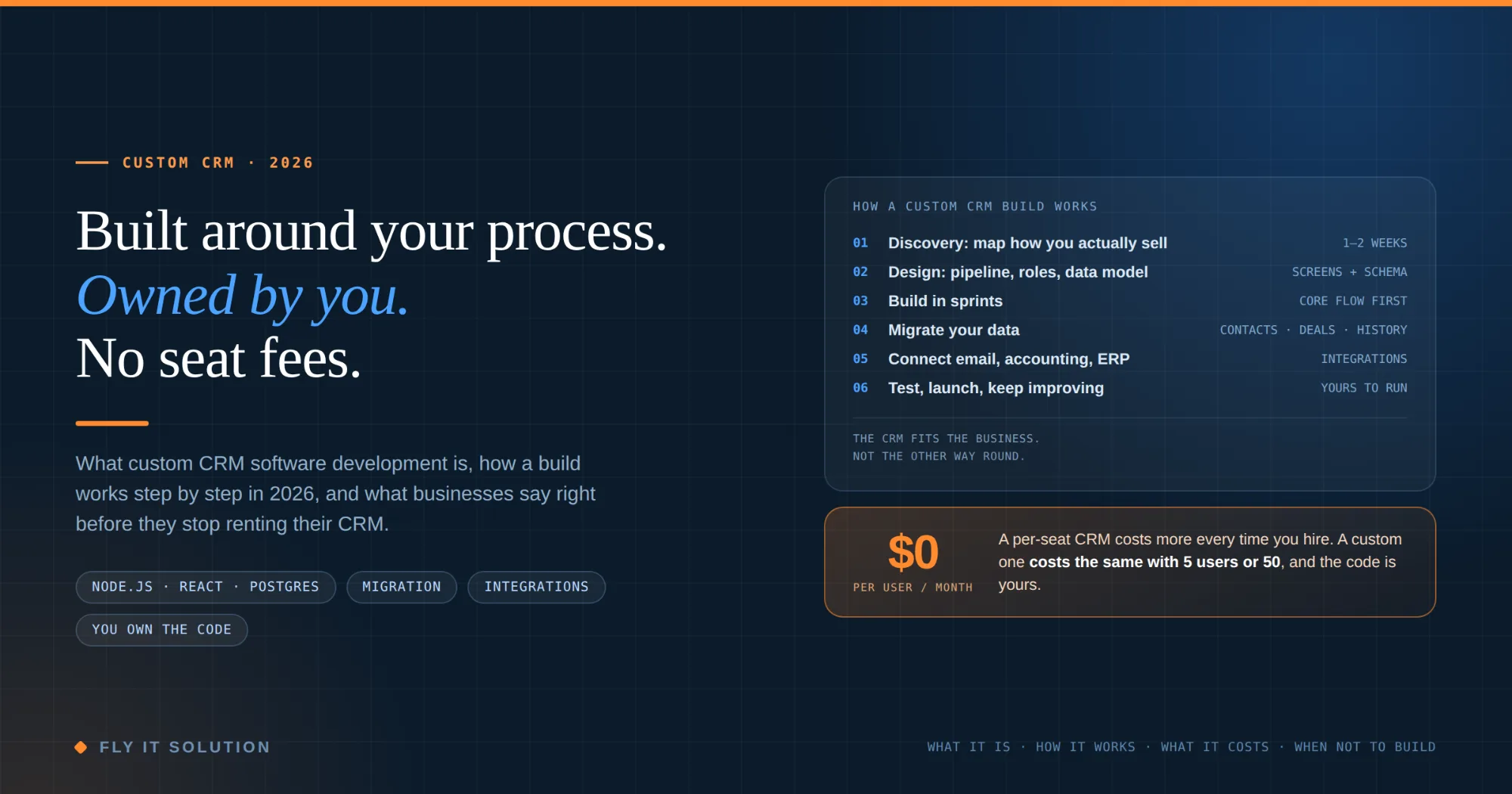
Custom CRM software development means building a CRM around the way your business already works, instead of changing the way you work to fit a tool somebody else built.
That is the whole idea. The rest of this post is about what it looks like in practice: what people say before they ask for one, how a build runs, what it costs, and when you should not do it.
| A custom CRM is built for one business: its pipeline stages, its fields, its roles, its reports and its integrations. The business owns the code and the data and pays no monthly fee per user. A build runs in six steps: discovery, design, sprints, data migration, integrations, launch. It is worth it when your process is part of how you win, when per-seat fees grow with every hire, or when the integrations you need do not exist off the shelf. It is not worth it for a small team with a standard process. |
|---|
What is a CRM, and what makes one custom?
A CRM is the system where a business keeps its customers, leads and deals, and tracks what happens to each of them.
An off-the-shelf CRM, such as Salesforce or HubSpot, is built for everyone. You configure it as far as its settings allow, and you pay per user, per month, for as long as you use it.
A custom CRM is built for you. The stages match your sales process, the fields match your business, the reports answer your questions, and it connects to the tools you already run. You own it outright.
Why do businesses move to a custom CRM?
Rarely because they want software. Usually because the tool they have has started costing more than it saves, in money or in workarounds.
Here is what they tell us, and what each statement usually means.
1. “Every time we hire someone, the CRM bill goes up.”
What it means: you are renting your own customer list.
Per-seat pricing is fine at five users. At twenty-five, with a few managers who only need to look, it becomes one of the larger software bills in the business.
What answers it: a one-time build. A custom CRM costs the same with five users or fifty.
2. “Our process doesn't fit their pipeline, so people stopped using it.”
What it means: the real pipeline lives in a spreadsheet, and the CRM is where people paste things later.
Off-the-shelf stages are generic by design. If your deals go through site survey, quote, deposit, scheduling and completion, a pipeline called Lead, Qualified, Proposal, Closed will never be trusted.
What answers it: stages, fields and rules designed in discovery, from how you actually sell.
3. “We pay for 200 features and use 12.”
What it means: the extra features are not free. They are in the price, on the screen, and in the training.
What answers it: a CRM that does your twelve things well and has no screens for the other 188.
4. “The lead comes in on the website and someone types it into the CRM.”
What it means: your integration is a person.
Every retype is a chance to lose a lead or create a duplicate. It is also the first task people skip on a busy day.
What answers it: integrations built in. Website forms, email, accounting and ERP connected through their APIs, so the lead is in the CRM before anyone has read it. We wrote up how we connect website forms to a CRM without losing leads if you want the detail.
5. “I can't get the report I want without exporting to Excel.”
What it means: the data is there; the reporting was built for someone else's questions.
What answers it: reports and dashboards designed around the three or four numbers you run the business on, built into the CRM rather than bolted on at extra cost.
6. “If we ever leave, I'm not sure we get our data back in a usable form.”
What it means: lock-in. Not always deliberate, but real.
What answers it: ownership. The source code and the database are yours, on hosting you control. Leaving us would be a handover, not an escape.
7. “We're a transport company and we're running on a sales CRM.”
What it means: the tool was built for a different kind of business, and every day is a small translation.
A transportation and moving company in Illinois came to us paying around $15,000 a year for a per-user system that still did not do what they needed. We built them a CRM with load assignment, carrier management, payroll and expenses, and compliance documents in one place. Not a sales CRM bent into shape; a system for how a moving company actually works.
What answers it: the word custom. The CRM fits the business, not the other way round.
How does custom CRM software development work?
Here are the six steps, in the order they happen. The first one decides most of the cost.
Discovery: map how you actually sell
Before anything is designed, we sit with the people who use the current CRM and write down how a lead really moves from first contact to invoice, including the workarounds. This usually takes one to two weeks and it is where most of the cost is decided.
Design: pipeline, roles and data model
We sketch every screen, define who can see and do what, and design the database. The data model is the part that is expensive to change later, so it gets the most care.
Build in sprints, core flow first
The first thing built is the path a lead takes through the business, end to end. Reports, automations and nice-to-haves come after it works. You see working software every one to two weeks.
Migrate your data
Contacts, companies, deals, notes and history are exported from the old system, cleaned, mapped to the new structure and imported. We run it on a copy first and check counts before the real cut-over.
Connect the tools around it
Email, calendar, accounting, ERP, marketing and support systems are connected through their APIs, so the CRM becomes the one place the team works from rather than one more tab.
Test, launch and keep improving
The team tests it with real data, we fix what gets in the way, and it goes live. After launch it is yours: you own the code and the data, and changes are a conversation, not a license upgrade.
A closer look: moving your data without losing it
Migration is the step people worry about most, and it is the one with the clearest method.
Everything is exported from the old CRM: contacts, companies, deals, notes, tasks, attachments and history. We clean it (duplicates, dead emails, fields nobody filled in) and map each old field to its place in the new structure.
Then we run the whole migration on a copy and compare: same number of contacts, same number of open deals, a sample of records checked by hand. Only when that matches do we run it for real, usually over a weekend, and the team opens the new CRM on Monday with its history intact.
What does a custom CRM cost in 2026?
Our scoped builds typically run from $5,000 to $10,000 for a basic CRM, $10,000 to $15,000 for a mid-market one with automation and integrations, and $15,000 and up for complex, multi-team systems. Every project is scoped first and estimated in phases.
Compare that with per-seat pricing. As of October 2026, HubSpot Sales Hub Professional starts at $90 per seat per month. Fifteen seats is $16,200 a year, every year, before onboarding fees, and the price rises with each hire.
So a custom CRM is not cheaper on day one. For a team of ten or more that plans to keep growing, it is usually cheaper within one to two years and stays cheaper after that, because there is nothing to renew.
When you should not build one
If you have a small team, a standard sales process and your CRM bill is a rounding error, keep the tool you have. The fit is fine and the cost is fine.
If nobody in the business will own the system after launch, do not build it. A custom CRM needs a home. That can be us or your team, but it has to be someone.
And if the real problem is that nobody updates the CRM, software will not fix that. A simpler CRM might; a custom one will not.
FAQ
What does custom CRM software development mean in simple terms?
It means a CRM is built around the way your business already sells and serves customers, instead of your business changing its process to fit a ready-made tool. The pipeline stages, fields, roles, reports and integrations are designed for you, the code and data belong to you, and there is no monthly fee per user.
How long does custom CRM development take?
A focused CRM with a pipeline, contacts, roles and one or two integrations usually takes two to three months from discovery to launch. Larger builds with complex automation, several integrations and a big data migration take longer. The first working version, with the core flow in place, usually appears within the first month.
Is a custom CRM cheaper than Salesforce or HubSpot?
Not on day one. A custom CRM is a one-time build, which our scoped projects typically price from $5,000 for a basic CRM to $15,000 and above for complex ones, while an off-the-shelf CRM charges per seat every month, for example HubSpot Sales Hub Professional from $90 per seat per month as of October 2026. For a team of ten or more that plans to keep growing, the custom build usually costs less within the first one to two years and keeps costing less after that.
What happens to our existing CRM data?
It moves with you. Contacts, companies, deals, notes, tasks and history are exported from the old system, cleaned, mapped to the new structure and imported. We do a trial migration on a copy first, compare record counts and spot-check records, and only then switch over, so the team starts in the new CRM with its history intact.
When should a business not build a custom CRM?
When the sales process is standard, the team is small, and a ready-made CRM's per-seat cost is a rounding error. Also when nobody in the business will own the system after launch. A custom CRM is worth it when the process is part of how you win, when license costs grow with every hire, or when the integrations you need do not exist off the shelf.
Does Fly IT Solution build custom CRM software?
Yes. We build custom CRMs with Node.js, React and PostgreSQL, migrate data from existing systems, and integrate with email, accounting, ERP and marketing tools. Clients own the source code and the data with no per-user fees. We work with US businesses from Minneapolis, Minnesota, with our development team in Mohali, India.
Closing
If two or three of the seven statements sounded like your business, tell us which ones. We will tell you whether a custom CRM makes sense for you, what it would take, and, sometimes, that your current tool is fine with a few changes. We work with US businesses from Minneapolis, Minnesota, with our development team in Mohali, India, and the first conversation is free.
Source: HubSpot Sales Hub pricing, hubspot.com/pricing/sales,