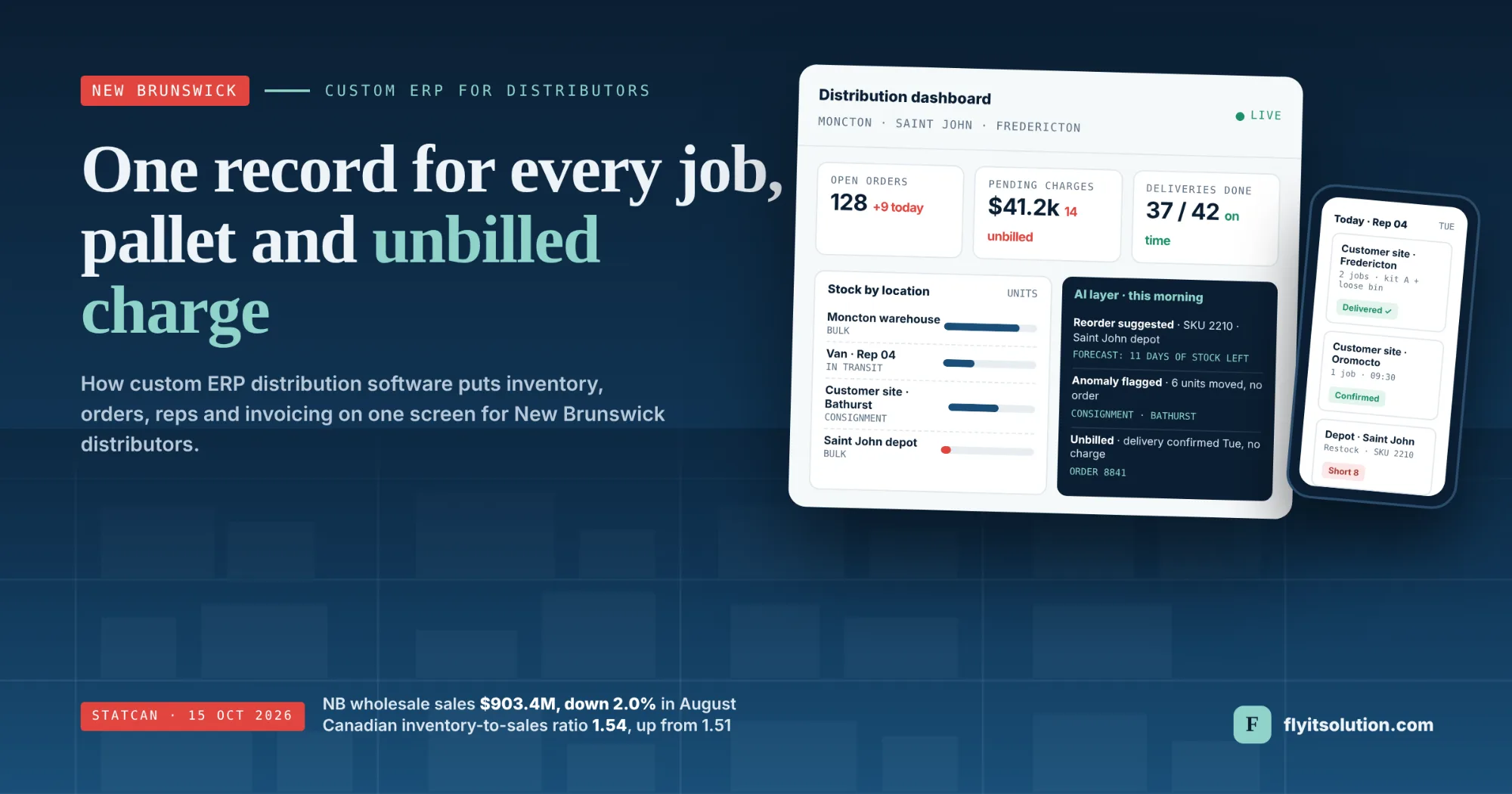
Custom ERP distribution software helps a New Brunswick distributor by putting inventory, orders, deliveries, charges and reporting into one system that the office, the warehouse and the reps on the road all update in real time. The gain is not a prettier spreadsheet; it is knowing what is in stock in Moncton, what is sitting at a customer site in Bathurst, what was delivered this morning and what has not been billed yet, without phoning anyone.
The timing matters. New Brunswick wholesale sales fell 2.0 percent to $903.4 million in August 2026, while Canadian wholesalers' inventories held at $141.0 billion and the inventory-to-sales ratio rose to 1.54 from 1.51, according to Statistics Canada's wholesale trade release for August 2026. Stock is sitting longer relative to sales, and a distributor that cannot see its stock by location is carrying that cost blind.
This post covers what distributors across the province tell us about their current set-up, what a distribution ERP contains, the platform we built for a specialty distributor and how it works, when custom beats a package, what it costs, and a six-step plan. If you want the proof first, it is our AI-powered operations platform for a specialty distributor.
What New Brunswick distributors tell us
Six sentences come up in almost every first conversation, whether the business delivers building supplies out of Saint John or specialty consumables across the Maritimes. Each one points to the same gap: the information lives wherever the last person wrote it down.
“The warehouse count and the spreadsheet never agree.”
The sheet says 40 cases, the shelf says 31, and nobody knows whether the difference went out on a truck, came back as a return, or is sitting at a customer site on consignment.
What it tells us: there is no single inventory record. One system that records every movement, including stock placed at customer sites, keeps the count and the shelf in agreement without a Friday recount.
“We find out stock is short when the customer calls.”
A product that sells steadily runs out because the reorder depended on someone noticing, and the replacement is a week away.
What it tells us: reordering is reactive. A platform that forecasts demand from order history and suggests recorders each morning turns the shortage into a line on a list before it becomes a lost sale.
“Orders come in by phone, email and the rep's notebook.”
Three channels, three formats, and an office that retypes all of them into whatever the invoice comes from. Errors appear at the retyping step, not at the order.
What it tells us: order capture is separate from order processing. When orders enter one system, routine ones are processed automatically, and staff handle only the exceptions.
“Our reps drive from Moncton to Edmundston and can't see stock.”
A rep in a customer's office promises what the spreadsheet showed on Monday, and the warehouse finds out on Thursday that it was never there.
What it tells us: the people who commit stock are furthest from the record. A phone app that shows live inventory, accounts and today's deliveries lets a rep promise only what exists.
“Charges wait for the paperwork, so invoices go out late.”
Delivery is done, the charge sheet is in a truck, and the invoice is raised a week later from memory, sometimes missing a line.
What it tells us: billing is not connected to delivery. When a confirmed delivery creates the charge and the dashboard shows pending charges, unbilled work is visible the same day instead of at month end.
“Month end means rebuilding everything for the accountant.”
Sales, stock and receivables are reconciled by hand from three sources, and audit or compliance documents are found by searching email.
What it tells us: reporting is a project rather than a screen. A live dashboard and an organized document store give leadership and the accountant the same numbers on any day of the month.
What custom ERP distribution software contains
A distribution ERP is one platform that follows a product from purchase to paid invoice, with every role seeing its own view. These are the modules that matter for a distributor, in the order a product moves through them.
Inventory by location, including consignment. Stock on hand in the warehouse, in vehicles and at customer sites, with every movement recorded and traceable.
Predictive planning. Demand forecasts, reorder suggestions and stock placement based on order history, so buying is proactive.
Order capture and automated processing. Orders from reps, customers and the office enter one system; routine orders process automatically and exceptions are flagged.
Scheduling and delivery. Deliveries, service visits or cases matched the stock and the people they need, with confirmation from the field.
Charges and invoicing. Confirmed deliveries create charges; pending and unbilled items are visible on the dashboard until invoiced.
Rep and warehouse mobile apps. Native iOS and Android apps with the day's list, livestock and accounts, and delivery confirmation.
Compliance and documents. Audit-ready documentation organized by customer, product or case rather than by inbox.
Dashboards and anomaly detection. One screen for orders, revenue, pending charges and stock, with an AI layer that flags unusual movements.
Our custom ERP software development service covers these modules along with procurement, finance, HR and manufacturing, and integration with accounting, e-commerce, payment and logistics systems.
The solution we implemented: an AI-powered distribution platform
We built a multi-module operations platform for a specialty distributor whose inventory moves in and out of customer sites on consignment, whose deliveries are scheduled around the customer's booked jobs, and whose compliance documents must be audit ready. Before the building, the business ran on spreadsheets and disconnected tools.
The platform has five working parts. Predictive inventory management forecasts demand to reduce stockouts and idle consignment stock; autonomous order processing handles routine orders so staff focus on exceptions; job scheduling matches each booked job to the products it needs and aligns inventory and reps with the customer's calendar; rep operations gives field reps a real-time view of jobs, inventory and accounts; and compliance, documentation and reporting keeps documents organized with live leadership dashboards.
Underneath is an AI layer, built in Python, that forecasts demand, suggests reorders and flags anomalies, and a unified dashboard that shows jobs, revenue and pending charges on one screen. Field reps and warehouse teams use native iOS and Android apps with the day's job list, confirmation and delivery status.
The stack is React, Node.js and PostgreSQL on AWS, with React Native for mobile apps and a multi-tenant SaaS architecture so more distributors can be added. We delivered it from concept through UI/UX design, development and launch, and support it today; the full case study has the screenshots. Every distributor's products are different, but the shape of the problem is the same one the six statements above describe.
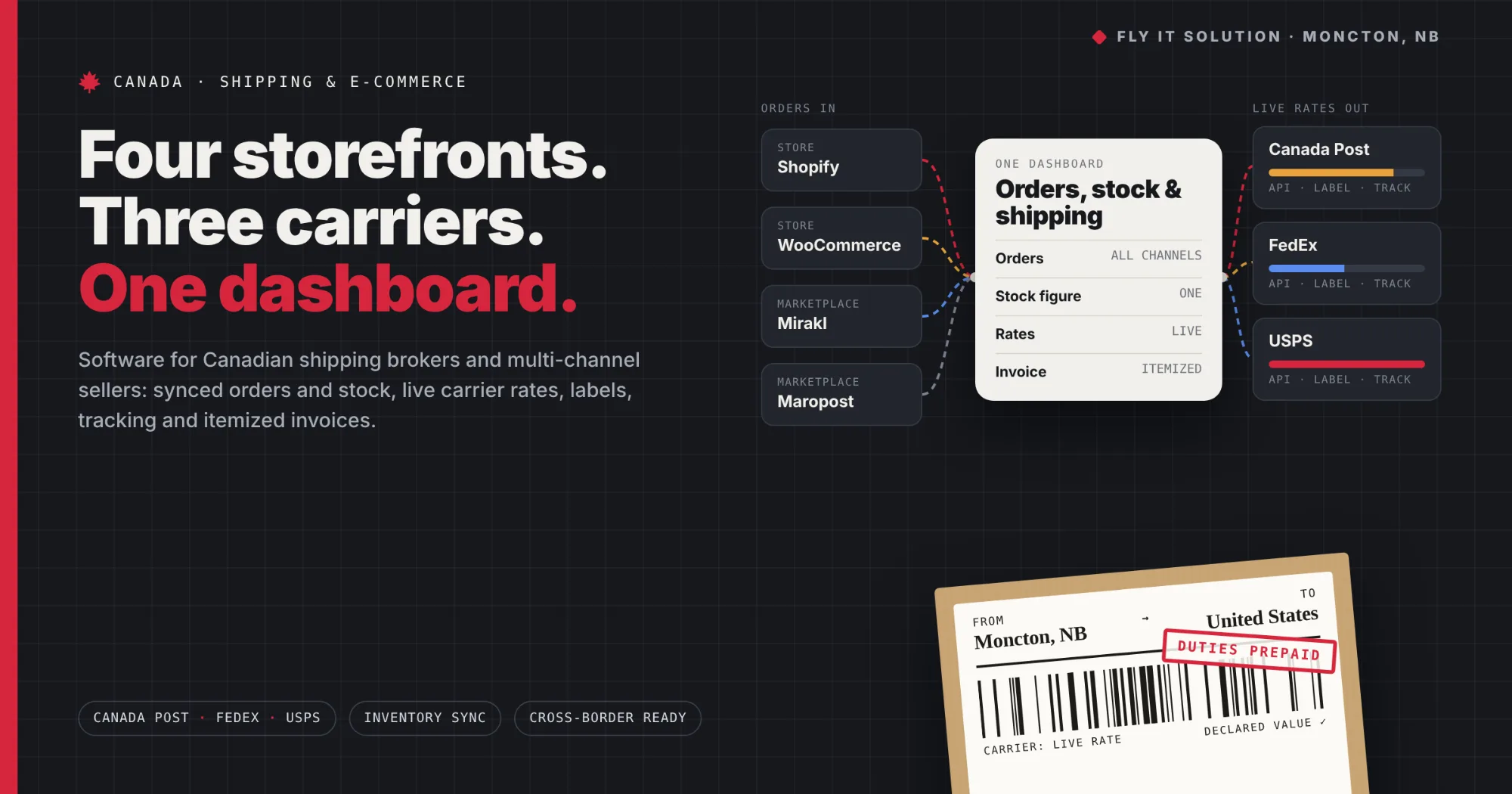
For distributors whose pain is at the shipping dock rather than the warehouse, we also built a multi-carrier shipping platform with FedEx, USPS and Canada Post connected through their APIs across one Canadian and two US warehouses; the shipping software for Canadian brokers and multichannel sellers post covers it.
Custom ERP or a packaged ERP?
Choose a package such as NetSuite, SAP Business One or Odoo when your distribution process is standard and you can adapt to the way the package works. Choose custom when the inventory model does not fit, such as consignment stock at customer sites or kitted products; when reps need a tailored mobile workflow; when per-user licensing across warehouse staff and reps becomes the largest line in the budget; or when you want software that is an asset you own.
The full decision framework, including the questions to ask a vendor, is in our custom ERP decision guide. Manufacturers who also distribute will find the production side covered in custom ERP and automation for Ohio manufacturers.
What it costs and how long it takes
A distribution ERP is quoted after a free discovery call, in writing within 24 hours, because the price follows the inventory model, the integrations and whether field apps are needed. Billing is fixed price or hourly, and the code and the deployment belong to you.
A focused first release, usually inventory, orders, invoicing and the rep app, takes a few months and is built in agile sprints with weekly progress reports. Forecasting and anomaly detection follows three months of clean order history exist. Distributors who want to prove the approach on one product line can start with MVP software development.
A six-step plan from spreadsheets to a distribution ERP
The order matters more than the speed, and the first three steps need no developer.
1. Follow one order from the rep's phone to the paid invoice. Trace a single order through quote, entry, pick, ship, delivery, charge and payment, and note where each step lives today: a notebook, an email, a spreadsheet tab, the accounting package. The hand-offs between those places are what the ERP removes.
2. Decide what inventory means for your products. Bulk stock in Moncton, consignment stock sitting at a customer site, kitted items, and lots or serials that must be traceable are different records. Write them down before design, because the inventory model decides what forecasting and billing can do.
3. Pick the three reports leadership opens. Usually, they are stock on hand by location, orders by status, and unbilled or pending charges. The first release should produce those three lives, and nothing else until they are trusted.
4. Give reps and warehouse staff a phone app, not a laptop login. Field reps and pickers update from a phone: today's deliveries, stock in the van or at the site, confirmation when a delivery is done. If the mobile step is skipped, the office re-enters everything and the ERP becomes another spreadsheet.
5. Connect accounting and carriers instead of replacing them. Keep the accounting package as the ledger and push invoices to it; connect Canada Post, Purolator, FedEx or your courier for rates and labels through their APIs. Integration keeps the first release short and the accountant on side.
6. Go live with new orders and let the old ones finish. Every order received after go-live goes into the platform; open orders finish on the old system. Add forecasting and reorder suggestions once three months of clean order history exist, because predictions are only as good as the data behind them.
How this works for distributors in New Brunswick
Fly IT Solution is a software development company in New Brunswick with a consultant in Moncton. Khushpinder Kaur meets distributors in person across Moncton, Dieppe and Riverview, and by video or on site in Saint John, Fredericton, Bathurst, Miramichi and Edmundston, to walk through one order from the rep's phone to the paid invoice.
Projects start within 48 hours of agreement. Our engineering teams in Minneapolis and Mohali build and support the platform, with weekly reports and a named consultant in the province as your point of contact.
If one of the six sentences at the top sounded like your warehouse, talk to Khushpinder. Bring last month's stock spreadsheet and one delivery's paperwork; together they show where the information is breaking.
Frequently asked questions
What is custom ERP distribution software?
Custom ERP distribution software is one system built around how a particular distributor buys, stores, sells and delivers: inventory by location including consignment stock, order capture from reps and customers, picking and shipping, charges and invoicing, and live dashboards, with a phone app for the people outside the office. It is built to the distributor's own products and routes rather than configured from a generic package.
How much does custom ERP software cost for a New Brunswick distributor?
We quote in writing within 24 hours of a free discovery call rather than publishing a flat price, because the cost follows the inventory model, the number of integrations and whether field apps are needed. A focused first release that covers inventory, orders and invoices takes a few months, and fixed-price and hourly billing are both available. You own the code.
Is custom ERP better than NetSuite, SAP Business One or Odoo for a distributor?
A packaged ERP is the better choice when your distribution process is standard, and you can adapt to the package. Custom is the better choice when the inventory model does not fit, for example consignment stock at customer sites or kitted products, when reps need a tailored mobile workflow, when per-user licensing across warehouse staff and reps becomes expensive, or when you want the software to be an asset you own. We build both integrations with existing ERPs and full custom platforms, and we recommend per project.
Can the ERP connect to our accounting software and Canadian carriers?
Yes. The usual pattern keeps your accounting package as the ledger and pushes invoices and payments to it through its API, and connects carriers for live rates, labels and tracking. Our multi-carrier shipping platform integrates FedEx, USPS and Canada Post through their APIs, with one Canadian and two US warehouses, and the same approach applies to a distribution ERP.
What does the AI in a distribution ERP actually do?
In the platform we built for a specialty distributor, a Python model layer forecasts demand, suggests reorders and flags anomalies such as unusual stock movements or unbilled items, and routine orders are processed automatically so staff handle exceptions. It does not replace the buyer or the controller; it gives them a prioritized list each morning instead of a spreadsheet to hunt through.
How long does it take to build a custom distribution ERP?
A first release covering inventory, orders, invoicing and the rep app typically takes a few months, delivered in agile sprints with weekly progress reports. Forecasting and anomaly detection follow once order history has accumulated. Projects start within 48 hours of agreement, and the old system keeps running until the new one has proved itself on live orders.
Does Fly IT Solution work with distributors in New Brunswick?
Yes. Khushpinder Kaur, Business and Software Consultant for North America, is based in Moncton and works with businesses across Moncton, Dieppe, Riverview, Saint John, Fredericton, Bathurst, Miramichi and Edmundston, with engineering teams in Minneapolis and Mohali. The distribution platform described in this post, with predictive inventory, automated order processing, rep mobile apps and compliance documentation, is documented in our portfolio.