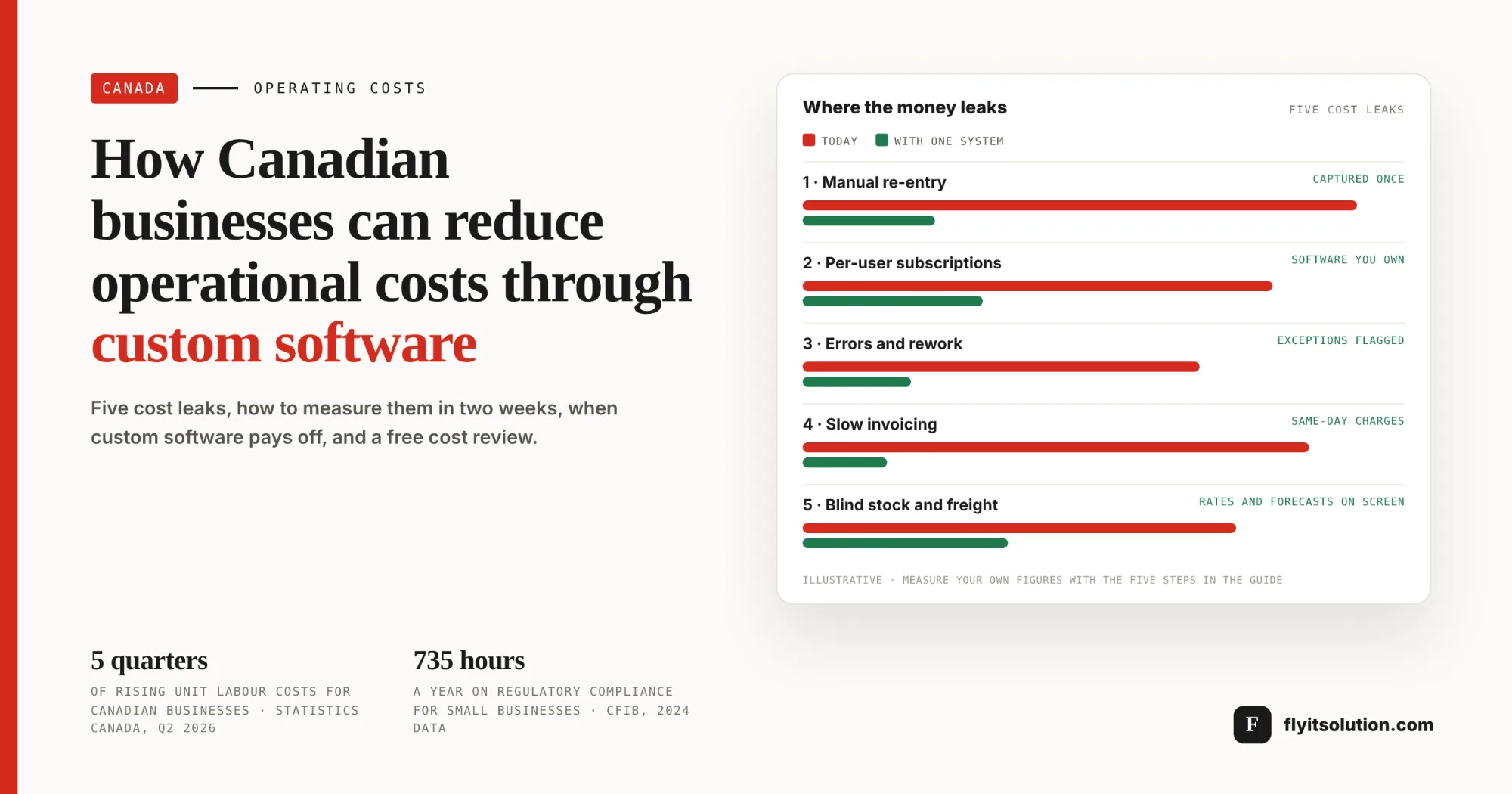
Canadian businesses reduce operational costs through custom software by closing five leaks: manual re-entry between systems, per-user subscription fees, errors and rework, slow invoicing, and stock or shipping decisions made without data. Each one is measurable in hours or dollars, and each one shrinks when the work is recorded once, in one system built around how the business runs.
This guide covers why costs are under pressure now, the five leaks and how software closes them, when custom software does not pay, how to measure your own savings, and how to get a free cost review.
Why operating costs are under pressure in Canada
Labour is getting more expensive for each unit of output. Unit labour costs for Canadian businesses rose 0.6 per cent in the second quarter of 2026, the fifth consecutive quarterly increase, according to Statistics Canada's second-quarter 2026 release (external).
Paperwork takes a large share of that labour. Small businesses spent 735 hours on regulatory compliance in 2024, 256 of them on red tape, according to CFIB's red tape report.
Software cannot change the rules or the wage. It can reduce the hours spent re-typing, checking, chasing and reporting, which is where the cost is.
Five ways custom software reduces operational costs
1. It removes manual re-entry
Every time a person copies an order, a lead or a timesheet from one system into another, the business pays twice: once for the time and once for the mistakes.
Custom software records the information once and sends it where it is needed. On a land listing platform we built, five website forms feed one lead inbox and reach the CRM without anyone retyping them; the same pattern is the core of custom CRM software development.
2. It replaces per-user subscriptions with software you own
Subscription software is priced per user per month, so the bill grows with every hire, whether or not the new person uses most of it.
Software you own has a build cost and a hosting cost, and neither rises with headcount. The arithmetic of renting against owning is worked through in rent or own your software; it applies to any tool your whole team logs into.
3. It prevents errors and rework
A wrong quantity, a missed line or an out-of-date price becomes a credit note, a second shipment or an awkward phone call. Most of these start where data is typed by hand.
When orders enter one system, routine ones can be processed automatically and only the exceptions need a person. That is how the operations platform for a specialty distributor we built handles order processing.
4. It gets invoices out the day the work is done
Work that is finished but not invoiced is money lent to the customer for free. The delay is usually paperwork: the delivery note is in a truck, the job sheet is on a desk.
Software that turns a confirmed delivery or a completed job into a charge closes that gap, and a dashboard of pending charges shows what is still unbilled. Invoicing is one of the first modules in most custom ERP software development projects for that reason.
5. It shows stock and shipping costs before the money is spent
Stock that sits unsold and freight booked at the first rate offered are costs nobody chose. They happen because the information was not on screen at the moment of decision.
Demand forecasts and reorder suggestions keep stock closer to what will sell. For freight, our multi-carrier shipping platform shows live rates from FedEx, USPS and Canada Post side by side, so the cheaper or faster option is picked on purpose.
The five leaks at a glance
| Cost leak | What it looks like today | How custom software closes it |
|---|---|---|
| Manual re-entry | Orders and leads typed from email or forms into another system | Captured once, sent automatically to the CRM, ERP or accounts |
| Per-user subscriptions | A monthly bill that rises with every hire | One system you own; no fee per user |
| Errors and rework | Credit notes, re-shipments, re-quotes | One record, validation at entry, exceptions flagged |
| Slow invoicing | Days between job done and invoice sent | Completed work creates the charge; unbilled work is visible |
| Blind stock and freight | Excess stock, stockouts, first-quote shipping | Forecasts, reorder suggestions, carrier rates compared live |
One more cost: old software
Software that is out of support costs money every month in workarounds, security risk and the one person who still understands it. Replacing it is often cheaper than keeping it.
Through legacy code migration we rebuilt an outdated CRM on a modern framework in two months while keeping its database, so the business kept its data and lost the maintenance burden.
When custom software does not reduce costs
Custom software is the wrong choice when your process is standard, your team is small, and an off-the-shelf product fits without workarounds. In that case the subscription is the cheaper option, and we will say so.
It starts to pay when per-user fees climb with headcount, when staff keep spreadsheets beside the package to make it work, or when several tools have to be kept in step by hand. The custom ERP decision guide sets out that test in full.
How to measure your own savings: five steps
You can find the size of the saving in two weeks, before speaking to any software company.
1. Time one process for a week. Pick the job your team complains about most, such as quoting, order entry or month-end, and record the hours it takes. Multiply by the hourly wage and by 52.
2. Add up what you pay per user. List every subscription, its monthly price per user and the number of users. The total, and how it grows with each hire, is the figure a one-time build is compared against.
3. Count last month's corrections. Credit notes, re-shipments, re-quotes and re-keyed orders. Each one has a cost in time, freight or goodwill, and most start where data is typed twice.
4. Measure days from job done to invoice sent. Take ten recent jobs and count the days between completion and invoice. Every day is cash you have earned and not asked for.
5. Rank the four numbers and fix the largest first. Build software for the single biggest cost, put it in daily use, and measure again. The second project is paid for by the first.
Start small. A first release built as MVP software development typically takes four to six weeks and targets the single largest cost.
How Fly IT Solution works with Canadian businesses
Fly IT Solution is a custom software development company with a Canadian office in Moncton. Khushpinder Kaur meets businesses in person across New Brunswick and works with companies elsewhere in Canada by video; details are on our New Brunswick office page.
Projects start within 48 hours of agreement, with a written progress report every week, fixed-price or hourly billing, and full ownership of the code. You pay for the build, not for each person who logs in.
Get a free cost review
Pick the one process that costs you the most time. Book a free cost review or call +1 (647) 913-9073, and we will estimate the hours and errors it costs today and send a written scope and quote within 24 hours for the software that would remove them.
Frequently asked questions
How does custom software reduce operational costs?
In five ways: it removes manual re-entry between systems, replaces per-user subscriptions with software you own, prevents the errors that cause credit notes and re-shipments, turns finished work into an invoice the same day, and shows stock and shipping costs before the money is spent. The saving comes from hours not worked and mistakes not made, so it grows as the business grows.
Is custom software cheaper than off-the-shelf software?
Not at the start, and not for every business. Off-the-shelf software costs less up front and is the right choice when your process is standard and your team is small. Custom software becomes cheaper when per-user fees climb with headcount, when staff work around the package in spreadsheets, or when several tools have to be kept in step by hand.
Which operating costs should a Canadian business cut first?
The one you can measure in hours. For most businesses that is manual re-entry: orders, leads or timesheets typed from one place into another. It is the easiest cost to time, the quickest to remove, and the saving funds the next project.
How long does custom software take to pay for itself?
It depends on the hours and errors it removes, which is why we ask you to measure them first. A focused first release typically takes four to six weeks to build, and the payback period is the build cost divided by the monthly saving you measured. A vendor who quotes a payback figure before seeing your numbers is guessing.
Does Fly IT Solution work with businesses across Canada?
Yes. Khushpinder Kaur, Business and Software Consultant for North America, is based on Gordon Street in Moncton, New Brunswick, meets businesses in person across the province, and works with companies elsewhere in Canada by video. The office phone is +1 (647) 913-9073.
What does the free cost review include?
A conversation about one process you choose, an estimate of the hours and errors it costs today, and a written scope and quote within 24 hours for the software that would remove them, with fixed-price and hourly options. There is no charge and no obligation, and you keep the estimate either way.